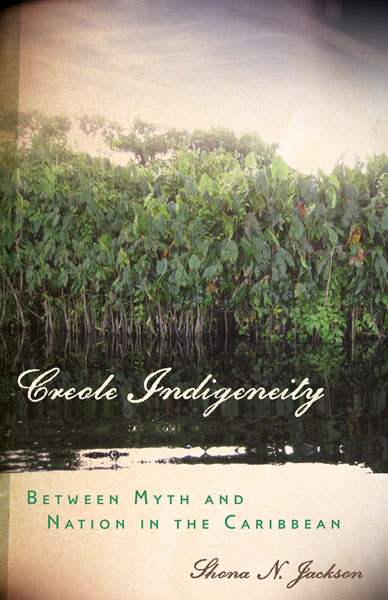
Creole Indigeneity
Between Myth and Nation in the Caribbean
Shona N. Jackson examines how labor shaped Creole claims to belonging in Guyana.
Labor and Belonging
Come here for
- Creole and aboriginal identities in Guyana
- Labor as a basis for belonging and political rights
Expect
- Government documents, interviews, and political speeches
- Political change from the 1950s to the present
Where it sits
How strongly BookFrontier reads the book as belonging to each subject.
Nearest books
Matched by our semantic model. Ordered by what its readers also loved.
 The Transit of EmpireJodi A. Byrd56% subject matchShares Indigenous Studies and Colonialism & Its Aftermath
 Atlantic Africa and the Spanish Caribbean, 1570-1640David Wheat55% subject match
 Blurred BordersJorge Duany54% subject matchShares Caribbean & Latin American Studies
 Indian NationCheryl Walker53% subject match
 Embodied EconomiesIsrael Reyes53% subject match
 Empire UnseenMelanie Lamotte52% subject matchShares Colonialism & Its Aftermath
 Antiracism in CubaDevyn Spence Benson51% subject matchShares Caribbean & Latin American Studies
 The Common PotLisa Brooks51% subject match
For younger readers: Black Indians, An Indigenous Peoples' History of the United States for Young People, Sugar Changed the World
Start with three books, and this one can be the first.
Members get a new edition every morning: a route out from their books to essays, research and talks, with the reason for each.
Sign upAbout this book
During the colonial period in Guyana, the country’s coastal lands were worked by enslaved Africans and indentured Indians. In Creole Indigeneity, Shona N. Jackson investigates how their descendants, collectively called Creoles, have remade themselves as Guyana’s new natives, displacing indigenous peoples in the Caribbean through an extension of colonial attitudes and policies.
Continue reading
Looking particularly at the nation’s politically fraught decades from the 1950s to the present, Jackson explores aboriginal and Creole identities in Guyanese society. Through government documents, interviews, and political speeches, she reveals how Creoles, though unable to usurp the place of aboriginals as First Peoples in the New World, nonetheless managed to introduce a new, more socially viable definition of belonging, through labor. The very reason for bringing enslaved and indentured workers into Caribbean labor became the organizing principle for Creoles’ new identities.
Creoles linked true belonging, and so political and material right, to having performed modern labor on the land; labor thus became the basis for their subaltern, settler modes of indigeneity—a contradiction for belonging under postcoloniality that Jackson terms “Creole indigeneity.” In doing so, her work establishes a new and productive way of understanding the relationship between national power and identity in colonial, postcolonial, and anticolonial contexts.
Publisher details
Publisher categories
- Caribbean History
- Caribbean & Latin American Criticism
- Authors
- Shona N. Jackson
- Publisher
- University of Minnesota Press
- Published
- October 25, 2012
- Format
- Print & ebook
- Reading lane
- Caribbean History