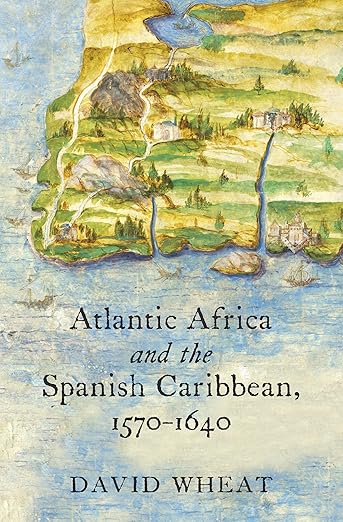
Atlantic Africa and the Spanish Caribbean, 1570-1640
David Wheat traces African migration and social formation across the Spanish Caribbean from 1570 to 1640.
African Caribbean Settlers
Come here for
- Upper Guinea and Angola’s distinct roles in Caribbean migration
- Port cities and hinterlands shaped by African migrants and descendants
Expect
- Cartagena, Havana, Santo Domingo, and Panama City
- A view of Luso-Africans and free people of color as settlers
Where it sits
How strongly BookFrontier reads the book as belonging to each subject.
Nearest books
Matched by our semantic model. Ordered by what its readers also loved.
 Domingos Álvares, African Healing, and the Intellectual History of the Atlantic WorldJames H. Sweet55% subject matchShares West African History
 The Age of Revolutions in Global Context, c. 1760-1840David Armitage, Sanjay Subrahmanyam44% subject match
 First Asians in the AmericasDiego Javier Luis58% subject match
 Empire UnseenMelanie Lamotte57% subject match
 A Fistful of ShellsToby Green56% subject matchShares West African History
 Two Princes of CalabarRandy J. Sparks56% subject matchShares West African History
 The Slave Coast of West Africa 1550-1750Robin Law55% subject matchShares West African History
 Creole IndigeneityShona N. Jackson55% subject match
For younger readers: Sugar Changed the World, Fort Mose, African Town
Start with three books, and this one can be the first.
Members get a new edition every morning: a route out from their books to essays, research and talks, with the reason for each.
Sign upAbout this book
This work resituates the Spanish Caribbean as an extension of the Luso-African Atlantic world from the late sixteenth to the mid-seventeenth century, when the union of the Spanish and Portuguese crowns facilitated a surge in the transatlantic slave trade.
Continue reading
After the catastrophic decline of Amerindian populations on the islands, two major African provenance zones, first Upper Guinea and then Angola, contributed forced migrant populations with distinct experiences to the Caribbean. They played a dynamic role in the social formation of early Spanish colonial society in the fortified port cities of Cartagena de Indias, Havana, Santo Domingo, and Panama City and their semirural hinterlands.
David Wheat is the first scholar to establish this early phase of the “Africanization” of the Spanish Caribbean two centuries before the rise of large-scale sugar plantations. With African migrants and their descendants comprising demographic majorities in core areas of Spanish settlement, Luso-Africans, Afro-Iberians, Latinized Africans, and free people of color acted more as colonists or settlers than as plantation slaves. These ethnically mixed and economically diversified societies constituted a region of overlapping Iberian and African worlds, while they made possible Spain’s colonization of the Caribbean.
Publisher details
Publisher categories
- Caribbean History
- Spanish & Portuguese History
- Slavery Studies
- Authors
- David Wheat
- Publisher
- Omohundro Institute and UNC Press
- Published
- August 1, 2018
- Format
- Paperback
- Reading lane
- Caribbean History