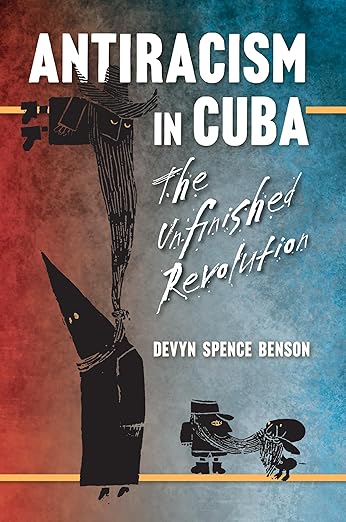
Benson traces how antiracist campaigns could reproduce racial stereotypes in revolutionary Cuba.
Race and Revolution
Come here for
- 1960s government campaigns against discrimination
- Afro-Cuban efforts to press for reforms and preserve black history
Expect
- Racial rhetoric in revolutionary propaganda
- Racial imagery in school materials
Where it sits
How strongly BookFrontier reads the book as belonging to each subject.
Nearest books
Matched by our semantic model. Ordered by what its readers also loved. Most of these share its genre: Cuban History.
 Colonial ReckoningLouis A Pérez74% subject match
 Revolutionary Masculinity and Racial InequalityBonnie A. Lucero73% subject matchAlso shares Caribbean & Latin American Studies
 Visions of Power in CubaLillian Guerra72% subject match
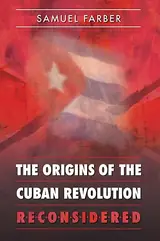 The Origins of the Cuban Revolution ReconsideredSamuel Farber70% subject match
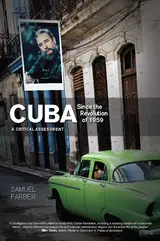 Cuba Since the Revolution of 1959Samuel Farber67% subject match
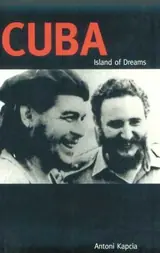 CubaAntoni Kapcia66% subject match
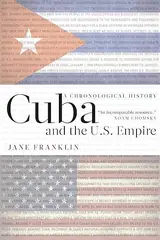 Cuba and the U.S. EmpireJane Franklin66% subject match
 Cuba's Revolutionary WorldJonathan C. Brown66% subject match
For younger readers: Leaving Glorytown, The Lightning Dreamer, We Are Not Yet Equal
Start with three books, and this one can be the first.
Members get a new edition every morning: a route out from their books to essays, research and talks, with the reason for each.
Sign upAbout this book
Analyzing the ideology and rhetoric around race in Cuba and south Florida during the early years of the Cuban revolution, Devyn Spence Benson argues that ideas, stereotypes, and discriminatory practices relating to racial difference persisted despite major efforts by the Cuban state to generate social equality.
Continue reading
Drawing on Cuban and U.S. archival materials and face-to-face interviews, Benson examines 1960s government programs and campaigns against discrimination, showing how such programs frequently negated their efforts by reproducing racist images and idioms in revolutionary propaganda, cartoons, and school materials.
Building on nineteenth-century discourses that imagined Cuba as a raceless space, revolutionary leaders embraced a narrow definition of blackness, often seeming to suggest that Afro-Cubans had to discard their blackness to join the revolution. This was and remains a false dichotomy for many Cubans of color, Benson demonstrates. While some Afro-Cubans agreed with the revolution’s sentiments about racial transcendence — “not blacks, not whites, only Cubans” — others found ways to use state rhetoric to demand additional reforms. Still others, finding a revolution that disavowed blackness unsettling and paternalistic, fought to insert black history and African culture into revolutionary nationalisms. Despite such efforts by Afro-Cubans and radical government-sponsored integration programs, racism has persisted throughout the revolution in subtle but lasting ways.
Publisher details
Publisher categories
- Cuban History
- Race & Discrimination
- Authors
- Devyn Spence Benson
- Publisher
- The University of North Carolina Press
- Published
- April 25, 2016
- Format
- Print & ebook
- Reading lane
- Cuban History