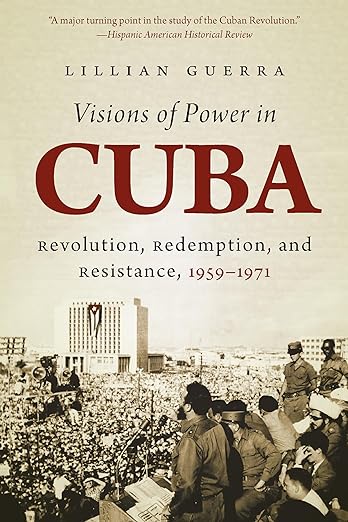
An account of revolutionary imagery, mass spectacles, and citizens contesting state-imposed boundaries.
Revolutionary Images
Come here for
- Mass rallies as evidence of claimed unanimous support
- Citizens challenging economic policies
Expect
- The political costs of participation and dissent in a one-party state
- Accounts of citizens resisting repression and state-imposed boundaries
Where it sits
How strongly BookFrontier reads the book as belonging to each subject.
Nearest books
Matched by our semantic model. Ordered by what its readers also loved. Most of these share its genres: Cuban History and Revolutionary History.
 The Origins of the Cuban Revolution ReconsideredSamuel Farber73% subject matchAlso shares Cold War History
 Awakening the AshesMarlene L. Daut50% subject match
 Cuba's Revolutionary WorldJonathan C. Brown76% subject matchAlso shares Cold War History
 CubaAntoni Kapcia74% subject match
 Cuba Libre!Tony Perrottet72% subject matchAlso shares Cold War History
 Antiracism in CubaDevyn Spence Benson72% subject match
 Cuban Revolution ReaderJulio García Luis71% subject matchAlso shares Cold War History
 Cuba Since the Revolution of 1959Samuel Farber70% subject match
For younger readers: Leaving Glorytown, Coming Up Cuban, How to Say Goodbye in Cuban
Start with three books, and this one can be the first.
Members get a new edition every morning: a route out from their books to essays, research and talks, with the reason for each.
Sign upAbout this book
In the tumultuous first decade of the Cuban Revolution, Fidel Castro and other leaders saturated the media with altruistic images of themselves in a campaign to win the hearts of Cuba’s six million citizens. In Visions of Power in Cuba, Lillian Guerra argues that these visual representations explained rapidly occurring events and encouraged radical change and mutual self-sacrifice.
Continue reading
Mass rallies and labor mobilizations of unprecedented scale produced tangible evidence of what Fidel Castro called “unanimous support” for a revolution whose “moral power” defied U.S. control. Yet participation in state-orchestrated spectacles quickly became a requirement for political inclusion in a new Cuba that policed most forms of dissent. Devoted revolutionaries who resisted disastrous economic policies, exposed post-1959 racism, and challenged gender norms set by Cuba’s one-party state increasingly found themselves marginalized, silenced, or jailed. Using previously unexplored sources, Guerra focuses on the lived experiences of citizens, including peasants, intellectuals, former prostitutes, black activists, and filmmakers, as they struggled to author their own scripts of revolution by resisting repression, defying state-imposed boundaries, and working for anti-imperial redemption in a truly free Cuba.
Publisher details
Publisher categories
- Cuban History
- How Media Works
- Authors
- Lillian Guerra
- Publisher
- The University of North Carolina Press
- Published
- August 1, 2014
- Format
- Print & ebook
- Reading lane
- Cuban History