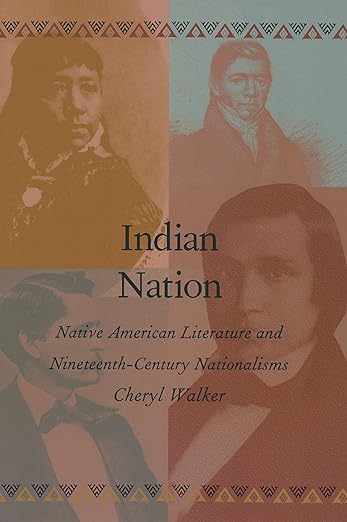
Cheryl Walker examines how nineteenth-century Native writers reshaped ideas of American nationhood and identity.
- Themes
- Native American political thought, Nineteenth-century nationalism, Intercultural American identity
Native Nationhood
Come here for
- Published texts by nineteenth-century Native American writers
- Speeches examining American nationhood and identity
Expect
- An account of Native participation in forming American nationalism
- Simon Pokagon’s “The Red Man’s Rebuke,” published here in its entirety
Where it sits
How strongly BookFrontier reads the book as belonging to each subject.
Nearest books
Matched by our semantic model. Ordered by what its readers also loved. Most of these share its genres: Native American Studies and Indigenous Lit Crit.
 Politics and Aesthetics in Contemporary Native American LiteratureMatthew Herman68% subject match
 The Common PotLisa Brooks66% subject matchAlso shares Native American History
 The Routledge Companion to Native American LiteratureDeborah L. Madsen64% subject match
 A New Continent of LibertyGeoff Hamilton64% subject match
 Indigenous ContinentPekka Hämäläinen61% subject matchAlso shares Native American History
For younger readers: Black Indians, An Indigenous Peoples' History of the United States for Young People, Explore Native American Cultures!
Start with three books, and this one can be the first.
Members get a new edition every morning: a route out from their books to essays, research and talks, with the reason for each.
Sign upAbout this book
Indian Nation documents the contributions of Native Americans to the notion of American nationhood and to concepts of American identity at a crucial, defining time in U.S. history. Departing from previous scholarship, Cheryl Walker turns the "usual" questions on their heads, asking not how whites experienced indigenous peoples, but how Native Americans envisioned the United States as a nation.
Continue reading
This project unfolds a narrative of participatory resistance in which Indians themselves sought to transform the discourse of nationhood.
Walker examines the rhetoric and writings of nineteenth-century Native Americans, including William Apess, Black Hawk, George Copway, John Rollin Ridge, and Sarah Winnemucca. Demonstrating with unique detail how these authors worked to transform venerable myths and icons of American identity, Indian Nation chronicles Native American participation in the forming of an American nationalism in both published texts and speeches that were delivered throughout the United States. Pottawattomie Chief Simon Pokagon’s "The Red Man’s Rebuke," an important document of Indian oratory, is published here in its entirety for the first time since 1893.
By looking at this writing through the lens of the best theoretical work on nationality, postcoloniality, and the subaltern, Walker creates a new and encompassing picture of the relationship between Native Americans and whites. She shows that, contrary to previous studies, America in the nineteenth century was intercultural in significant ways.
Publisher details
Publisher categories
- American Lit Crit
- Native American Studies
- Authors
- Cheryl Walker
- Publisher
- Duke University Press
- Published
- April 30, 1997
- Format
- Print & ebook
- Reading lane
- American Lit Crit