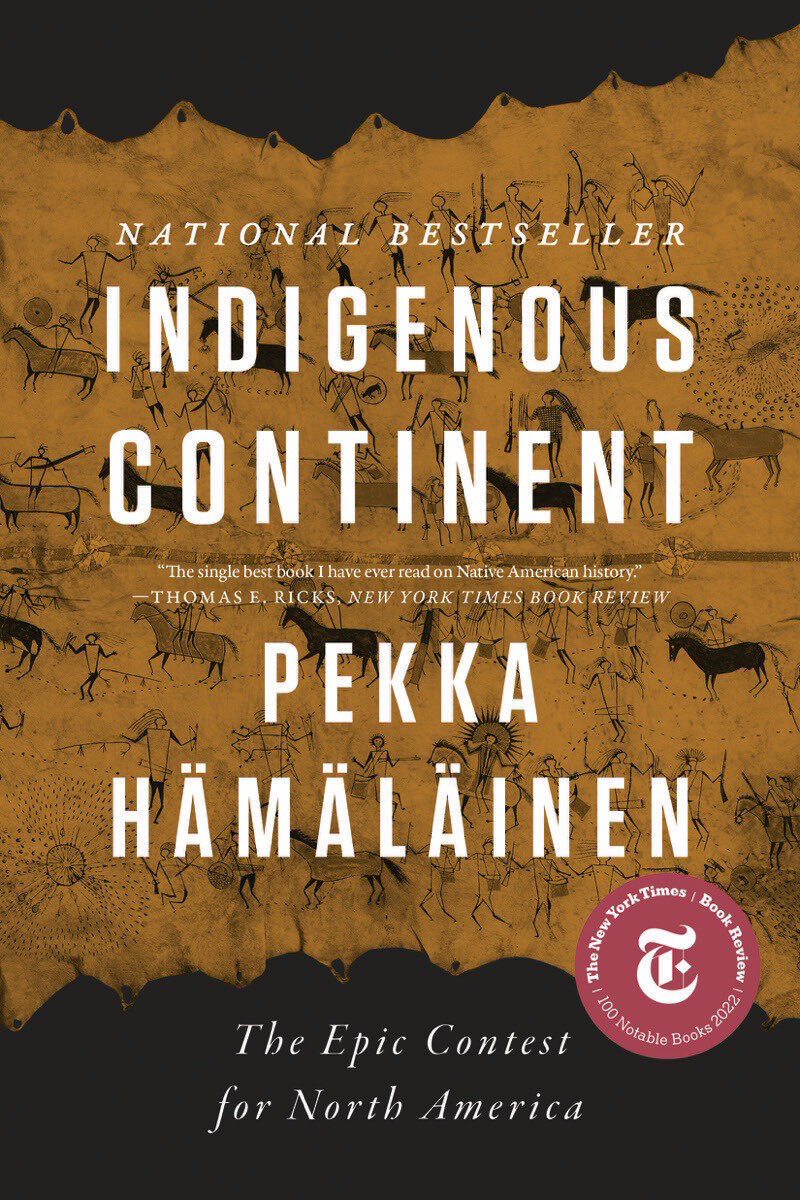
Indigenous Continent
The Epic Contest for North America
- Themes
- Indigenous sovereignty, Colonial expansion, Revising American history
Who it’s for
- Readers interested in Native nations' role in North American history
- Readers seeking a counternarrative to conventional American history
Where it sits
How strongly BookFrontier reads the book as belonging to each subject.
Nearest books
Matched by our semantic model. Ordered by what its readers also loved.
 American RevolutionsAlan Taylor58% subject match
 The Barbarous YearsBernard Bailyn62% subject match
 Shaping Our NationMichael Barone56% subject match
 The Apocalypse of Settler ColonialismGerald Horne67% subject match
 The Indigenous Paleolithic of the Western HemispherePaulette F. C. Steeves63% subject matchShares Native American Studies and Indigenous Studies
 The ExplorersAmanda Bellows64% subject match
 OriginJennifer Raff64% subject match
For younger readers: Colonization and the Wampanoag Story, An Indigenous Peoples' History of the United States for Young People, Black Indians
Start with three books, and this one can be the first.
Members get a new edition every morning: a route out from their books to essays, research and talks, with the reason for each.
Sign upAbout this book
There is an old, deeply rooted story about America that goes like this: Columbus “discovers” a strange continent and brings back tales of untold riches. The European empires rush over, eager to stake out as much of this astonishing “New World” as possible. Though Indigenous peoples fight back, they cannot stop the onslaught. White imperialists are destined to rule the continent, and history is an irreversible march toward Indigenous destruction.
Continue reading
Yet as with other long-accepted origin stories, this one, too, turns out to be based in myth and distortion. In Indigenous Continent, acclaimed historian Pekka Hämäläinen presents a sweeping counternarrative that shatters the most basic assumptions about American history. Shifting our perspective away from Jamestown, Plymouth Rock, the Revolution, and other well-trodden episodes on the conventional timeline, he depicts a sovereign world of Native nations whose members, far from helpless victims of colonial violence, dominated the continent for centuries after the first European arrivals. From the Iroquois in the Northeast to the Comanches on the Plains, and from the Pueblos in the Southwest to the Cherokees in the Southeast, Native nations frequently decimated white newcomers in battle. Even as the white population exploded and colonists’ land greed grew more extravagant, Indigenous peoples flourished due to sophisticated diplomacy and leadership structures.
By 1776, various colonial powers claimed nearly all of the continent, but Indigenous peoples still controlled it—as Hämäläinen points out, the maps in modern textbooks that paint much of North America in neat, color-coded blocks confuse outlandish imperial boasts for actual holdings. In fact, Native power peaked in the late nineteenth century, with the Lakota victory in 1876 at Little Big Horn, which was not an American blunder, but an all-too-expected outcome.
Hämäläinen ultimately contends that the very notion of “colonial America” is misleading, and that we should speak instead of an “Indigenous America” that was only slowly and unevenly becoming colonial. The evidence of Indigenous defiance is apparent today in the hundreds of Native nations that still dot the United States and Canada. Necessary reading for anyone who cares about America’s past, present, and future, Indigenous Continent restores Native peoples to their rightful place at the very fulcrum of American history.
Publisher details
Publisher categories
- U.S. Military History
- Native American History
- North American History
- Authors
- Pekka Hämäläinen
- Publisher
- WW Norton
- Published
- September 12, 2023
- Format
- Print & ebook
- Reading lane
- U.S. Military History