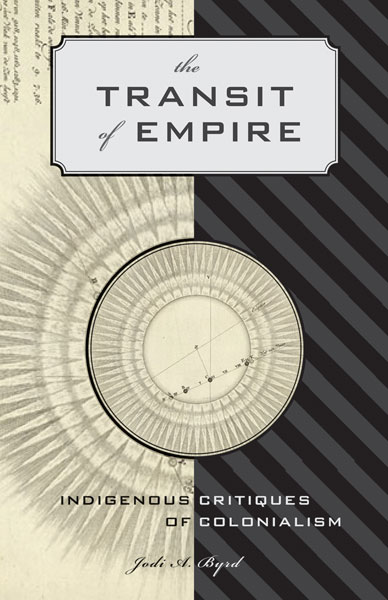
The Transit of Empire
Indigenous Critiques of Colonialism
Jodi A. Byrd traces how transferable “Indianness” shapes U.S. imperial expansion and colonial inclusion.
Indigeneity in U.S. Empire
Come here for
- An argument linking indigeneity to the movement of lands, territories, and resources
- Discussion of Cherokee Freedmen and Native Hawaiian government reorganization
Expect
- Readings across literary texts, historical moments, and pending legislation
- A critique of multicultural inclusion as a site of continuing colonization
Where it sits
How strongly BookFrontier reads the book as belonging to each subject.
Nearest books
Matched by our semantic model. Ordered by what its readers also loved. Most of these share its genre: Native American Studies.
 Immigrant ActsLisa Lowe48% subject match
 Indigenous ContinentPekka Hämäläinen64% subject matchAlso shares Indigenous Studies
 Decolonizing MethodologiesLinda Tuhiwai Smith64% subject matchAlso shares Indigenous Studies and Colonialism & Its Aftermath
 Politics and Aesthetics in Contemporary Native American LiteratureMatthew Herman58% subject match
 Indian NationCheryl Walker58% subject match
For younger readers: An Indigenous Peoples' History of the United States for Young People, Imperialism, Origin
Start with three books, and this one can be the first.
Members get a new edition every morning: a route out from their books to essays, research and talks, with the reason for each.
Sign upAbout this book
In 1761 and again in 1768, European scientists raced around the world to observe the transit of Venus, a rare astronomical event in which the planet Venus passes in front of the sun. In The Transit of Empire, Jodi A. Byrd explores how indigeneity functions as transit, a trajectory of movement that serves as precedent within U.S. imperial history.
Continue reading
Byrd argues that contemporary U.S. empire expands itself through a transferable “Indianness” that facilitates acquisitions of lands, territories, and resources.
Examining an array of literary texts, historical moments, and pending legislations—from the Cherokee Nation of Oklahoma’s vote in 2007 to expel Cherokee Freedmen to the Native Hawaiian Government Reorganization bill—Byrd demonstrates that inclusion into the multicultural cosmopole does not end colonialism as it is purported to do. Rather, that inclusion is the very site of the colonization that feeds U.S. empire.
Byrd contends that the colonization of American Indian and indigenous nations is the necessary ground from which to reimagine a future where the losses of indigenous peoples are not only visible and, in turn, grieveable, but where indigenous peoples have agency to transform life on their own lands and on their own terms.
Publisher details
Publisher categories
- Colonialism & Its Aftermath
- Native American Studies
- Authors
- Jodi A. Byrd
- Publisher
- University of Minnesota Press
- Published
- September 6, 2011
- Format
- Print & ebook
- Reading lane
- Colonialism & Its Aftermath