The Lake Mead Crash Was Decades in the Making
One way to read the latest Lake Mead alarm is as weather news. There is a second way, and it sits less easily.
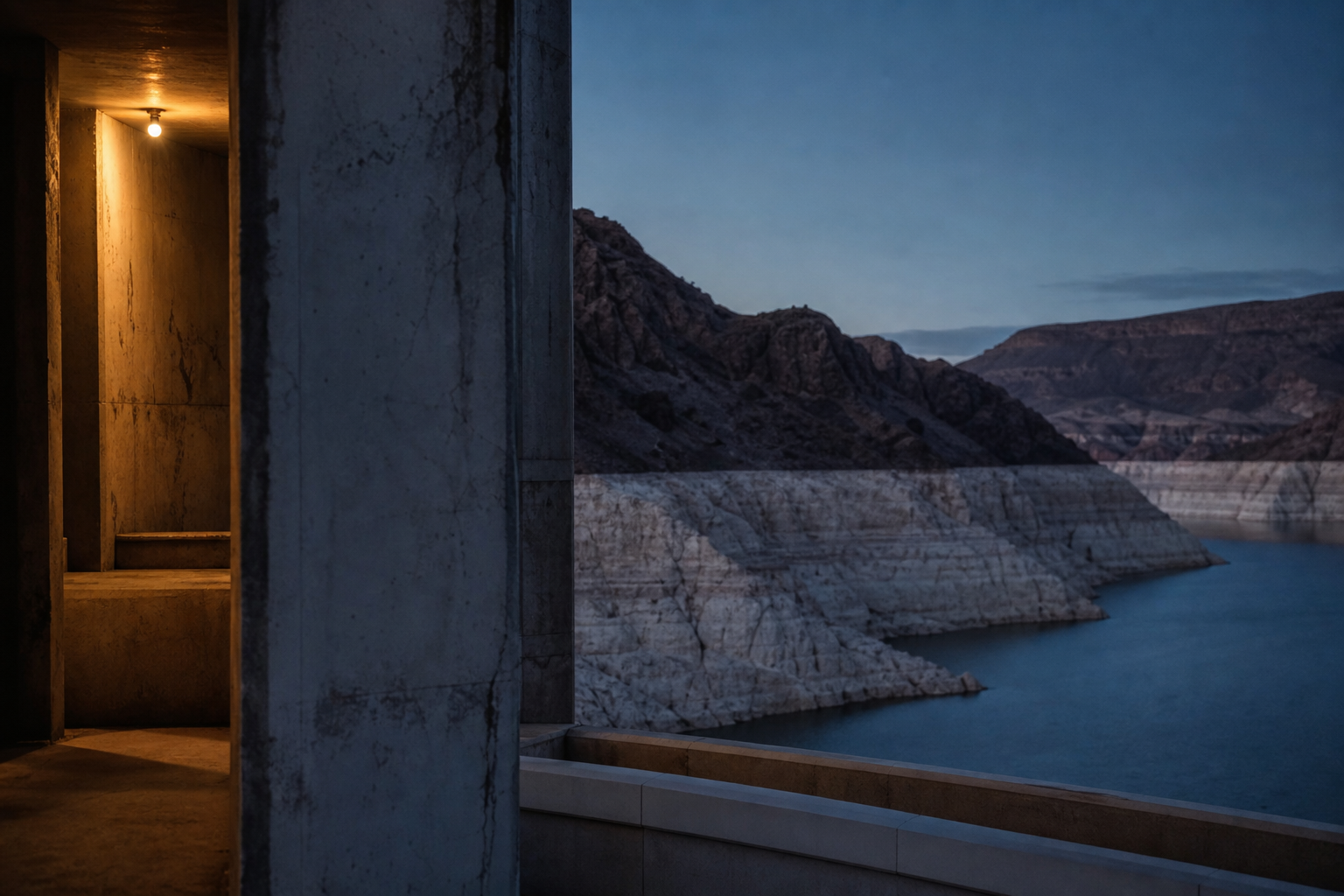
One way to read the latest Lake Mead alarm is as weather news: another thin winter in the Colorado River Basin, another set of grim satellite photos of that pale ring around the reservoir. The river feeds about 40 million people across seven states, so the panic makes sense. There is a second way to read it, and it sits less easily. The shortage did not arrive like a storm. It is a bill coming due. The water that built Phoenix, Las Vegas, and the citrus groves of the Imperial Valley was always borrowed against a future that assumed the rivers would keep behaving. They have stopped behaving. A 'system crash' warning sounds sudden, the way a heart attack sounds sudden to everyone except the arteries.
There are two stories on offer, and each is satisfying for the wrong reasons. In one, the West is blameless and unlucky, a victim of climate change. In the other, it is a cautionary tale about greed, all those desert golf courses finally getting what they had coming. The first story falls apart because the vulnerability was engineered well before the droughts showed up. The second flatters us into thinking smarter people would have known better, when the smartest engineers of the era were the ones placing the bets. The honest version is the part the recaps skip: how a region with too little water talked itself into living like a region with plenty, and who profited from keeping the arithmetic fuzzy. That takes longer to tell than a dry winter does.
Marc Reisner's Cadillac Desert is the account that works out the arithmetic. Written long before Lake Mead became a recurring headline, it follows how the American West was engineered into existence one dam, one canal, one diverted river at a time, and why the abundance always rested on shakier ground than the brochures admitted. The spine of the book is a rivalry, and a stranger one than you would guess. The Bureau of Reclamation and the U.S. Army Corps of Engineers spent decades competing to remake the same rivers, each chasing bigger projects partly to outdo the other.
Reisner follows the political maneuvering, the financial gambles, the water-rights fights that turned on a few words in old compacts. Dams went up because building them was how careers and budgets grew, and only secondarily because the math worked. The agencies were hungry, and the rivers were lunch. The reporting holds up because of the patience behind it. Reisner spent more than a decade on this, and it shows in the specificity: which rivers were dammed, who controlled the resulting water, how growth kept outrunning the supply nature could actually deliver. He grants that these were real feats of engineering.
The trouble is that each feat created a dependency, and dependencies compound. Build a city on a river that delivers in wet years, and you have quietly promised that the wet years will hold. The Colorado River Basin is the case that connects straight to the current warnings. The compact dividing its water was negotiated using flow estimates from an unusually wet run of years, so the river was over-promised almost from the start. Everyone walked away with a paper share. The paper added up to more water than the river carries in an ordinary year, never mind a dry one.
That gap between the promise and the flow is what now shows up as a falling reservoir. I have one quibble. Reisner can slide into a prophet-of-doom register, and his sharpest predictions of imminent collapse have played out slower and messier than his tone implied. The systems turned out more adaptable, the politics more able to muddle through, than the bleakest passages allow. That does not sink the analysis. The slow grind of the actual crisis confirms his structural point even as it embarrasses his timing, which is its own odd form of vindication and worth keeping in mind when a fresh 'crash' warning lands sounding final.
What you come away with is a working sense of cause. The shrinking reservoirs are not a break from how the West was built. They are the design doing exactly what it was set up to do, with the water levels finally honest about the books.
Cadillac Desert will not tell you how the Lake Mead story ends, and it predates the worst of the current numbers, so do not come to it for a forecast. It gives you the why beneath the headlines: the bets, the rivalries, the compact built on optimistic arithmetic. It is a thick book and an opinionated one, and you may catch yourself arguing with its gloomiest stretches. Consider that a sign you are reading something with a point of view rather than a summary. If the falling reservoir has you wondering how the West got here, this is the long version, and it earns its length.
Why this book
The practical payoff is in how you hear the next round of coverage. When a basin official warns of a system crash, you will know the system was never as solid as the word suggests, and you will know which questions the recap leaves out. Who holds the senior water rights, and who gets cut first. Which cities have already started paying farmers to fallow their fields, and whether that buys a fix or just a delay. Whether a proposed solution adds new water or merely reshuffles claims on a river that keeps shrinking. None of this makes the problem cheerier. It does make the debate less mystifying, because the fights over the Colorado today are recognizably the same fights Reisner documented, with higher stakes and thinner margin. Read him and the difference becomes clear between watching a slow emergency and understanding why it was always going to be slow, and always going to be an emergency.
Bridges by email
A news story and the book that goes with it, whenever we publish one.