
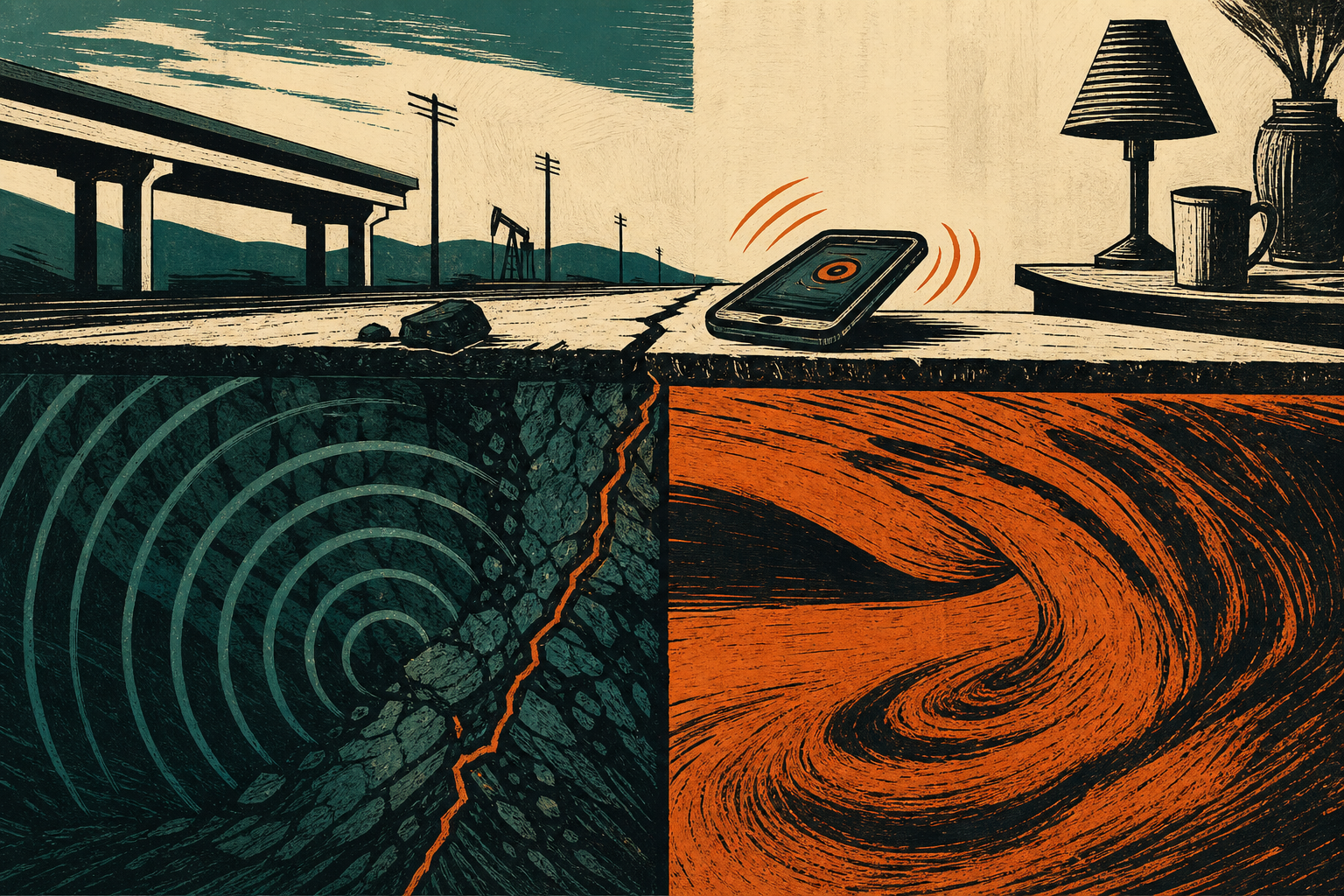
Your phone buzzes a few seconds before the shaking starts. That happened to plenty of people across Southern California when a magnitude-4.3 earthquake near Kern County rolled through one Monday morning, and the alert arrived like a guest who announces himself right before walking in. Those few seconds feel almost supernatural, but they are pure physics. The warning outruns the slow, damaging waves because a signal travels faster than the ground can move. The U.S. Geological Survey built a whole network to catch that head start and push it to your screen. It is a small marvel wrapped inside a much larger unease, because the alert answers only the immediate question. It tells you the ground is moving now. It says nothing about the deeper story under your feet, the one that decides whether the next jolt is a nuisance or the event Californians have spent a century bracing for.
Alert culture is fluent in the present tense and mute about the past. You learn that shaking is coming, you feel it arrive, and then coverage moves on until the next tremor. What rarely surfaces is why that particular patch of California was primed to slip, or how a single fault grew an entire family of smaller ones threaded through cities most people assume are safe. A 4.3 is a footnote in that longer account. The real subject is the machinery that produces these earthquakes on a schedule measured in centuries, and that is the part the notification cannot deliver.
John Dvorak's Earthquake Storms takes the thing you drive over without noticing and makes it impossible to un-see. The San Andreas fault runs almost the length of California, from the redwood country in the north down to the eastern edge of the Salton Sea, and it threads straight through San Francisco and Los Angeles on the way. Dvorak's claim is blunt: a colossal rupture is coming, and the only open question is when. The crust is storing strain, and strain does not negotiate. The geography gives the book its charge. Dvorak follows how the main fault spawned a sprawling network of subsidiary faults, some of them cutting through Hollywood, Beverly Hills, and Santa Monica.
One slices a University of California football stadium cleanly in half, the kind of detail that turns an abstract hazard into a Saturday afternoon problem. He shows where these fractures cross highways, interstates, and dense housing, and why the distance between your house and the nearest strand is not a piece of trivia. The history is where Dvorak earns your attention. He walks through the researchers who mapped the fault by hand and the great historical quakes that exposed how it actually behaves, the way a doctor learns a patient from old scars. The 1906 San Francisco rupture and the slow detective work that followed become a story about how anyone came to believe the ground moves in long, patterned cycles at all.
Seismology, in his telling, is a century of people arguing over what the rocks were trying to say. The book handles one tension honestly and fumbles another. On uncertainty, Dvorak refuses to hand you a date, because the science can supply only ranges and probabilities that stretch across generations. That restraint is the right call, even when it frustrates the part of you that wants a countdown clock. Where he stumbles is repetition. A narrative built on inevitability starts to beat like a drum, and the constant return to the coming catastrophe flattens the more interesting question of how people actually live on top of a fault they cannot move away from.
The connection back to your buzzing phone is exact. The warning system exists because the pattern Dvorak describes is real and repeating. That head-start alert is the thin, modern edge of a very old process, the part we finally figured out how to measure. The book fills in everything the notification leaves blank: not just that the ground will move, but why it must, and what a hundred years of hard-won observation says about the shape of the next one.
The next time your phone warns you a few seconds early, you will know it is the smallest visible piece of something enormous and slow. Earthquake Storms is a good way to meet that larger thing on its own terms, without waiting for it to introduce itself. You do not need to be a geologist or a Californian to find it worth your time. If you are the latter, though, the book has a way of making the ground under your feet feel less like scenery and more like a neighbor with a long memory.