
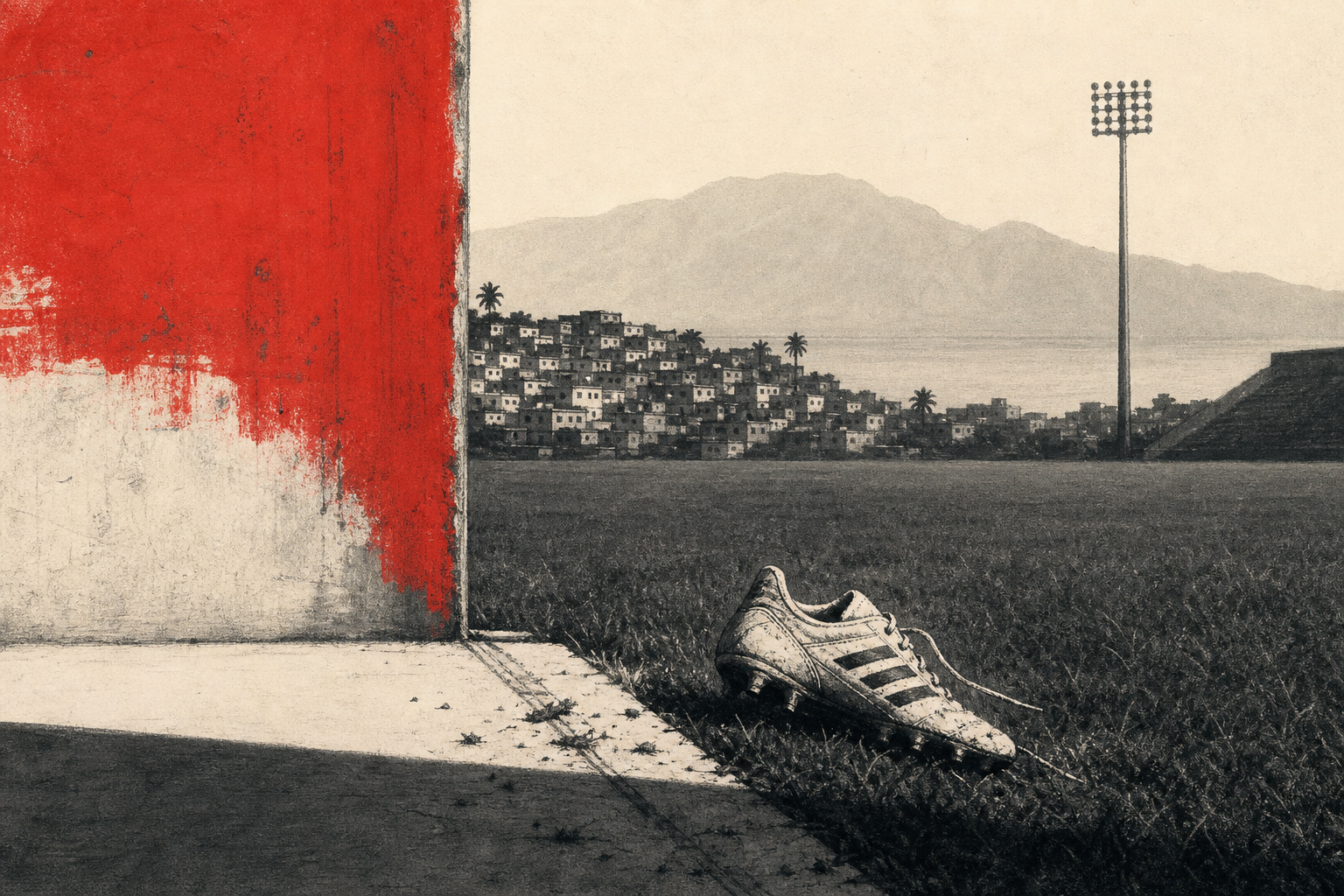
Frantzdy Pierrot peeling himself off the grass in Foxborough, a 6-foot-4 Haitian striker on a World Cup stage, is the kind of image that travels fast and explains little. Haiti at the biggest tournament in football, a player who passed through Melrose and now wears the shirt of a country that has spent the last decade taking hit after hit. The headline writes itself. The harder part is what it costs a nation to keep producing these moments of grace while the ground underneath it keeps shifting. Pierrot's homecoming is a story of pride and a story about a place that has learned, over and over, how to get back on its feet. To find the second story, the one running underneath the celebration, look at how Haiti has told its own catastrophes from the inside.
Coverage of a moment like Pierrot's tends to stop at uplift. Diaspora kid makes good, flag flies, crowd roars, and the segment ends before anyone asks what national feeling is built on when the nation has buried around 300,000 people within living memory. The mechanism goes missing. You get the goal and the homecoming without the machinery that turns collective loss into something a country can still carry onto a pitch and call its own. How does a place absorb disaster and keep working? Who gets to speak for what happened, and who decides their account is allowed? Those are not soccer questions, yet they sit directly underneath the pride you saw in Foxborough. Dany Laferrière wrote a small book that takes the machinery seriously, from inside the rubble, on the day it happened.
On January 12, 2010, Laferrière had just ordered dinner at a Port-au-Prince restaurant when the ground gave way. He lived. According to his account and widely reported estimates, roughly 300,000 people did not. "The World Is Moving around Me," translated by David Homel, is his eyewitness record of those hours and the long stretch that followed, told in short, sharp vignettes instead of one continuous narrative. The form does the arguing. A catastrophe does not arrive as a story with a beginning and an end. It arrives in pieces, and Laferrière keeps the pieces in pieces.
What he sets down first is mechanical and concrete. A city's ordinary life stops, and he watches its parts fail and improvise in real time: small acts of bravery from people who had no reason to be brave, rage and grief drifting through a crowd like weather, his own survivor's guilt, which he refuses to dress up as anything nobler than luck. The book is at its best here, holding to plain observation and skipping the consolations usually bolted onto disaster writing. Then his nephew, stunned to be alive, asks him not to write about "this." That request opens the question the whole book circles: who does a catastrophe belong to, and who has the right to put it into words?
Laferrière does not settle it, and he is honest enough not to pretend the act of writing is clean. He is a survivor profiting, in some sense, from the thing that nearly killed him, and he says as much. From here he reaches past Haiti toward the ethical strain of post-Holocaust testimony, the old worry about whether describing mass death honors the dead or simply spends them. That comparison is his riskiest move, and I do not think it fully earns its keep. The Holocaust and an earthquake are different kinds of catastrophe, one human and deliberate, the other geological and indifferent, and folding them into a single frame of testimony can blur what is specific to each.
Laferrière is too careful to collapse them outright, but the gesture is there, and it pulls at the seams. Where he succeeds without reservation is in keeping people's everyday dignity intact while their world comes apart. A woman doing her hair. Someone insisting on a proper meal. These details teach you more about Haiti than any casualty figure, because they show a population treating normal life as a form of refusal. That is the thread back to a striker rising off the grass. The pride you watched in Foxborough runs on the same stubborn habit Laferrière documents, the refusal to let disaster have the last word, performed in public, again and again.
If the Pierrot moment stays with you, read Laferrière next, and read him slowly, since the vignettes are built to be sat with. Keep one question open while you do: when a country becomes a symbol, who paid for that symbol, and who gets to narrate the bill. It is a short book that flatters neither its subject nor its author, which is rarer than it sounds. You will not walk away with neat uplift. You will walk away better equipped to watch the next homecoming and see the decade of endurance standing just behind it.