
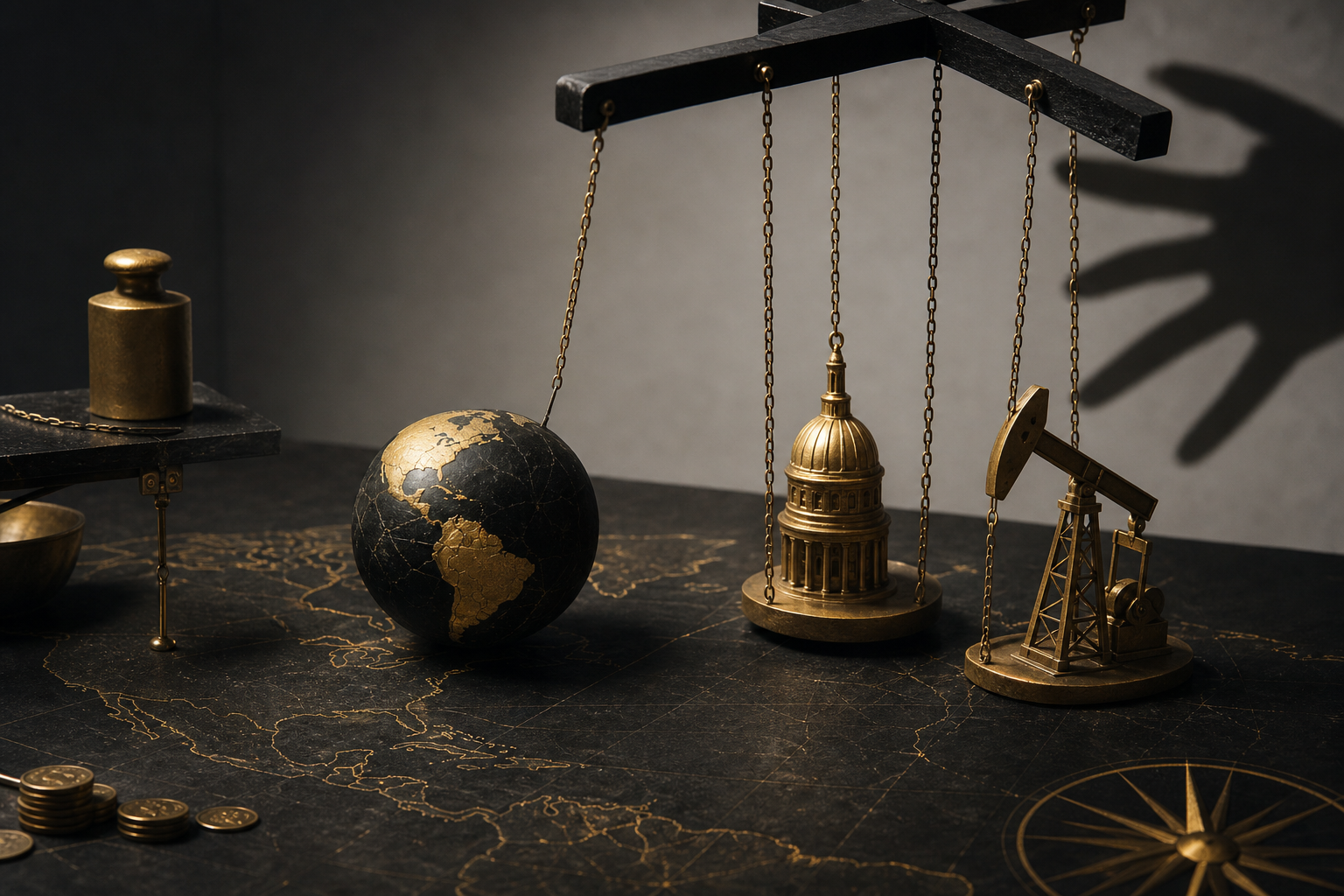
Picture a supermarket in Caracas around 2018: shelves holding a single brand of pasta, and a cashier weighing stacks of bolivars by the fistful because counting them one bill at a time would eat the whole afternoon. This was a country sitting on some of the largest proven oil reserves on the planet. The math never worked, and the people living inside it understood that before any economist did. Now the story has picked up a new chapter, and it comes from Washington. Reporting in 2026 describes Secretary of State Marco Rubio effectively steering Venezuela's finances, its resource deals, and the shape of its government from a few thousand miles away. The oil is still there. The crisis is still there. The controls have simply moved north.
Most coverage of the Rubio story runs as a power scorecard: who holds the strings, who lost them, which sanctions bite hardest. That works for a news alert and falls apart as an explanation. The harder question is how a nation this rich became so easy to run from a distance, because foreign leverage does not invent itself. It grows in soil that decades of local decisions already turned over. You can follow every twist of American pressure and still miss why the pressure works at all. The long descent is what goes untold, the ordinary choices and quiet rationalizations that hollowed out a Venezuelan state until an outside official could plausibly manage its money and its minerals. William Neuman's account fills that space, tracing the collapse from the inside before anyone in Washington started drawing the maps.
Neuman spent years as The New York Times Andes Region Bureau Chief, and Things Are Never So Bad That They Can't Get Worse has the texture of a Venezuela history reported on foot. His attention goes to the granular scene rather than the grand thesis: the price of a chicken, the queue that forms before dawn, the accountant improvising against triple-digit monthly inflation. The title is a piece of dark Venezuelan folk wisdom, and it earns its keep chapter by chapter. The book runs on oil and how a blessing curdled. Neuman follows the way once-abundant petroleum wealth became a source of distortion, funding patronage and imports while the productive economy withered on the vine.
Hugo Chávez arrives as a charismatic figure who read real grievance accurately and then built a system that concentrated power around his own person. Nicolás Maduro inherited the machine without the charm, and the machine kept grinding along without it. Neuman's strength is that he lets no one off easy. The mismanagement and the corruption are homegrown, and he names them plainly. He also tracks the international forces that shaped the descent: the sanctions, the courtiers, and the foreign patrons who found the wreckage useful. Here I owe you a caveat. Neuman's on-the-ground method, so good at capturing what collapse felt like, sometimes stops short of the colder financial accounting.
You finish with an unforgettable sense of the human cost and a looser grip on the precise mechanics of how the oil revenue was looted and rerouted. That is a fair trade for the intimacy, but it is a trade, and you should know it walking in. The ethical thread is where the book presses hardest. Populism that begins by feeding the poor and ends by starving them is a moral failure with many authors, and Neuman hands out the responsibility without flinching. The revolutionaries who promised dignity, the technocrats who cooked the numbers, the outside powers who treated a hungry country as a chessboard.
Everyday Venezuelans paid the bill for all of it, and the emigration figures, millions gone, are the receipt. Read this way, the 2026 headlines stop being surprising. A state can be emptied out from within long before it is managed from without, and Neuman shows you that emptying in slow, specific motion.
Skip the recap the next time Venezuela and Marco Rubio come up together. The durable insight is that foreign control is a symptom, and Venezuela's collapse was authored at home long before it was administered from abroad. Neuman gives you the descent in human scale, which is precisely the part the power-scorecard coverage leaves on the floor. If you want the headlines to stop landing as disconnected shocks and start reading as consequences, Things Are Never So Bad That They Can't Get Worse is a clear-eyed place to begin.