
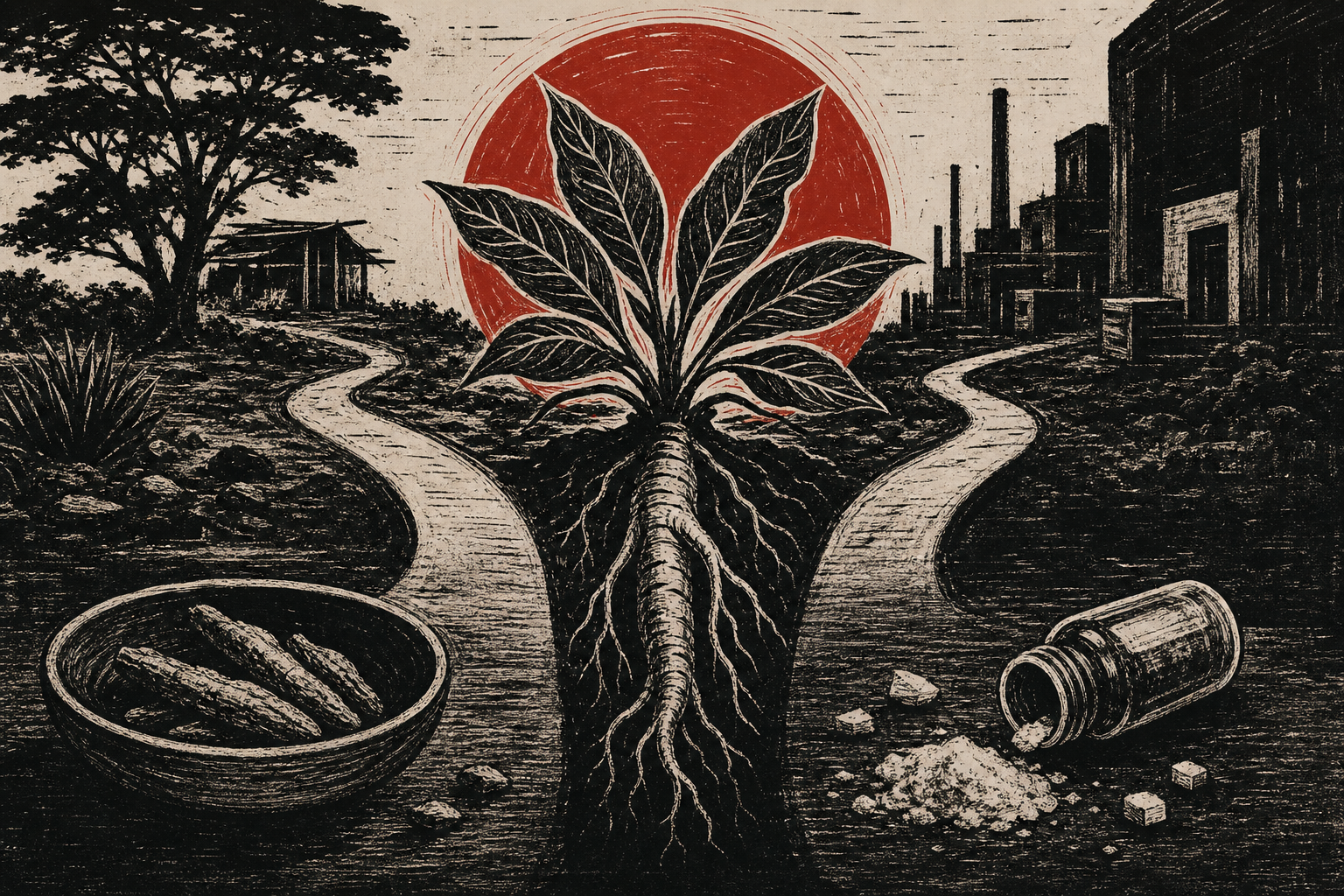
The trip is usually short and the paperwork is usually thin. People who want ibogaine leave the country to get it, because a compound drawn from the root bark of a West African shrub sits on the wrong side of American drug scheduling. Presley Gerber flew to Mexico for his treatment; in September he died at twenty-seven in a rehab facility, and his family asked for privacy. What happens after the flight takes far longer than the flight itself: a dose, a darkened room, many hours of waking dream-state, and a cardiac monitor within arm's reach, because ibogaine can disturb heart rhythm in ways nobody should be improvising around. Some people come home saying a single day loosened the grip of opioid withdrawal. Research money is arriving now and the trial designs are getting serious, so those accounts will finally have to meet data. Meanwhile, forty minutes outside most American cities, a syringe exchange is running out of somebody's car trunk, on the days one runs at all.
Most of the curiosity around ibogaine is pharmacological: what the molecule does at the opioid receptors, why a plant alkaloid can quiet a craving that methadone manages for years. Fair questions. The outcome gets decided by logistics, starting with the plainest one, which is who pays for a facility staffed to watch a heart for a full day. America has spent a decade proving it can identify an effective addiction treatment and then decline to distribute it. Buprenorphine works, and it is still hard to obtain in the counties with the highest overdose rates. A new treatment entering that arrangement inherits the arrangement. Excitement about the compound tells you close to nothing about whether anyone in Wise County will ever be offered it.
Beth Macy's follow-up to Dopesick plants itself in the aftermath, among people improvising care in communities where the crisis stopped being news. Dopesick traced how the pills arrived and who profited from them. Raising Lazarus stays with harm reductionists handing out clean supplies and naloxone under legal conditions vague enough that arrest remains a live possibility, and with clinicians arguing about what addiction even is with sheriffs and judges who hold a different theory. Macy's method is to stand close to a handful of specific people for a long time and let the friction show rather than smoothing it into policy language.
What accumulates from those scenes is an unsentimental account of institutional drag. Courts grind through pharmaceutical litigation at a pace that outlasts the people waiting on it, and Purdue and the Sackler family have still not answered for the harm. Medical authorities and law enforcement leaders contradict each other in public, in the same county, sometimes in the same week. Programs that demonstrably keep people breathing run at the ragged edge of capacity on grants with expiration dates. Through all of it, overdose deaths climbed to record highs during the pandemic years, a cost now shouldered by roughly a third of American families.
Set beside the ibogaine conversation, the book works as a capacity audit. Whether a treatment works gets settled in trials. Whether it reaches a county with no hospital obstetrics unit, let alone a cardiology suite, gets settled by budgets, buildings, and staff rosters. Ibogaine asks for screening, overnight supervision, and people trained to read a monitor, which makes it a treatment shaped by whoever can afford to build the room and keep the lights on in it. That is the arithmetic Macy has been documenting for years, under a different drug's name. I do not think the book is right about everything it argues, and its softest instinct is a fondness for its own heroes.
The harm reductionists here are brave and usually correct, and the narrative seldom stops to ask what happens when their improvisation fails, or when a beloved local program turns out to be mediocre at the one thing it exists to do. Macy's villains are drawn with more certainty than her doubts. On the question of what a working delivery system would actually look like, who runs it and who funds it past the grant cycle, the book goes quiet. There is a temperamental limit worth naming too. A writer who has watched this crisis be marketed to, first by a pharmaceutical company and then by a parade of treatment entrepreneurs, develops a reasonable allergy to anything new and promising.
That allergy is protective, and it can misfire. Ibogaine may deserve the attention it is getting, and the case for it will rest on trial data rather than on whether it sounds too good to be true. What Raising Lazarus supplies is the harder-won knowledge: even a real breakthrough has to travel through a delivery system this broken, and the system does not repair itself while everyone argues about the molecule.
The question worth holding onto is whether a country that learned how to keep opioid users alive, then declined to pay for it at scale, will behave differently with a treatment that costs more and demands more supervision. Raising Lazarus gives you the ground-level version of that problem, told through people whose names stay with you long after the statistics blur. Nothing in it will settle the pharmacology, and the pharmacology was never the part holding this up. It explains, with some precision, why promising science keeps stalling about thirty miles short of the people who need it, and why the next promising thing will stall in the same place unless somebody funds the room it happens in.