
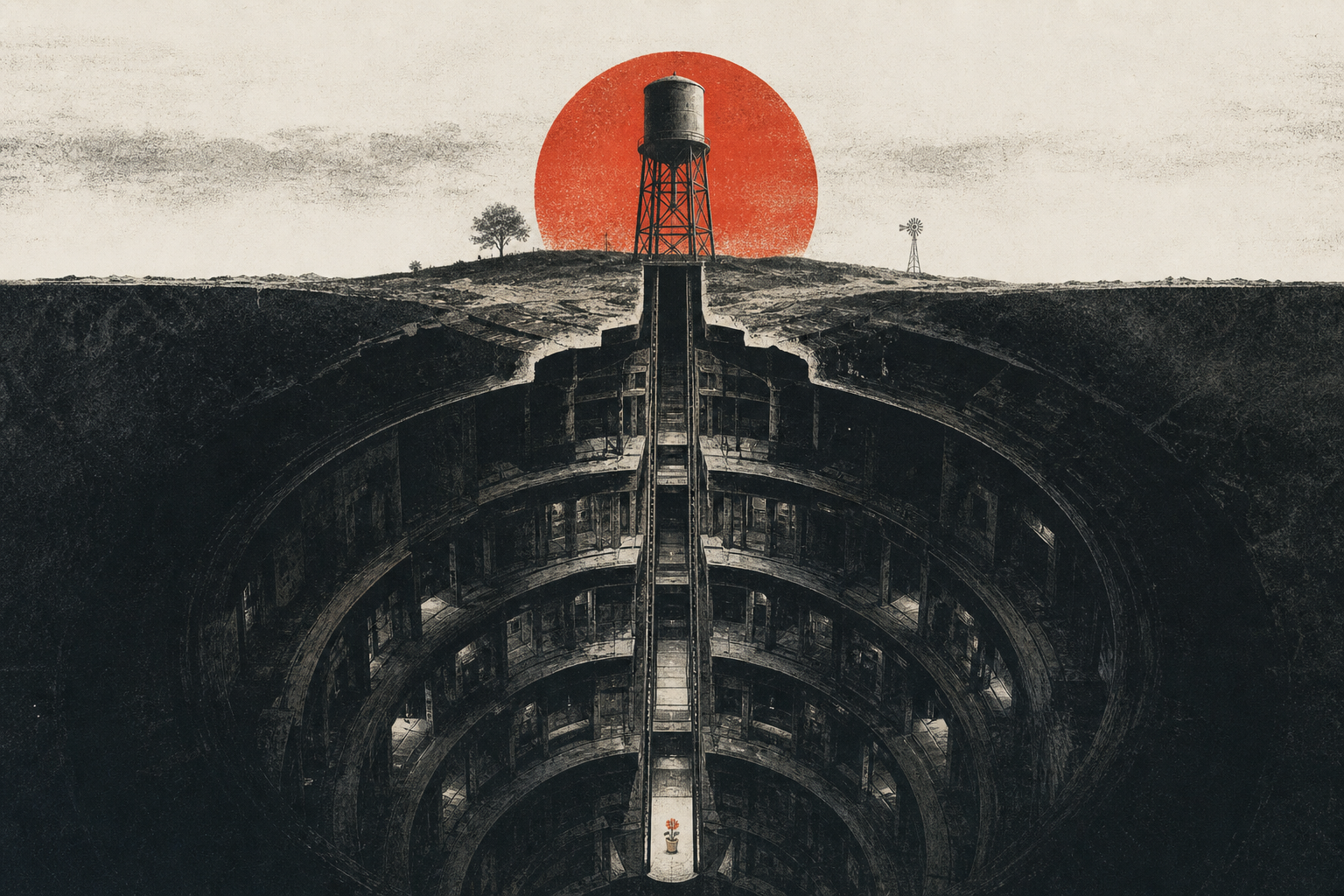
Three seasons of a show built on withholding, and now the withholding stops. One week the audience learns who ordered the silos dug. The next, in episode 8, why. The scene lands like a chair pulled out from under you: the machinery that kept a whole underground society obedient rests on a decision some people made, in a room, with names attached. That is a strange thing to watch in 2026. Post-apocalyptic television usually hands over a catastrophe with no politics in it, a virus or a poisoned sky, and then skips ahead to the aftermath. Something happened, and now we live in silos. The version where a small group saw the ending coming and chose the silos over the argument is harder to file away as fiction, since it requires no technology we lack.
Most coverage of the reveal assumes the mystery was always about mechanism: what the trigger was, which faction pushed the button. Solve that and the story closes. What episode 8 actually circles is a set of people who knew, calculated, and proceeded while everyone else went about their week. So the question the season has opened concerns the long, well-documented run-up, when the warnings are public, the graphs are unambiguous, and the official response is a committee. That question belongs to psychology, and to whatever we call the study of why populations watch a slow emergency arrive and mostly keep their seats.
Jon Mills works as both a philosopher and a psychoanalyst, and in End of the World he asks the question straight: is civilization steering itself toward self-destruction? His candidate emergencies are deliberately unglamorous: famine, extreme climate change, nuclear annihilation, and wealth disparities he is willing to call obscene. Nothing arrives from space. Every item on the list is already funded, staffed, and reported on quarterly. None of them requires a new invention, only the continuation of current practice by people who show up to work on time. The book's real subject is our conduct around those emergencies.
Mills follows the unconscious conflicts that shape behavior at population scale and arrives at something worse than distraction: a collective unconscious death wish, a mass bystander disorder that keeps us standing still while the warning signs accumulate. Call it participation in an outcome that never has to announce itself as a choice. Denial would almost be reassuring by comparison, since denial at least takes effort. The pattern is easy to spot once it has a name. Nuclear arsenals have sat on short notice for decades, maintained by professionals, budgeted by legislatures, and discussed in public with the calm of a highway resurfacing schedule.
Climate summits produce documents, and the documents produce next year's summit. Ministers fly home; staff begin drafting. The distance between the wealthiest and everyone else widens on schedule, tracked by the same institutions that describe it as unsustainable. The information is never hidden. It gets received and set down somewhere tidy. I part ways with Mills on the diagnosis itself. A civilizational death wish is close to unfalsifiable, and an explanation that fits every possible behavior explains none of it. Scaling psychoanalysis up to the species also flattens distinctions that matter enormously: the tenant farmer and the energy minister do not share a psyche, and only one of them signs leases.
When the culprit is humanity's unconscious, anyone with real decision-making power gets a share of blame thin enough to work as an alibi. Mills does not reach for that comfort; his frame permits it anyway. The bystander idea survives the objection, and it indicts institutions more sharply than it indicts the species. Organizations that keep meticulous records of a coming harm and proceed anyway are functioning exactly as designed, which is the more disturbing reading and the one Mills's clinical vocabulary keeps pressing toward. He does not stop at diagnosis. The book closes toward agency, on the argument that our fate is still ours to take back, which reads as the honest move available to a clinician who spends his days telling people that change is possible.
The season's last stretch will resolve its plot, and the resolution will be satisfying in the way good television is, and none of it will address the question the reveal opened. End of the World stays with that question at book length, written by someone who spends his working life listening to people explain why they did nothing. It is a philosophical argument with a clinical temperament, and it will annoy you in places, which seems about right for the subject. Keep it nearby if the finale leaves you thinking less about the ending and more about the years when everyone already knew.