Why Fixed Income Sets the Terms of Medical Care in Old Age
A woman in her eighties takes her blood pressure pills every other day so the bottle lasts two months, and her chart records none of the income arithmetic behind it.
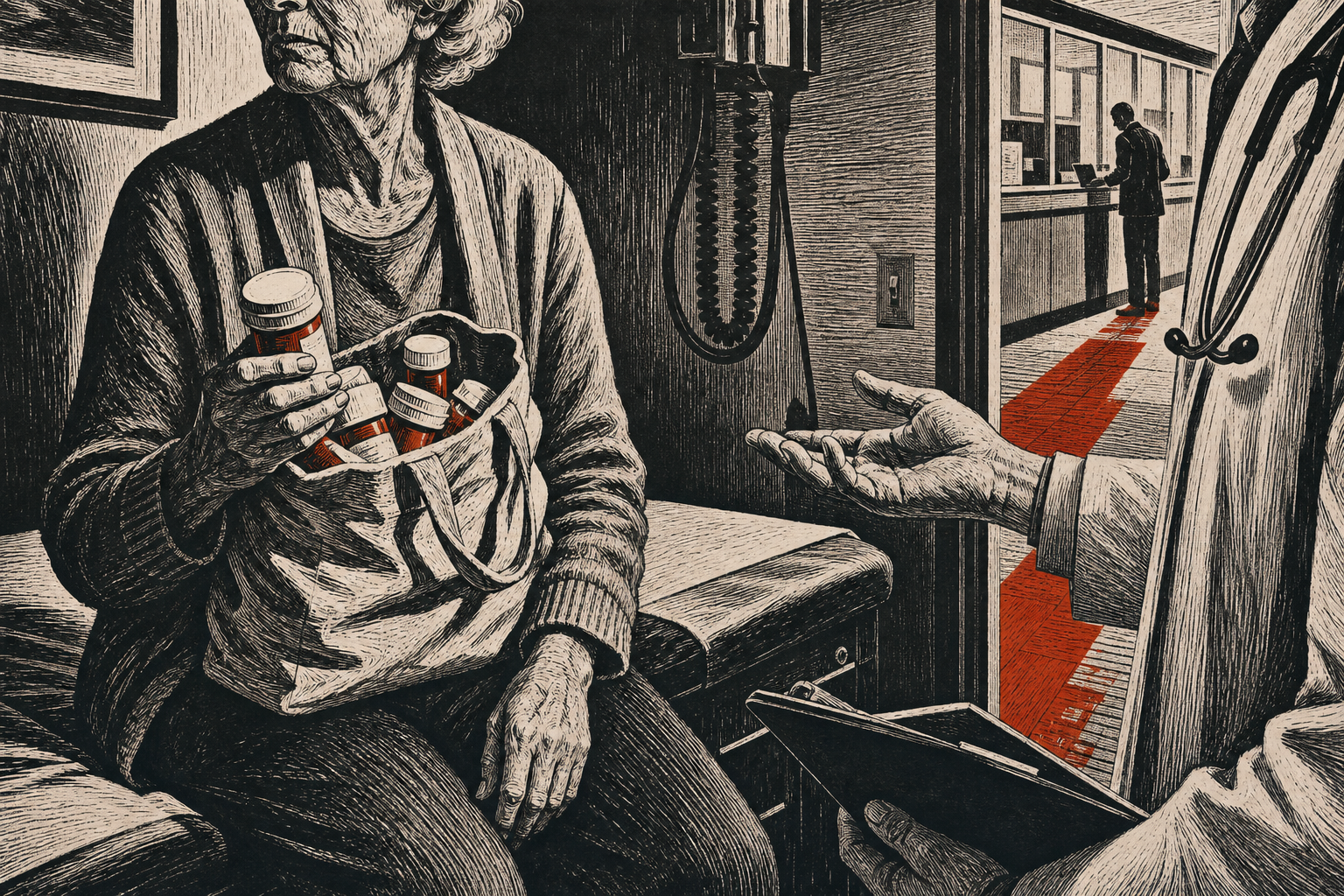
A woman in her eighties sits on the exam table with her pill bottles in a grocery bag, and when the doctor asks whether she is taking the blood pressure medication, she says yes. Every other day, so the bottle lasts two months instead of one. Nothing in her chart records this. The chart says adherent, or partially adherent, which is the clinical way of saying somebody did arithmetic at a kitchen table and nobody in the building asked to see the numbers. Multiply that scene across a country where rent, groceries, and the ride to the clinic all draw on the same fixed monthly deposit, and you are looking at a budget working exactly as designed. The prescription was free advice. The pills were not.
The usual assumption is that money belongs to a different department. Medicine handles the disease, and social services or a family member or a church van handles the rest. That division falls apart once you notice how much of later-life health gets bought at a cash register. Coverage exists, and coverage has holes, and the holes sit where the spending concentrates: long-term help at home, teeth, hearing, the difference between an apartment with stairs and one without. A second assumption does more damage, which is that low income in old age is a failure of thrift. Somebody should have saved; somebody picked the cheaper plan. That framing keeps the question inside the household, which has the least room to negotiate and absorbs nearly all of the cost. Ask instead who sits on the other side of that ledger, collecting revenue on terms they never had to discuss with the person paying.
Louise Aronson has practiced geriatrics for more than twenty-five years, and "Elderhood" is built from what that accumulates: patients, charts, family meetings, and the slow recognition that her profession was trained to treat organs in people whose emergency arrived on the first of the month. She sets clinical case studies beside history, science, and policy. A case tells you what happened to one person. The policy chapters explain why it kept happening to the next one. Cost enters treatment decisions long before anyone says the word out loud. It shapes which drug gets written on the pad, which follow-up gets scheduled, and which operation gets described as "a lot for someone your age" instead of as a choice.
Aronson catches those moments at the size they actually occur, in a softened sentence or a visit that quietly does not get booked, and she is exact about how social assumptions do their own rationing, narrowing what gets offered before the patient has said a word. Chronic illness turns out to be inseparable from daily survival. Managing diabetes assumes a refrigerator, food that stays in it, and a way across town. Remove the bus route and the disease is no longer chronic; it becomes acute on a timetable set by the transit schedule. Aronson's patients keep demonstrating that the medical plan and the household budget are the same document.
Her historical frame is hard to shake off. For roughly five thousand years, "old" has been placed somewhere around sixty to seventy. Most people now spend more years in elderhood than in childhood, many of them four decades or more. Childhood got pediatrics and a developmental literature. Elderhood got dread, denial, and a greeting card aisle. My quarrel with the book is about aim. Aronson's diagnosis of system failure, Medicare included, often arrives in the passive voice, as though the money simply evaporated instead of landing somewhere. It lands somewhere. Insurers set the benefit design.
Facility operators set the staffing ratios. Landlords set the rent that decides whether a discharge plan is a plan or a piece of fiction. A book this fluent in consequence could name those beneficiaries more often, and when it does not, the weight drifts back onto clinicians and families, who have the thinnest margin for carrying it. The evidence survives the complaint. The case studies are too concrete to argue away, and they establish what the policy debate usually skips: affordability is the substance of medical care in later life. Once you have sat with a few of Aronson's patients, the spreadsheet stops looking neutral.
"Elderhood" is long, and it wanders through memoir, medical history, and policy at a pace that asks for patience. If the affordability figures in the news have been sitting flat on the page, Aronson's patients give them weight, and her account of how cost quietly edits a treatment plan is hard to unlearn. Pick it up if you want the economics of later life somewhere other than the margin of the conversation. Forty years is a long time to spend in a category nobody bothered to plan for.
Why this book
That is the useful thing to carry into the current coverage of income and aging. A 2026 report from the AARP Public Policy Institute examines spending patterns and affordability pressure in households with low-income older adults, working from the Bureau of Labor Statistics' Consumer Expenditure Survey, and its findings land where Aronson's exam room does: fixed income meeting unfixed prices, with housing and care claiming the share that used to cover everything else. The live discussions attached to the report, about Medicare, democracy, and the future of health care, are arguments about who sets those prices and who has standing to object. Read the numbers with the clinical material in mind and a percentage of income spent on housing becomes a person choosing between a hearing aid and a heating bill. That same person is less likely to contest a denied claim or turn up in the rooms where benefit rules get drafted. Financial pressure and political voice thin out together, which is why the democracy half of that conversation belongs beside the spending tables rather than in a separate panel. Whoever drafts those rules gains room to maneuver. The cost settles on whoever cannot afford to move.
Bridges by email
A news story and the book that goes with it, whenever we publish one.