
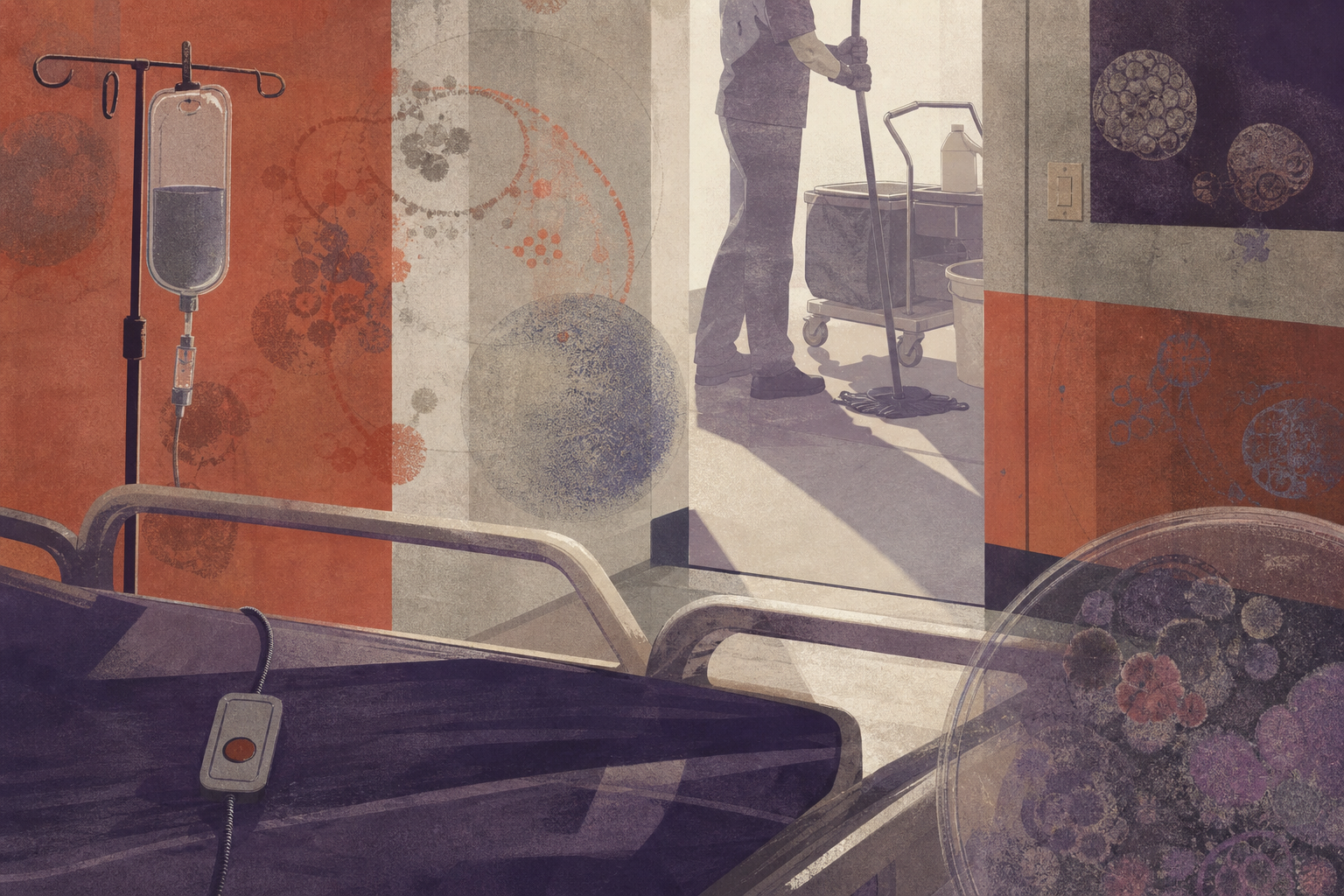
A cleaning crew works through a hospital room at shift change: bed rails, call button, the plastic seam of the mattress, the pole holding the IV bag. Everything looks fine afterward. Weeks later, swabs from those same surfaces come back positive for Candida auris, some of it lifted from equipment logged as clean. That is the patient quality of the organism now confirmed in 23 US states, with more than 3,130 active clinical cases recorded by mid-July 2026. It can settle into a mattress seam and outlast the patient who brought it in. Coverage of the deadly fungus outbreak moves at the speed of the case count, adding states and risk categories week by week. The count is the outline of something whose real shape sits in soil, in shipping routes, and in the awkward biology of drugs that kill fungi while our own cells register a complaint.
The reflex is to file this beside a bad flu season and assume the same rules apply: person infects person, hospital tightens hygiene, drug companies eventually catch up. Fungal biology breaks two of those assumptions. Fungi are eukaryotes, built from cellular machinery close enough to ours that the list of safe drug targets is short, which is why the antifungal shelf is thin and why losing anything on it to resistance is so costly. Then there is the environment. A virus that loses its host generally loses. A fungus that loses its host settles into a drain, a dust layer, a hillside of dry soil, and stays viable for months. The question that pays off is what conditions keep producing organisms that live outside us and shrug at our drugs.
Emily Monosson's Blight, which took the 2024 Phi Beta Kappa Award for Science and made Science News's favorites list the year before, starts where the case counts stop. She explains why a pathogen like Candida auris keeps surfacing on its own in hospitals across widely separated regions, and why an organism that stays alive in a ward long after the patient is discharged turns eradication into grinding, repetitive work. The infection-control chapters live at the level of the drain trap and the ventilator circuit. Monosson spends her time on which disinfectants actually kill this yeast and on how a colonized patient travels between a hospital and a nursing home without anyone flagging the transfer.
Nobody writes a medical drama about a drain trap, which is part of why the work stays underfunded and half-done. Then the book widens, and the widening is the argument. Trade, travel, and a warming climate are stretching the territory fungi can occupy and delivering them to populations with no evolutionary history of exposure. Human wards are one destination among many. Fungal disease has driven bat populations toward extinction, with frogs and salamanders on the same trajectory. Whitebark pines stand dead across national parks, gray and skeletal in numbers that read as storm damage until you learn what killed them.
Crops carry the story into the food supply. Coffee, bananas, and wheat all face mounting fungal pressure, and the banana is the cleanest case: a global trade built on near-identical genetics, which is efficient right up until something learns to digest that particular genome. Coccidioides, thriving in dry dusty soils, can put an otherwise healthy person in a hospital bed with no immune deficiency required. My hesitation sits with the response material. Take the fungicide problem, which Monosson raises and then leaves standing: heavy agricultural use may be selecting for resistance in fungi that later turn up in patients, and restraining that use means asking growers to absorb crop losses on behalf of hospital wards.
She names the conflict without weighing what winning it would cost. The same goes for diversifying banana genetics and for funding antifungal development that promises poor margins. Her steady, well-mannered tone can make an agenda of budget and trade fights sound more tractable than the past two decades of inaction suggest. What you come away with is a working model of how a common organism becomes a public health emergency. After a few chapters, "drug-resistant fungus reaches 23 states" reads as a symptom of how we plant fields and prescribe drugs on a warming planet.
Blight is an uncomfortable book and a clear one, and clarity is the scarce commodity while case counts do all the talking. If your interest in this outbreak has outlasted the news cycle, Monosson is good company: precise about the biology, unsentimental about the ecology, and unwilling to pretend the fix is purely technical. She hands you no reassurance and does not seem to want any. The organisms in these pages were here long before our wards and our monocultures. We built the conditions that made a few of them dangerous to us.