
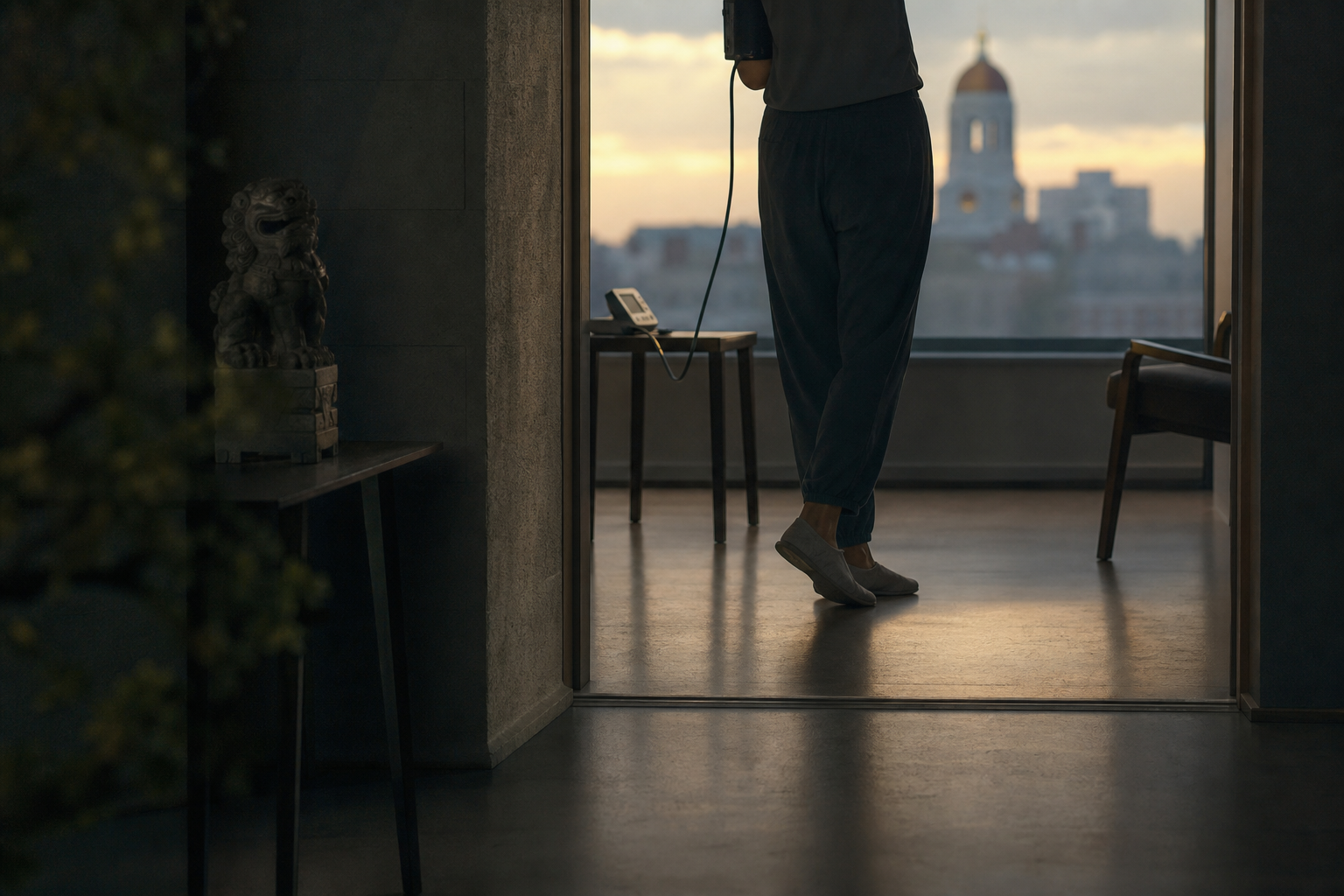
Picture a trial participant in soft shoes, shifting weight slowly from one leg to the other in a Harvard research room while a blood pressure cuff records what eight weeks of unhurried baduanjin practice have done to her numbers. That image, more or less, is what the recent baduanjin coverage points to: a rheumatologist on America Reports, a fresh study, and the suggestion that an ancient sequence of standing exercises might quietly lower hypertension at home. The headline part is easy. The harder question is what to do with the information once the segment ends and you are standing in your kitchen wondering whether to push the coffee table aside. A useful case sits one shelf over, in a book that took on the same translation problem for tai chi and worked through it without mysticism or marketing copy.
Most of the baduanjin coverage stops at the finding. A study suggests it helps, a doctor confirms the mechanism in broad strokes, the segment cuts to commercial. What goes missing is the method by which a centuries-old movement practice becomes something a cardiologist can recommend with a straight face. How do you design a trial around breathing and weight shifts? What counts as a dose, and which benefits hold up when you strip away the cultural framing? Public health news rarely has the minutes to show that work, which leaves you guessing at the strength of the evidence. The tai chi literature has already walked this road, and the walking is documented in unusual detail.
Peter Wayne runs the Osher Center research program at Harvard Medical School and has spent decades on exactly this translation problem. The Harvard Medical School Guide to Tai Chi, written with health journalist Mark Fuerst, puts the clinical evidence and the practice instructions in one volume, which is rarer than it sounds. Most tai chi books pick a side. This one holds both. The practical half is a simplified program, illustrated with more than fifty step-by-step photographs, designed for a few minutes a day rather than an hour in the park. Wayne is candid that the abbreviated form is a compromise.
Traditional curricula run longer and harder, and something is lost in compression. What is gained is a sequence ordinary people will actually repeat, which is the only kind of intervention that shows up in outcome data. The research half summarizes Harvard work and adjacent studies on cardiovascular markers, balance, bone density, sleep, mood, and cognition. Wayne is careful with claims. He separates effects with strong replication, like fall prevention in older adults, from effects that look promising but rest on smaller samples. That restraint is the habit worth borrowing when you read about baduanjin trials.
He also names the awkward methodological problem at the center of this field. You cannot easily blind a tai chi study. Participants know they are doing tai chi, instructors know they are teaching it, and expectation effects are real. Wayne does not wave this away. He walks through how researchers try to control for it, where the controls are weak, and which findings survive the scrutiny anyway. This is the section that makes the book a working case study rather than a manual. The chapters on traditional principles are the weakest stretch. The prose softens into language about energy and flow that sits uneasily next to the regression tables, and Wayne's attempt to translate the classical vocabulary into body mechanics works only intermittently.
A skeptical engineer will want more anatomy and less poetry, and would be right to want it. The book is better when it is counting things than when it is describing qi. What the book delivers is a working example of how a slow movement tradition can be studied without being either debunked or sanctified. That is the template the baduanjin coverage is missing.
If the baduanjin coverage caught your attention, spend an evening with Wayne's chapters on study design and decide what you want from your own practice. Then try ten minutes a day of something slow and breath-paced for a few weeks, and take your own readings. The book happens to teach tai chi. It also teaches a way of reading the next baduanjin headline that comes through your feed, which you will need sooner than you think.