
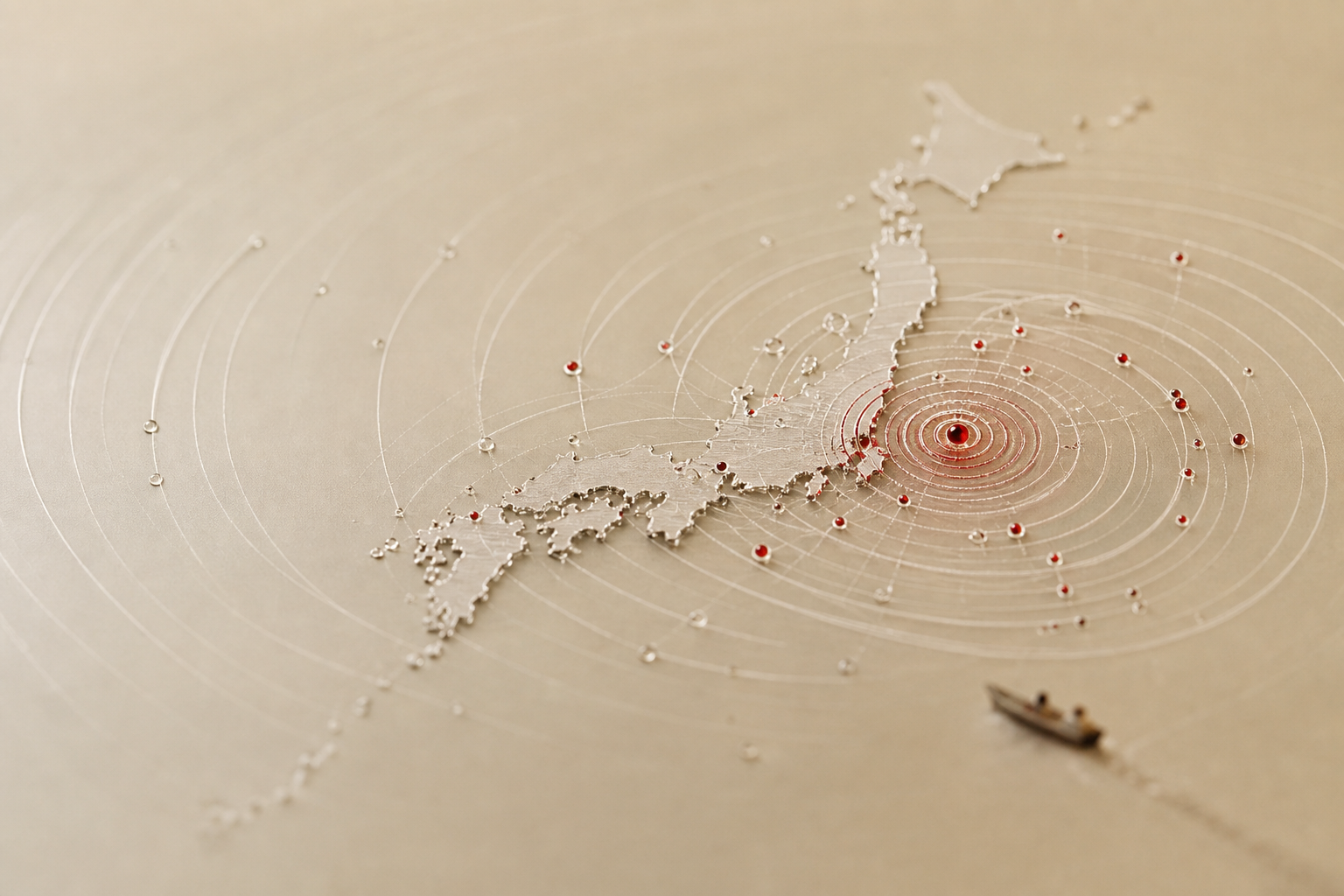
A study making the rounds describes how the 2011 Tohoku earthquake nudged the entire Japanese archipelago sideways by several millimeters, the shift carried by seismic waves bouncing off deep boundaries inside the planet. Several millimeters sounds like nothing. It is the width of a pencil lead, the kind of gap you would ignore on a bookshelf. That figure, though, comes from measuring an actual nation, and the people who live on it, against the rest of the Earth. Behind the tidy number is something harder to hold in your head: the ground you trust to stay put does not stay put. It rises, drops, and slides, and occasionally it does so violently enough to relocate a coastline while you are standing on it. The Tohoku result is the calm, instrument-fed version of a question people have asked in panic for as long as there have been cities to lose.
Most coverage stops at the wow. The number gets a headline, a diagram of arrows over a map, maybe a quote about precision instruments, and then the cycle moves on. How anyone learned to read the ground this way in the first place gets left out. The idea that a quake could lift one stretch of land and sink another, that the planet's outer shell is broken into moving pieces grinding against each other, was contested science within living memory. Someone had to go stand in the wreckage with a notebook and prove it. The instruments did not invent the insight. They confirmed a story that began with mud, barnacles, and a geologist who would not stop walking the shoreline.
Henry Fountain's The Great Quake goes back to the moment that argument cracked open. At 5:36 p.m. on March 27, 1964, a magnitude 9.2 earthquake, the second strongest ever recorded, tore through the young state of Alaska. The shaking and the tsunamis that followed flattened Valdez, swept away the island village of Chenega, and killed more than 130 people. Fountain, a science journalist at the New York Times, reconstructs those minutes with the texture of lived disaster rather than the smoothness of hindsight. Then the book follows George Plafker, a U.S. Geological Survey geologist who arrived a day later and spent months trying to figure out what the land had actually done.
His method was almost comically low-tech for a story about plate tectonics. He looked at where barnacles and seaweed had died, marking old waterlines, and compared them against the new ones. By tracing how the ground had risen in some places and dropped in others, he assembled physical evidence for how the plates had moved. What Plafker pieced together pointed toward something the geological establishment was still resisting. Continental drift had been floated decades earlier by Alfred Wegener and largely dismissed as the notion of an outsider who could not explain a mechanism. Plafker's Alaska fieldwork helped supply that mechanism: a slab of ocean floor diving under the continent, releasing strain in one enormous lurch.
The detective work in the mud did what years of theorizing had not. Fountain's framing earns its keep on the human scale, the dread of the shaking and the grief afterward, and stays clear-eyed about how scientific consensus shifts through piled-up evidence rather than a single triumphant flash. The science itself gets the thinner slice. Come wanting the full physics of subduction zones and you will find the explanations more gestural than they should be. Fountain trusts story over equation, and the trade costs him real explanatory ground when the geology gets hard. The through-line is what makes Tohoku land differently.
The 2011 measurement is Plafker's question answered by satellites. He inferred plate motion from dead barnacles; now instruments clock an archipelago shifting millimeters from waves echoing through the deep Earth. Same planet, same restless plates, far better ears.
Read it for Plafker walking a ruined shoreline with a notebook, building a planetary argument out of dead seaweed and stubbornness. The Tohoku headline gives you a number. The Great Quake gives you the human work that turned numbers like it into something we can act on. A few millimeters is still just a few millimeters. But knowing how hard it was to learn to measure them, and what we lost the day before someone did, changes what the figure feels like in your hand.