
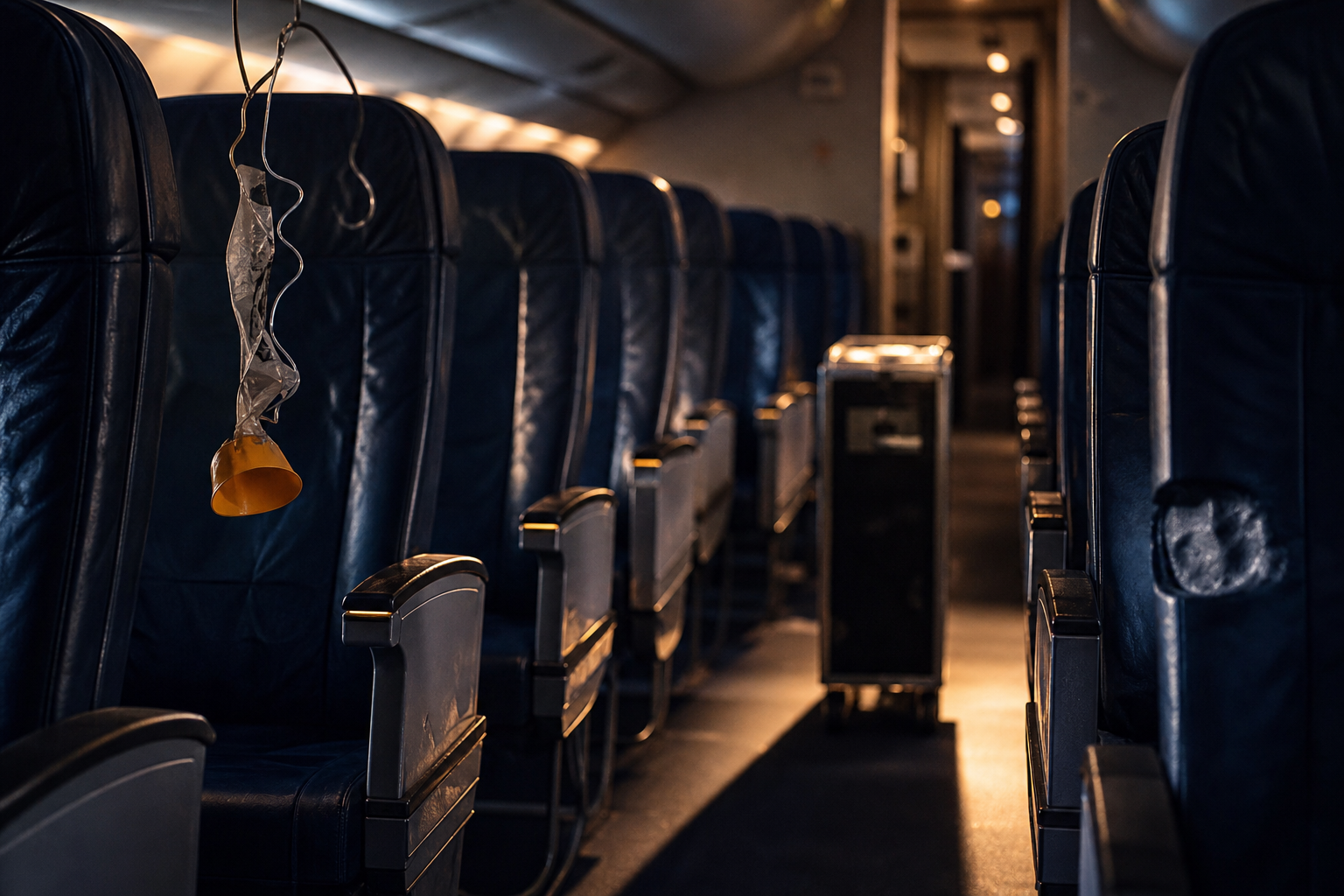
A passenger on the Halifax-bound Air Canada flight described a man kicking and flailing in the aisle, the kind of detail that never reaches the official statement about a medical emergency and a diversion to Boston. The plane landed safely. The captain was the one in trouble, not the cabin, though for the people strapped into seats nearby, that distinction felt academic. What stays with you in these accounts is the texture: who unbuckled, who froze, who tried to help and got it wrong. Aviation reporting flattens all of that into a tidy sequence of cause and outcome. The cabin, where the actual fear lives, gets summarized in a sentence. The space between what happened and what it felt like holds the whole story.
The reflex, when one of these incidents surfaces, is to ask whether the crew followed procedure and whether the systems worked. Fair questions. They also assume the interesting part is the machinery and the rules, and that passengers are essentially cargo who experience an event without shaping it. That assumption deserves a second look. When an emergency arrives without warning, the people in the seats are deciding things, fast and often badly, with no training and no script. They misjudge exits. They reach for bags. They calm strangers or panic them. The diverted Air Canada flight ended fine, so the cabin's behavior never got tested. The question it raised, what actually happens back there, has a fuller answer somewhere else.
On January 15, 2009, a US Airways jet lost both engines to a bird strike minutes after leaving New York, and the crew put it down in the Hudson River with no runway and no margin. "Miracle on the Hudson" gathers the firsthand testimony of all 155 people aboard Flight 1549, and that head count is the point. William Prochnau and Laura Parker built their account around everyone, not the cockpit alone. The result reconstructs the descent and landing moment by moment, from takeoff to rescue, in a single unbroken narrative. You get the explosion, the smell of burning, the impact that several survivors compared to a head-on car crash.
You also get the part no flight recorder can capture: the gridlock in the aisles as cold river water climbed, the people who froze, the split-second instincts that decided who moved toward an exit and who didn't. The book holds two registers at once. The technical sequence is there, accurate and clear, yet it never crowds out the human one. A passenger fumbling with a life vest sits beside the physics of a water landing, and neither gets condescended to. That balance is harder than it looks, and headline coverage of something like the Air Canada diversion has no space to attempt it.
I'll register one reservation. The framing leans inspirational, and the book sits among Christian biographies and motivational titles, which tells you how it wants to be read. Chesley Sullenberger became a figure of national reassurance almost overnight, and the narrative mostly honors that arc instead of complicating it. If you want a colder, more institutional account of why the landing succeeded, the meaning the book reaches for can feel like a thumb on the scale. The redemptive shape is chosen, not discovered. The chorus structure earns its keep anyway. No single survivor saw the whole thing, so the truth here is assembled from partial views that sometimes contradict each other, and the authors let those seams show rather than sanding them flat.
One person remembers calm; the person beside them remembers chaos. Both sat in the same row. That discrepancy is the most honest thing in the book, because it matches how memory works under terror. What you take away is a usable picture of cabin behavior under sudden threat, drawn from the rare case where almost everyone lived to describe it. The Air Canada flight gave us a frightened secondhand glimpse through one passenger's eyes. This gives you 155 of them, cross-checked against each other.
If the Air Canada story left you wanting the part the headline skipped, this is the book that has it, told by the people strapped in for the real thing. It won't coach you through a crisis you'll probably never face. It shows you, with unusual honesty, how a planeful of ordinary people actually behaved when one arrived without warning. That's a quieter offer than the cover's inspirational framing suggests, and a more interesting one.