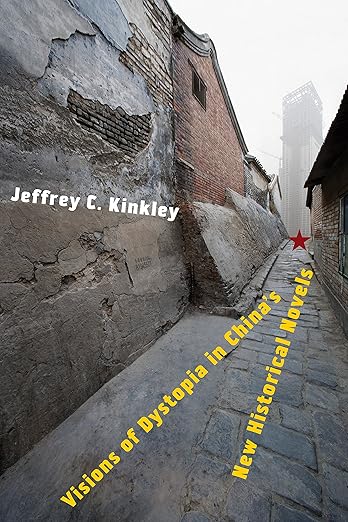
Visions of Dystopia in China’s New Historical Novels
Kindle Edition
Columbia University Press · Ebook · November 18, 2014
The depiction of personal and collective suffering in modern Chinese novels differs significantly from standard Communist accounts and many Eastern and Western historical narratives.
We earn from qualifying purchases.
- Who it’s for
- An account of how late-century Chinese historical novels recast suffering, history, and dystopia.
- Genres
- Chinese Literary Criticism, 20th-Century Literary Criticism, 21st Century Literature
- Published
- Columbia University Press, November 18, 2014
Nearest books
Matched by what the books are about, then ordered by what their readers also loved. Most of these share its genre: Chinese Literary Criticism.
 Changing Stories in the Chinese WorldMark Elvin74% match
 The Big Red Book of Modern Chinese LiteratureYunte Huang70% match
 Tales of Futures PastPaola Iovene68% matchAlso shares 20th-Century Literary Criticism and 21st Century Literature
 Misogyny, Cultural Nihilism, and Oppositional PoliticsTonglin Lu66% match
 The Stranger and the Chinese Moral ImaginationHaiyan Lee65% match
 From Burke and Wordsworth to the Modern Sublime in Chinese LiteratureYi Zheng64% match
 The Literature of China in the Twentieth CenturyBonnie S. McDougall, Kam Louie64% matchAlso shares 20th-Century Literary Criticism
 Sound and SilenceLianke Yan63% match
For younger readers: Revolution Is Not a Dinner Party, Along the River, Red Scarf Girl
Start with three books, and this one can be the first.
Members get a new edition every morning: a route out from their books to essays, research and talks, with the reason for each.
Join the waitlistAbout this book
The depiction of personal and collective suffering in modern Chinese novels differs significantly from standard Communist accounts and many Eastern and Western historical narratives.
Continue reading
Writers such as Yu Hua, Su Tong, Wang Anyi, Mo Yan, Han Shaogong, Ge Fei, Li Rui, and Zhang Wei skew and scramble common conceptions of China's modern development, deploying avant-garde narrative techniques from Latin American and Euro-American modernism to project a surprisingly "un-Chinese" dystopian vision and critical view of human culture and ethics. The epic narratives of modern Chinese fiction make rich use of magical realism, surrealism, and unusual treatments of historical time. Also featuring graphic depictions of sex and violence, as well as dark, raunchy comedy, these novels reflect China's recent history re-presenting the overthrow of the monarchy in the early twentieth century and the resulting chaos of revolution and war; the recurring miseries perpetrated by class warfare during the dictatorship of Mao Zedong; and the social dislocations caused by China's industrialization and rise as a global power. This book casts China's highbrow historical novels from the late 1980s to the first decade of the twenty-first century as a distinctively Chinese contribution to the form of the global dystopian novel and, consequently, to global thinking about the interrelations of utopia and dystopia.
Chinese Dystopian Novels
An account of how late-century Chinese historical novels recast suffering, history, and dystopia.
Come here for
- How novels unsettle standard Communist and historical narratives
- Chinese contributions to global dystopian fiction
Expect
- Magical realism in epic narratives
- Surrealism in epic narratives
Where it sits
| Chinese Literary Criticism | 97% |
|---|---|
| 21st Century Literature | 34% |
| 20th-Century Literary Criticism | 30% |
Percentages are BookFrontier’s reading of the book.
Publisher categories
- Literary Theory
- Chinese Literary Criticism
- Authors
- Jeffrey Kinkley, Jeffrey C Kinkley
- Publisher
- Columbia University Press
- Published
- November 18, 2014
- Format
- Ebook
- Reading lane
- Literary Theory