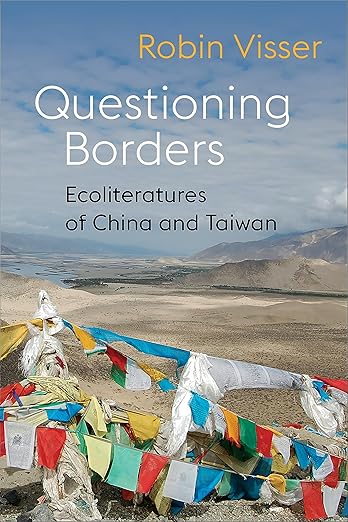
Questioning Borders
Ecoliteratures of China and Taiwan
Columbia University Press · Print & ebook · September 12, 2023
Indigenous knowledge of local ecosystems often challenges settler-colonial cosmologies that naturalize resource extraction and the relocation of nomadic, hunting, foraging, or fishing peoples.
We earn from qualifying purchases.
- Who it’s for
- Robin Visser compares Indigenous and Han Chinese ecoliteratures across China and Taiwan.
- Genres
- Chinese Literary Criticism, Nature in Literature, Indigenous Studies
- Published
- Columbia University Press, September 12, 2023
Nearest books
Matched by what the books are about, then ordered by what their readers also loved. Most of these share its genre: Chinese Literary Criticism.
 Postcolonial EcologiesElizabeth DeLoughrey, George B. Handley64% matchAlso shares Nature in Literature
 China in a Polycentric WorldYingjin Zhang63% match
 Translingual PracticeLydia Liu, Lydia H. Liu62% match
 Transpacific ImaginationsYunte Huang61% match
 Changing Stories in the Chinese WorldMark Elvin61% match
 Imagining India in Modern ChinaGal Gvili60% match
 Tales of Futures PastPaola Iovene59% match
 Premodern Ecologies in the Modern Literary ImaginationVin Nardizzi, Tiffany Jo Werth59% matchAlso shares Nature in Literature
For younger readers: Origin, The Children of China, Asian Children's Favorite Stories
Start with three books, and this one can be the first.
Members get a new edition every morning: a route out from their books to essays, research and talks, with the reason for each.
Join the waitlistAbout this book
Indigenous knowledge of local ecosystems often challenges settler-colonial cosmologies that naturalize resource extraction and the relocation of nomadic, hunting, foraging, or fishing peoples. Questioning Borders explores recent ecoliterature by Han and non-Han Indigenous writers of China and Taiwan, analyzing relations among humans, animals, ecosystems, and the cosmos in search of alternative possibilities for creativity and consciousness.
Continue reading
Informed by extensive field research, Robin Visser compares literary works by Bai, Bunun, Kazakh, Mongol, Tao, Tibetan, Uyghur, Wa, Yi, and Han Chinese writers set in Xinjiang, Tibet, Inner Mongolia, Southwest China, and Taiwan, sites of extensive development, migration, and climate change impacts. Visser contrasts the dominant Han Chinese cosmology of center and periphery that informs what she calls “Beijing Westerns” with Indigenous and hybridized ways of relating to the world that challenge borders, binaries, and hierarchies. By centering Indigenous cosmologies, this book aims to decolonize approaches to ecocriticism, comparative literature, and Chinese and Sinophone studies as well as to inspire new modes of sustainable flourishing in the Anthropocene.
Indigenous Ecologies
Robin Visser compares Indigenous and Han Chinese ecoliteratures across China and Taiwan.
Come here for
- Literary works by Indigenous and Han Chinese writers
- Relations among humans, animals, ecosystems, and the cosmos
Expect
- A contrast between Han center-periphery cosmology and Indigenous perspectives
- Sites shaped by development, migration, and climate change
Where it sits
| Chinese Literary Criticism | 61% |
|---|---|
| Indigenous Studies | 41% |
| Nature in Literature | 37% |
Percentages are BookFrontier’s reading of the book.
Publisher categories
- Chinese Literary Criticism
- 21st Century Literature
- Nature in Literature
- Indigenous Studies
- Authors
- Robin Visser
- Publisher
- Columbia University Press
- Published
- September 12, 2023
- Format
- Print & ebook
- Reading lane
- Chinese Literary Criticism