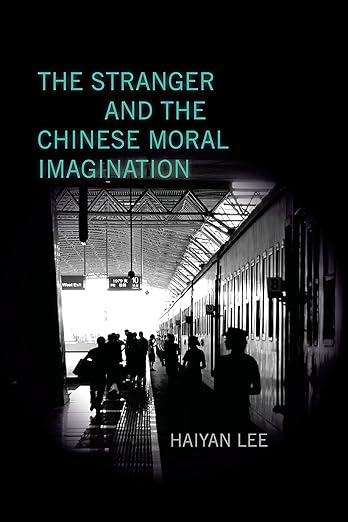
The Stranger and the Chinese Moral Imagination
1st Edition, Kindle Edition
Stanford University Press · Ebook · November 12, 2014
In the last two decades, China has become a dramatically more urban society and hundreds of millions of people have changed residence in the process.
We earn from qualifying purchases.
- Who it’s for
- Haiyan Lee traces the figure of the stranger across Chinese arts and culture.
- Genres
- Chinese Literary Criticism, Race & Culture in Literature, How Cultures Work
- Published
- Stanford University Press, November 12, 2014
Nearest books
Matched by what the books are about, then ordered by what their readers also loved.
 Changing Stories in the Chinese WorldMark Elvin65% matchShares Chinese Literary Criticism
 China - Culture Smart!Culture Smart!, Indre Balcikonyte-Huang60% match
 China in Ten WordsYu Hua, Allan H. Barr59% match
 Floating ChinamanHua Hsu59% match
 Factory GirlsLeslie T. Chang59% match
 Strangers in the LandEric Yang, Michael Luo59% match
 Translingual PracticeLydia Liu, Lydia H. Liu59% matchShares Chinese Literary Criticism
For younger readers: Revolution Is Not a Dinner Party, Girl Under a Red Moon: Growing Up During China's Cultural Revolution (scholastic Focus), China's Son
Start with three books, and this one can be the first.
Members get a new edition every morning: a route out from their books to essays, research and talks, with the reason for each.
Join the waitlistAbout this book
In the last two decades, China has become a dramatically more urban society and hundreds of millions of people have changed residence in the process. Family and communal bonds have been broken in a country once known as "a society of kith and kin." There has been a pervasive sense of moral crisis in contemporary China, and the new market economy doesn't seem to offer any solutions.
Continue reading
This book investigates how the Chinese have coped with the condition of modernity in which strangers are routinely thrust together. Haiyan Lee dismisses the easy answers claiming that this "moral crisis" is merely smoke and mirrors conjured up by paternalistic, overwrought leaders and scholars, or that it can be simply chalked up to the topsy-turvy of a market economy on steroids. Rather, Lee argues that the perception of crisis is itself symptomatic of a deeper problem that has roots in both the Confucian tradition of kinship and the modern state management of stranger sociality. This ambitious work is the first to investigate the figure of the stranger—foreigner, peasant migrant, bourgeois intellectual, class enemy, unattached woman, animal—across literature, film, television, and museum culture. Lee's aim is to show that hope lies with a robust civil society in which literature and the arts play a key role in sharpening the moral faculties and apprenticing readers in the art of living with strangers. In so doing, she makes a historical, comparative, and theoretically informed contribution to the on-going conversation on China's "(un)civil society."
Strangers in China
Haiyan Lee traces the figure of the stranger across Chinese arts and culture.
Come here for
- Strangers ranging from foreigner to unattached woman
- Literature, film, television, and museum culture
Expect
- A study of modernity, kinship, and moral crisis in China
- An argument for the role of arts in civil society
Where it sits
| Chinese Literary Criticism | 91% |
|---|---|
| Race & Culture in Literature | 17% |
| How Cultures Work | 16% |
Percentages are BookFrontier’s reading of the book.
Publisher categories
- Chinese Literary Criticism
- Authors
- Haiyan Lee
- Publisher
- Stanford University Press
- Published
- November 12, 2014
- Format
- Ebook
- Reading lane
- Chinese Literary Criticism