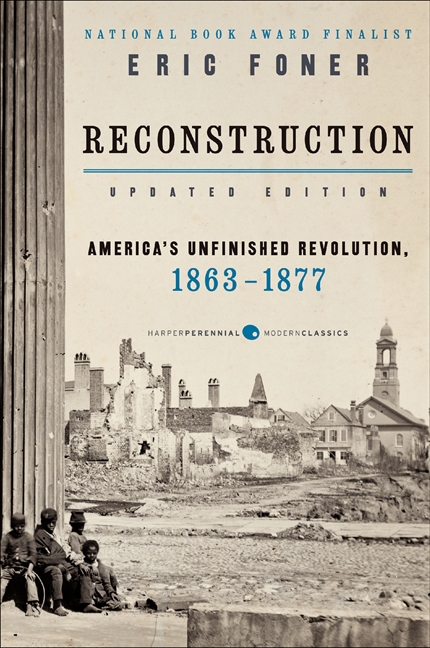
Reconstruction Updated Edition
America's Unfinished Revolution, 1863-1877
A concise, layered guide to Reconstruction’s unsettled aftermath and its stubborn questions.
Reconstruction Lens
Come here for
- clear-eyed reconstruction history
- rigorous explanation without fuss
Expect
- structured historical analysis
- works as read-through or reference
Where it sits
How strongly BookFrontier reads the book as belonging to each subject.
Nearest books
Matched by our semantic model. Ordered by what its readers also loved. Most of these share its genres: Civil War Era and Black History.
 W.E.B. Du Bois: Black ReconstructionW.E.B. Du Bois, Eric Foner70% subject match
 The Second FoundingEric Foner72% subject match
 Stony the RoadHenry Louis Gates, Jr.65% subject match
 The Fiery TrialEric Foner70% subject match
 Battle Cry of FreedomJames M. McPherson64% subject matchAlso shares 19th-Century America
 Frederick DouglassDavid W. Blight55% subject match
 The Republic for Which It StandsRichard White74% subject matchAlso shares 19th-Century America
For younger readers: What Was Reconstruction?, Stolen Justice: The Struggle for African American Voting Rights, Now Is Your Time!
Start with three books, and this one can be the first.
Members get a new edition every morning: a route out from their books to essays, research and talks, with the reason for each.
Sign upAbout this book
From the "preeminent historian of Reconstruction" (New York Times Book Review), the prize-winning classic work on the post-Civil War period that shaped modern America.
Eric Foner's "masterful treatment of one of the most complex periods of American history" (New Republic) redefined how the post-Civil War period was viewed.
Reconstruction chronicles the way in which Americans—black and white—responded to the unprecedented changes unleashed by the war and the end of slavery.
Continue reading
It addresses the ways in which the emancipated slaves' quest for economic autonomy and equal citizenship shaped the political agenda of Reconstruction; the remodeling of Southern society and the place of planters, merchants, and small farmers within it; the evolution of racial attitudes and patterns of race relations; and the emergence of a national state possessing vastly expanded authority and committed, for a time, to the principle of equal rights for all Americans.
This "smart book of enormous strengths" (Boston Globe) remains the standard work on the wrenching post-Civil War period—an era whose legacy still reverberates in the United States today.
Publisher details
Publisher categories
- Studying History
- Civil War Era
- World History
- Modern History
Show all 8 publisher categories
- The Americas History
- Black History
- Philosophy Overviews
- Political History & Ideas
- Authors
- Eric Foner
- Publisher
- HarperCollins
- Published
- December 2, 2014
- Format
- Print & ebook
- Reading lane
- Studying History