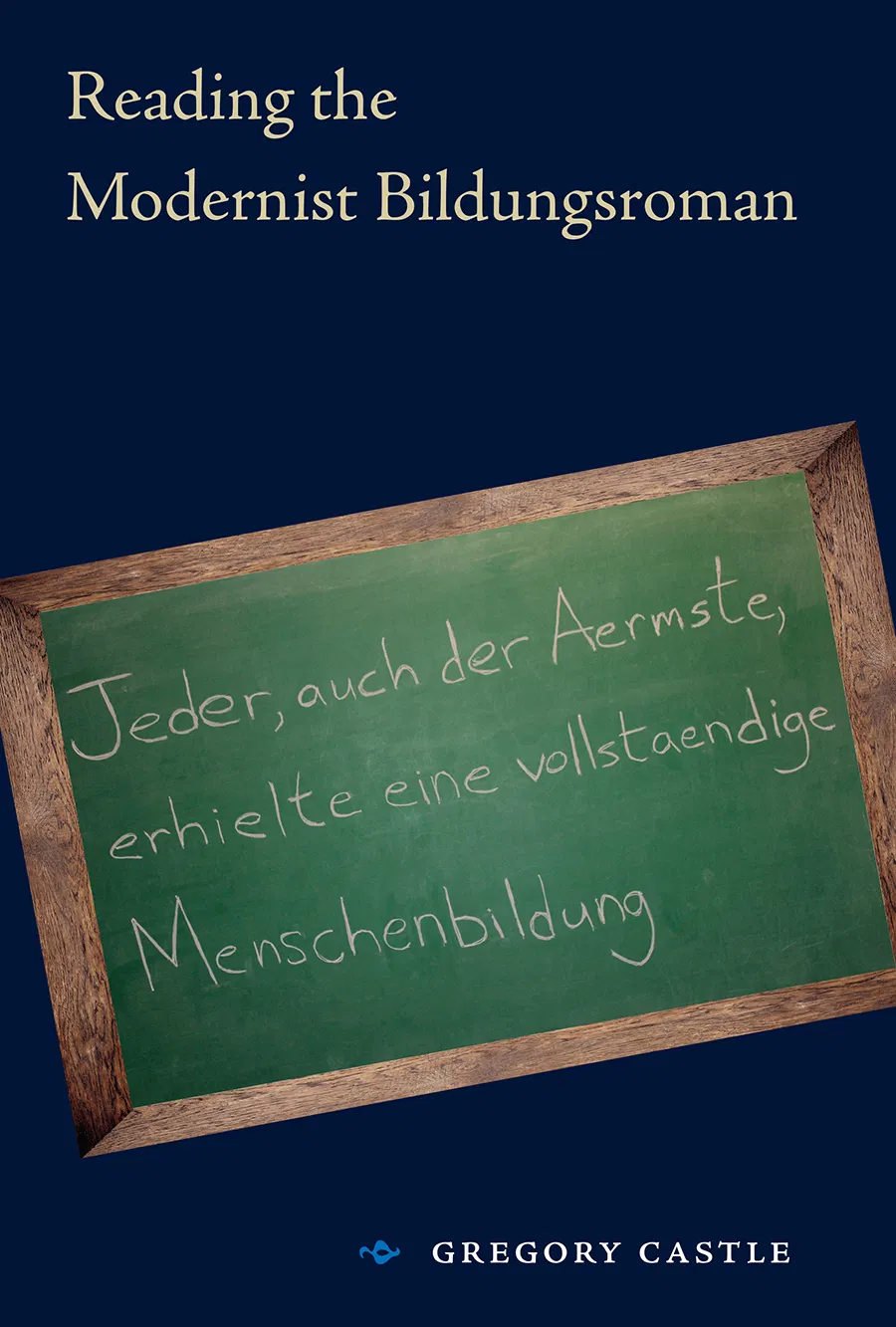
Reading the Modernist Bildungsroman
English and Irish modernists reshape the Bildungsroman through identity and self-development.
Modernist Bildung
Come here for
- The genre’s German roots and classical idea of Bildung
- Adorno’s negative dialectics as a critical lens
Expect
- Discussion of D. H. Lawrence’s Sons and Lovers
- Discussion of James Joyce’s A Portrait of the Artist as a Young Man
Where it sits
How strongly BookFrontier reads the book as belonging to each subject.
Nearest books
Matched by our semantic model. Ordered by what its readers also loved.
 Novel TranslationsBethany Wiggin52% subject match
 The Antinomies of RealismFredric Jameson50% subject matchShares British & Irish Literary Criticism
 Writing WeimarDavid Midgley49% subject matchShares 20th-Century Literary Criticism
 Genre BendingJeremy Rosen49% subject match
 Marvelous SolitudeLina Bolzoni48% subject match
 Demian: The Story of Emil Sinclair's YouthHermann Hesse48% subject match
 Gothic and ModernismJohn Paul Riquelme47% subject matchShares 20th-Century Literary Criticism
 Modernism: A Very Short IntroductionChristopher Butler47% subject matchShares 20th-Century Literary Criticism
Start with three books, and this one can be the first.
Members get a new edition every morning: a route out from their books to essays, research and talks, with the reason for each.
Sign upAbout this book
The Bildungsroman is a genre novel whose territory is well traveled, that of a young and often alienated hero on the cusp of maturity, intent on discovering who he or she is and being true to that identity. The German word Bildung refers to forming and shaping, and the first Bildungsromane in 18th-century Germany focused on the hero’s self-formation.
Continue reading
Modernists such as Thomas Hardy, D. H. Lawrence, James Joyce, Oscar Wilde, and Virginia Woolf adopted and reinvigorated the Bildungsroman form as a means of telling stories about longing and transition. With this first major study of the historical context of the English and Irish Bildungsroman, Gregory Castle revisits the genre with a special interest in self-development and identity, as well as the viability of the classical concept of Bildung in the modernist era.
Drawing on German philosopher Theodor Adorno’s theory of negative dialectics (which values the negative moment as a potentially critical force), Castle demonstrates the ongoing relevance of the Bildungsroman form and its powerful capacity for social and cultural critique. Its vitality is due in large measure to its ability to represent, in a self-consciously critical fashion, the complex and contradictory modes of self-development that have arisen in late modernity. The author contends that modernism managed to rehabilitate one of the most conventional genres in the history of literature. Examining such works as D. H. Lawrence’s Sons and Lovers and James Joyce’s APortrait of the Artist as a Young Man, Castle provides a significant scholarly contribution to literary criticism that will be of interest to students and scholars of modernism, the modernist novel, and Irish studies, as well as the problem of education and class in English and Irish literature.
Publisher details
Publisher categories
- Literary Theory
- Authors
- Gregory Castle
- Publisher
- University Press of Florida
- Published
- May 15, 2015
- Format
- Print & ebook
- Reading lane
- Literary Theory