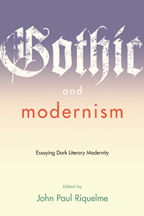
This collection traces Gothic writing’s influence across modern literature, from canonical works to popular forms.
Gothic Traditions
Come here for
- Readings of Gothic traditions in modern works
- Essays on language, literary form, and time
Expect
- Essays on writers including Wilde, Woolf, Beckett, Butler, and Ellis
- Attention to Gothic parody, cultural criticism, and technological threats and promises
Where it sits
How strongly BookFrontier reads the book as belonging to each subject.
Nearest books
Matched by our semantic model. Ordered by what its readers also loved. Most of these share its genres: Gothic & Romance Lit Crit and Horror Lit Crit.
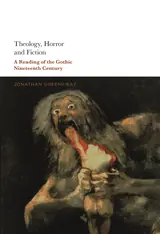 Theology, Horror and FictionJonathan Greenaway70% subject match
 Gothic ReflectionsPeter Garrett69% subject match
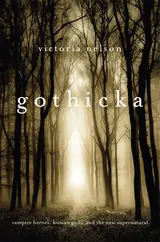 GothickaVictoria Nelson69% subject match
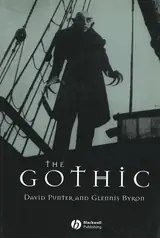 The GothicDavid Punter, Glennis Byron68% subject match
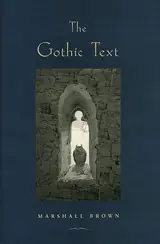 The Gothic TextMarshall Brown68% subject match
 American Gothic FictionAllan Lloyd-Smith66% subject match
 EcoGothicAndrew Smith, William Hughes64% subject match
 Tales of the Troubled DeadCatherine Belsey59% subject match
For younger readers: Poe: Stories and Poems, The Book of Living Secrets, House of Roots and Ruin
Start with three books, and this one can be the first.
Members get a new edition every morning: a route out from their books to essays, research and talks, with the reason for each.
Sign upAbout this book
Gothic and Modernism establishes and interprets the significant presence and the transformations of the Gothic tradition at the dark heart of writing during the long twentieth century.
Continue reading
Artfully introduced and collected by John Paul Riquelme, the essays—nine previously published in Modern Fiction Studies—reveal challenges to both realism and to optimistic Enlightenment attitudes in the narratives and the styles of writers ranging from Oscar Wilde and Virginia Woolf to Samuel Beckett, Octavia Butler, and Bret Easton Ellis.
In examining nineteenth-century works and popular dark writing of the twentieth century, the contributors elucidate literary modernism’s relationship to nineteenth-century Gothic traditions, effectively extending the chronological and conceptual boundaries of the former and challenging the propriety of the barrier between high and popular forms of literature. Through compelling readings of a range of modern works, they reveal the aestheticizing of the Gothic, its parodic, culturally critical tendencies, its relation to language, literary form, and time, and its response to technological threats and promises.
From canonical modernism to more popular forms, such as detective fiction, science fiction, and pornohorror, this wide-ranging and accessibly written collection offers an overview of Gothic writing’s persistent influence on modern works.
Contributors: Penny Fielding, University of Edinburgh; Graham Fraser, Mount Saint Vincent University; Theodora Goss, Boston University; Ruth Helyer, University of Teesside; Susan Kollin, Montana State University; Patrick R. O'Malley, Georgetown University; John Paul Riquelme, Boston University; Charles J. Rzepka; Boston University; Paul K. Saint-Amour, University of Pennsylvania; Joseph Valente, University of Illinois
Publisher details
Publisher categories
- Gothic & Romance Lit Crit
- Literary Theory
- Authors
- John Paul Riquelme
- Publisher
- Johns Hopkins University Press
- Published
- October 10, 2008
- Format
- Print & ebook
- Reading lane
- Gothic & Romance Lit Crit