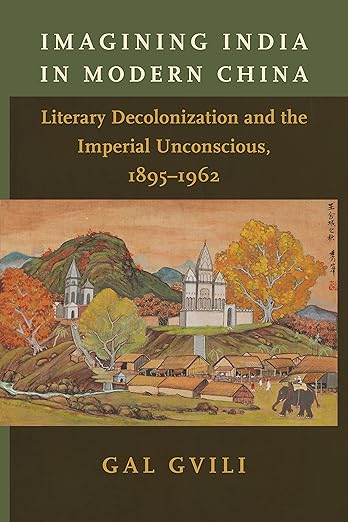
Imagining India in Modern China
Literary Decolonization and the Imperial Unconscious, 1895–1962
Gal Gvili traces how Chinese writers imagined India while seeking literary possibilities and anticolonial solidarity.
India in Chinese Letters
Come here for
- Chinese writers’ visions of India from the late Qing era onward
- Literary decolonization and the influence of English translations
Expect
- An account of South-South literary connections and their limits
- Coverage spanning 1895–1962
Where it sits
How strongly BookFrontier reads the book as belonging to each subject.
Nearest books
Matched by our semantic model. Ordered by what its readers also loved. Most of these share its genre: Chinese Literary Criticism.
 Translingual PracticeLydia H. Liu62% subject matchAlso shares Comparative Literature
 Questioning BordersRobin Visser60% subject match
 More than RealDavid Shulman59% subject matchAlso shares Indic Literary Criticism
Start with three books, and this one can be the first.
Members get a new edition every morning: a route out from their books to essays, research and talks, with the reason for each.
Sign upAbout this book
Winner, 2023 Harry Levin Prize, American Comparative Literature Association
Beginning in the late Qing era, Chinese writers and intellectuals looked to India in search of new literary possibilities and anticolonial solidarity. In their view, India and China shared both an illustrious past of cultural and religious exchange and a present experience of colonial aggression.
Continue reading
These writers imagined India as an alternative to Western imperialism—a Pan-Asian ideal that could help chart an escape route from colonialism and its brutal grasp on body and mind by ushering in a new kind of modernity in Asian terms.
Gal Gvili examines how Chinese writers’ image of India shaped the making of a new literature and spurred efforts to achieve literary decolonization. She argues that multifaceted visions of Sino-Indian connections empowered Chinese literary figures to resist Western imperialism and its legacies through novel forms and genres. However, Gvili demonstrates, the Global North and its authority mediated Chinese visions of Sino-Indian pasts and futures. Often reading Indian literature and thought through English translations, Chinese writers struggled to break free from deeply ingrained imperialist knowledge structures.
Imagining India in Modern China traces one of the earliest South-South literary imaginaries: the hopes it inspired, the literary rejuvenation it launched, and the shadow of the North that inescapably haunted it. By unearthing Chinese writers’ endeavors to decolonize literature and thought as well as the indelible marks that imperialism left on their minds, it offers new perspective on the possibilities and limitations of anticolonial movements and South-South solidarity.
Publisher details
Publisher categories
- Literary Theory
- Chinese Literary Criticism
- Indic Literary Criticism
- 20th-Century Literary Criticism
- Authors
- Gal Gvili
- Publisher
- Columbia University Press
- Published
- October 11, 2022
- Format
- Print & ebook
- Reading lane
- Literary Theory