
Book
Peopling the World
Representing Human Mobility From Milton to Malthus
Charlotte Sussman
University of Pennsylvania Press, Inc. · Print & ebook · April 24, 2020
Reading lane: LITERARY CRITICISM / Modern / 18th Century
A compelling study of views about population and demographic mobility in the British long eighteenth century In John Milton's Paradise Lost of 1667, Adam and Eve are promised they will produce a "race to fill the world," a thought that consoles them even after the trauma of the fall.
Disclosure: Some outbound links are affiliate links. If you buy through them, we may earn a commission. It doesn't affect which books we include. Learn more in our disclosure policy.
At a Glance
Who It's For
Book Details
- Authors
- Charlotte Sussman
- Publisher
- University of Pennsylvania Press, Inc.
- Published
- April 24, 2020
- Format
- Print & ebook
- Theme
- LITERARY CRITICISM / Modern / 18th Century · British & Irish Literary Criticism
- Reading lane
- LITERARY CRITICISM / Modern / 18th Century
Affinity
Publisher Categories
British & Irish Literary Criticism
LITERARY CRITICISM / Modern / 18th Century
About This Book
A compelling study of views about population and demographic mobility in the British long eighteenth century In John Milton's Paradise Lost of 1667, Adam and Eve are promised they will produce a "race to fill the world," a thought that consoles them even after the trauma of the fall. By 1798, the idea that the world would one day be entirely filled by people had become, in Thomas Malthus's hands, a nightmarish vision. In Peopling the World , Charlotte Sussman asks how and wh...
Read full description
Similar Books
Philanthropic Discourse in Anglo-american Literature, 1850-1920
Frank Q. Christianson, Leslee Thorne-Murphy · Indiana University Press
Shared affinity
LITERARY CRITICISM / Modern / 18th Century
British & Irish Literary Criticism
LITERARY CRITICISM / Modern / 19th Century

Sentimental Figures of Empire in Eighteenth-century Britain and France
Lynn Festa · Johns Hopkins University Press
Shared affinity
LITERARY CRITICISM / Modern / 18th Century
British & Irish Literary Criticism
LITERARY CRITICISM / Modern / 19th Century

The Ideology of Imagination
Forest Pyle · Stanford University Press
Shared affinity
LITERARY CRITICISM / Modern / 18th Century
British & Irish Literary Criticism
LITERARY CRITICISM / Modern / 19th Century

The Practice of Satire in England, 1658-1770
Ashley Marshall · Johns Hopkins University Press
Shared affinity
LITERARY CRITICISM / Modern / 18th Century
British & Irish Literary Criticism
LITERARY CRITICISM / Modern / 19th Century

The Construction of Authorship
Martha Woodmansee, Peter Jaszi · Duke University Press
Shared affinity
LITERARY CRITICISM / Modern / 18th Century
British & Irish Literary Criticism
LITERARY CRITICISM / Modern / 19th Century
Approaches to Teaching Austen's Persuasion
Marcia McClintock Folsom, John Wiltshire · Modern Language Association of America
Shared affinity
LITERARY CRITICISM / Modern / 18th Century
British & Irish Literary Criticism
LITERARY CRITICISM / Modern / 19th Century
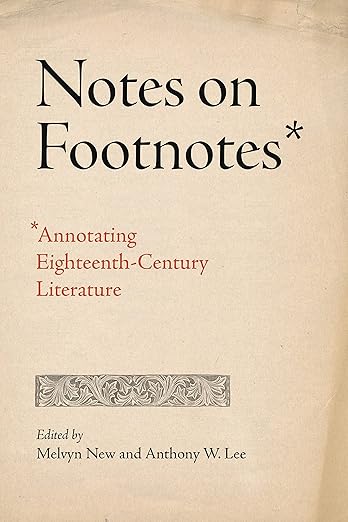
Notes on Footnotes
Melvyn New, Anthony W. Lee · Penn State University Press
Shared affinity
LITERARY CRITICISM / Modern / 18th Century
British & Irish Literary Criticism
LITERARY CRITICISM / Modern / 19th Century

Genius and Ink: Virginia Woolf on How to Read
Virginia Woolf, Francesca Wade · HarperCollins Publishers
Shared affinity
LITERARY CRITICISM / Modern / 18th Century
British & Irish Literary Criticism
LITERARY CRITICISM / Modern / 19th Century