
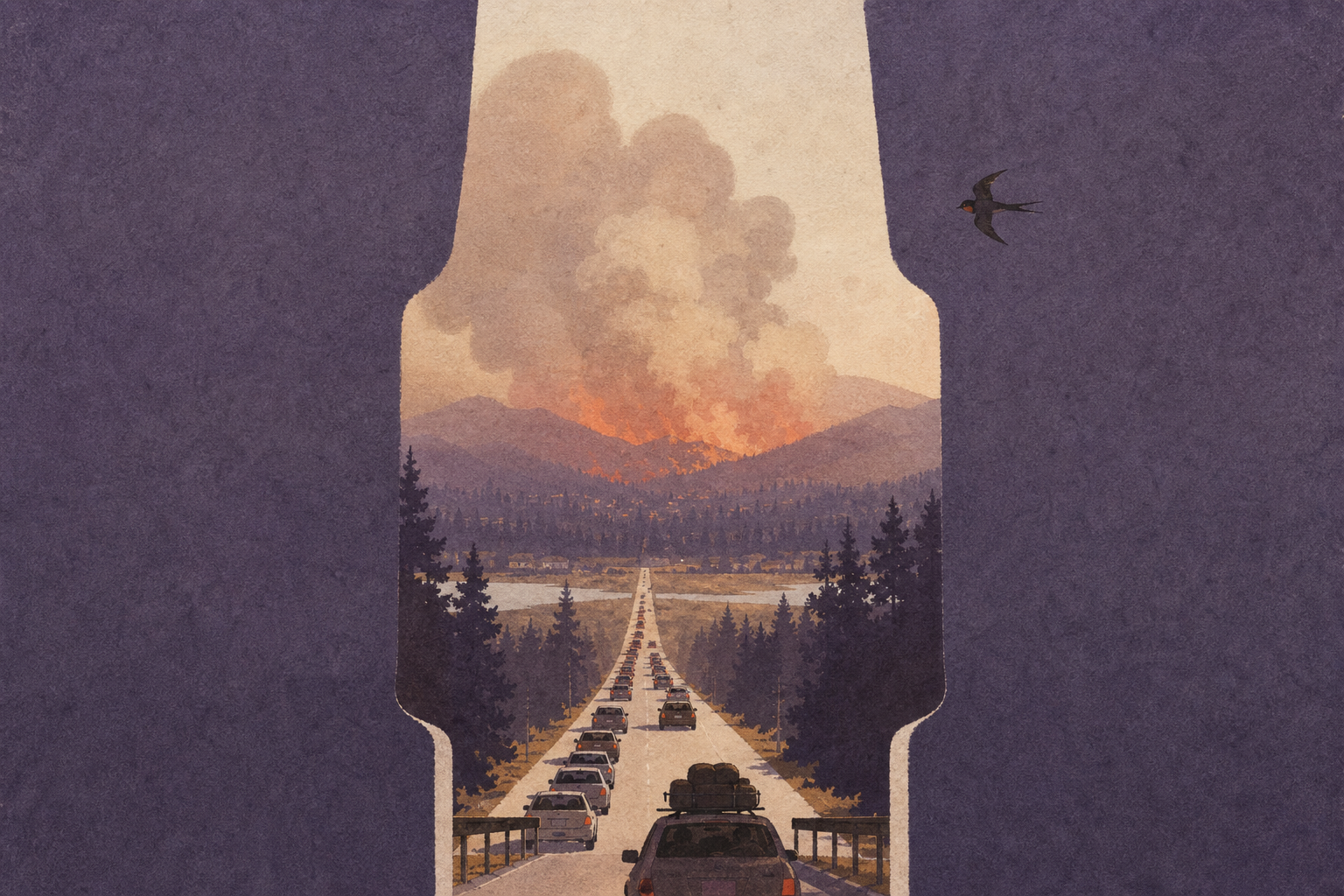
Spokane County is under a state of emergency, thousands of families are packing what fits in a car, and the Washington National Guard is on its way. Live coverage gives you wind speeds, a road closure, a shelter address, then another road closure, all of it accurate and nearly impossible to hold in your head for longer than an hour. The questions underneath stay put. Why a smudge on the horizon at breakfast is a wall of flame by lunch, and why an evacuation order reaches one phone and skips the one charging beside it. Why the households that got out early so often had somebody awake and looking out a window. Those questions have answers. They were documented in obsessive detail after a November morning in a California foothill town that had drilled for exactly this and still buried eighty-five people.
The Inland Northwest has run this experiment before, at a scale that is hard to picture from a driveway in Airway Heights. In August 1910, the Big Burn crossed Idaho, Montana, and eastern Washington in about two days, took some three million acres, and killed dozens of firefighters. The young Forest Service came out of that summer committed to putting out every fire, fast, everywhere, and it held that line for most of a century. The policy looked correct for decades while a hundred years of brush and small timber piled up in country that used to burn lightly and often. That bill has been arriving in installments, and Spokane County is paying one this weekend. What decides an event like this is the two hours after ignition, and the fullest record anyone has of those two hours comes from Paradise.
Lizzie Johnson's Paradise reconstructs November 8, 2018, close to minute by minute. Residents woke to gray skies and a wind that would not settle. Within two hours the Camp Fire had run the town, catching people in their kitchens and in cars that had stopped moving. By the next morning eighty-five of them were dead. Johnson was reporting from the ground while the town burned and stayed with the same people for years afterward, working through interviews, 911 recordings, and grand jury testimony until she could place individuals on specific streets at specific minutes. The book is written at the scale of a windshield.
A young mother drives out with a newborn on the seat beside her. A school bus full of children hunts for a road that has not already closed, finds one, then loses it. Paramedics and patients end up cornered in a cul-de-sac, beating at flames with rakes and garden hoses because that is what was in the yard. That close focus is what lets you watch the catastrophe get assembled. Extreme wind and drought-dried fuels were the standing conditions. The ignition was a worn hook on an aging transmission tower, a piece of hardware that had been flagged and left alone.
Turning a fast fire into a mass casualty event took the human plumbing around it: an alert system most residents had never signed up for, evacuation zones designed to empty the town in orderly stages, and two-lane roads laid out for a Paradise half the size of the one that needed to leave. Every one of those failures is ordinary, which is the finding that keeps you up. Nobody in the book is stupid or negligent in the cinematic sense. Dispatchers make defensible calls on bad information. Drivers turn around because a neighbor said the other route was clear.
The town had a plan and had rehearsed it, and the plan quietly assumed more than two hours. I part company with the climate framing that has grown up around the book, and occasionally with the book itself. Hotter, drier autumns lengthened the odds, no argument. A warming planet did not decline to replace a flagged hook on a tower, and it did not approve houses on a ridge with two ways out. Climate loads the weather; utility maintenance and county land use pull the trigger. Blur the two and you get a disaster with nobody responsible for it, which suits everyone except the people living on the ridge.
The rebuilding chapters sag. Johnson writes them honestly, but the institutional accounting has none of the pressure of the fire hours, and the momentum that carried the first half stops dead. What survives that slack is the reconstruction itself, still the most detailed account we have of how a modern American town fails to get out in time.
Fires like this are settled before the flame front arrives, by a piece of hardware nobody replaced and a phone that did or did not buzz. Johnson's book makes the news out of Spokane more specific, which is a sharper and more useful kind of unease, and it will change what you notice in the next round of live updates. Worth picking up when the smoke clears, or while it is still hanging over the river and the windows are shut. The Forest Service spent a century trying to make that first hour unnecessary. It is still the only hour there is.