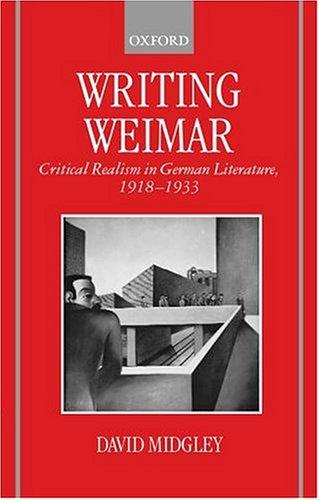
Writing Weimar
Critical Realism in German Literature, 1918-1933
Oxford University Press · Print & ebook · March 15, 2000
The years of the Weimar Republic saw complex cultural change in Germany as well as political turmoil.
We earn from qualifying purchases.
- Who it’s for
- An account of how German writers examined social and political issues across literary forms.
- Genres
- German Literary Criticism, 20th-Century Literary Criticism, Politics in Literature
- Published
- Oxford University Press, March 15, 2000
Nearest books
Matched by what the books are about, then ordered by what their readers also loved.
 Germany 1923Volker Ullrich62% match
 Otto Dix and the Memorialization of World War I in German Visual Culture, 1914-1936Ann Murray, Deborah Ascher Barnstone58% match
 Fateful HoursVolker Ullrich, Jefferson Chase58% match
For younger readers: Crushing the Red Flowers, Good-bye Marianne, Prisoner of Night and Fog
Start with three books, and this one can be the first.
Members get a new edition every morning: a route out from their books to essays, research and talks, with the reason for each.
Join the waitlistAbout this book
The years of the Weimar Republic saw complex cultural change in Germany as well as political turmoil. Writing Weimar draws on the large amount of research done on the period since the 1980s in order to show how literary writers developed critical perspectives on the social and political issues of the time, and how those perspectives were related to longer-term developments in German culture which run beyond the watershed events of 1918 and 1933.
Continue reading
Individual chapters discuss the dominant trends in the poetry, the theatre, and the novel, as well as the literary representation of the city, of technology, and of the First World War. The book also sheds new light on one of the abiding mysteries of German culture in the 1920s: precisely what were the implications of the term Neue Sachlichkeit as it came to be applied to the cultural trends of the time?
Weimar Literary Trends
An account of how German writers examined social and political issues across literary forms.
Come here for
- Critical perspectives on social and political issues
- The literary representation of the city
Expect
- Dominant trends in poetry, theatre, and the novel
- What Neue Sachlichkeit meant in the 1920s
Where it sits
| German Literary Criticism | 90% |
|---|---|
| 20th-Century Literary Criticism | 86% |
| Politics in Literature | 35% |
Percentages are BookFrontier’s reading of the book.
Publisher categories
- German Literary Criticism
- Authors
- David Midgley, David R. Midgley
- Publisher
- Oxford University Press
- Published
- March 15, 2000
- Format
- Print & ebook
- Reading lane
- German Literary Criticism