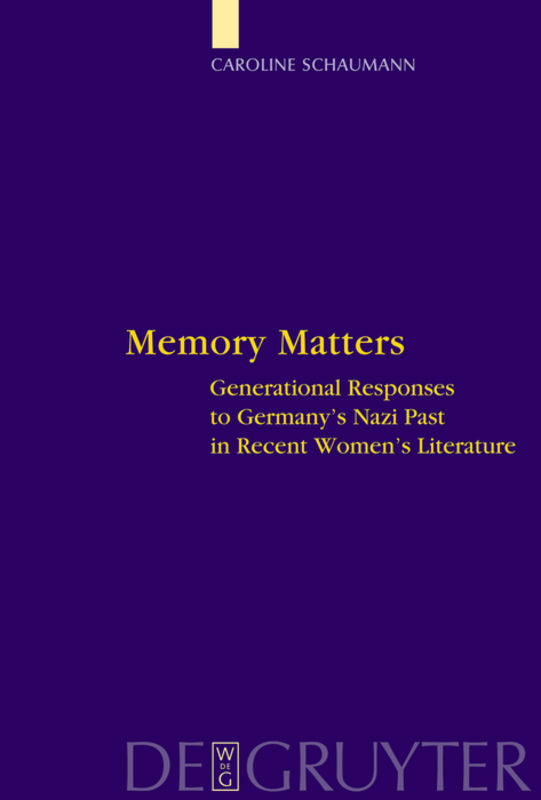
Memory Matters
Generational Responses to Germany's Nazi Past in Recent Women's Literature
De Gruyter · Print & ebook · May 20, 2008
We earn from qualifying purchases.
- Who it’s for
- Caroline Schaumann traces how women’s texts negotiate Germany’s Nazi past across generations and family histories.
- Genres
- German Literary Criticism, Jewish Literary Criticism, Feminist Lit Crit
- Published
- De Gruyter, May 20, 2008
Nearest books
Matched by what the books are about, then ordered by what their readers also loved.
 Worlds ApartBenjamin Paloff61% matchShares Jewish Literary Criticism
 GermanyAndrew I. Port59% match
 People Love Dead JewsDara Horn56% match
 Defying HitlerGordon Thomas, Greg Lewis56% match
 Fear and Other StoriesChana Blankshteyn, Anita Norich55% match
For younger readers: Good-bye Marianne, Questions I Am Asked About the Holocaust, They Went Left
Start with three books, and this one can be the first.
Members get a new edition every morning: a route out from their books to essays, research and talks, with the reason for each.
Join the waitlistAbout this book
Memory Matters juxtaposes in tripartite structure texts by a child of German bystanders (Wolf), an Austrian-Jewish child-survivor (Klüger), a daughter of Jewish émigrés (Honigmann), a daughter of an officer involved in the German resistance (Bruhns), a granddaughter of a baptized Polish Jew (Maron), and a granddaughter of German refuges from East Prussia (Dückers).
Continue reading
Placed outside of the distorting victim-perpetrator, Jewish-German, man-woman, and war-postwar binary, it becomes visible that the texts neither complete nor contradict each other, but respond to one another by means of inspiration, reverberation, refraction, incongruity, and ambiguity. Focusing on genealogies of women, the book delineates a different cultural memory than the counting of (male-inflected) generations and a male-dominated Holocaust and postwar literature canon. It examines intergenerational conflicts and the negotiation of memories against the backdrop of a complicated mother-daughter relationship that follows unpredictable patterns and provokes both discord and empathy. Schaumann’s approach questions the assumption that German-gentile and German-Jewish postwar experiences are necessarily diametrically opposed (i.e. respond to a “negative symbiosis”) and uncovers intersections and continuities in addition to conflicts.
Women’s Memory Lines
Caroline Schaumann traces how women’s texts negotiate Germany’s Nazi past across generations and family histories.
Come here for
- Six writers’ texts placed in conversation across distinct family histories
- Women’s genealogies and mother-daughter memory conflicts
Expect
- Intergenerational conflict, discord, and empathy
- Memory that intersects across German-Jewish and German-gentile experience
Where it sits
| German Literary Criticism | 46% |
|---|---|
| Jewish Literary Criticism | 40% |
| Feminist Lit Crit | 36% |
Percentages are BookFrontier’s reading of the book.
Publisher categories
- Literary Criticism
- German Literary Criticism
- Authors
- Caroline Schaumann, Caroline Jones Mckay
- Publisher
- De Gruyter
- Published
- May 20, 2008
- Format
- Print & ebook
- Reading lane
- Literary Criticism