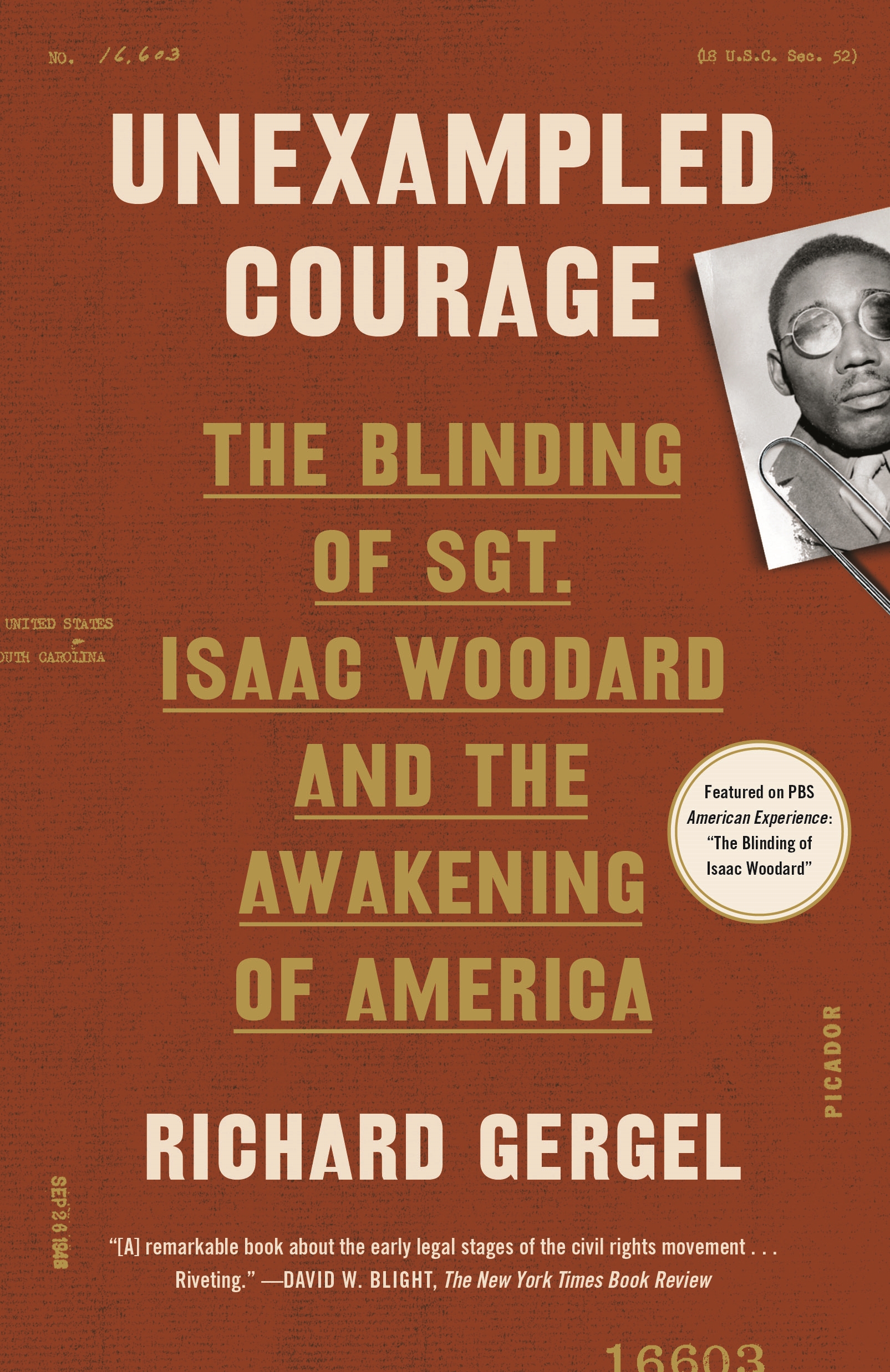
Unexampled Courage
The Blinding of Sgt. Isaac Woodard and the Awakening of America
Trace how one act of racial violence reverberated through presidential action and judicial dissent.
- Themes
- Civil rights history, Racial violence and injustice, Legal challenges to segregation
History in Motion
Come here for
- The connection between Woodard’s case and landmark civil rights decisions
- A close look at Truman’s response and Waring’s changing convictions
Expect
- A focused account of outrage, legal failure, and consequential dissent
- Clear links between one episode and wider civil rights change
Where it sits
How strongly BookFrontier reads the book as belonging to each subject.
Nearest books
Matched by our semantic model. Ordered by what its readers also loved.
 Freedom’s DominionJefferson Cowie50% subject matchShares 20th-Century America
 The Second FoundingEric Foner52% subject matchShares Black History
 Bring the War HomeKathleen Belew49% subject matchShares 20th-Century America
 Devil in the GroveGilbert King55% subject matchShares Black History and Civil Rights
 From the War on Poverty to the War on CrimeElizabeth Hinton47% subject match
 Slavery by Another NameDouglas A. Blackmon49% subject matchShares Black History
 Stony the RoadHenry Louis Gates, Jr.58% subject matchShares Black History
 Parting the WatersTaylor Branch56% subject matchShares 20th-Century America
For younger readers: Stolen Justice: The Struggle for African American Voting Rights, Warriors Don't Cry, Freedom's Children
Start with three books, and this one can be the first.
Members get a new edition every morning: a route out from their books to essays, research and talks, with the reason for each.
Sign upAbout this book
*The book that inspired the 2021 PBS American Experience documentary, The Blinding of Isaac Woodard.*
How the blinding of Sergeant Isaac Woodard changed the course of America’s civil rights history.
Richard Gergel’s Unexampled Courage details the impact of the blinding of Sergeant Woodard on the racial awakening of President Truman and Judge Waring, and traces their influential roles in changing the course of America’s civil rights history.
Continue reading
On February 12, 1946, Sergeant Isaac Woodard, a returning, decorated African American veteran, was removed from a Greyhound bus in Batesburg, South Carolina, after he challenged the bus driver’s disrespectful treatment of him. Woodard, in uniform, was arrested by the local police chief, Lynwood Shull, and beaten and blinded while in custody.
President Harry Truman was outraged by the incident. He established the first presidential commission on civil rights and his Justice Department filed criminal charges against Shull. In July 1948, following his commission’s recommendation, Truman ordered an end to segregation in the U.S. armed forces. An all-white South Carolina jury acquitted Shull, but the presiding judge, J. Waties Waring, was conscience-stricken by the failure of the court system to do justice by the soldier. Waring described the trial as his “baptism of fire,” and began issuing major civil rights decisions from his Charleston courtroom, including his 1951 dissent in Briggs v. Elliott declaring public school segregation per se unconstitutional. Three years later, the Supreme Court adopted Waring’s language and reasoning in Brown v. Board of Education.
Publisher details
Publisher categories
- 20th-Century America
- Civil Rights
- African American Studies
- Authors
- Richard Gergel
- Publisher
- Picador
- Published
- February 18, 2020
- Format
- Print & ebook
- Reading lane
- 20th-Century America