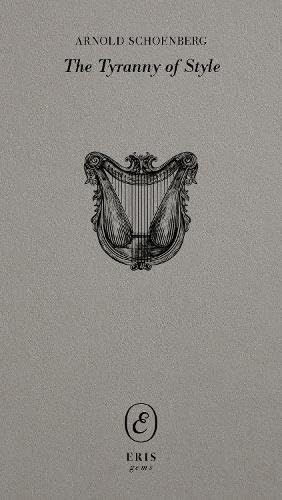
Tyranny of Style
Series: ERIS gems
Schoenberg argues that a composer’s duty is to render textual meaning, not entertain or soothe.
The Composer’s Duty
Come here for
- A composer’s defense of fidelity to the text
- The claim that music should translate meaning with precision
Expect
- An uncompromising argument about music, taste, and truth
- A sharp address on artistic responsibility
Where it sits
- 68%Music History
- 42%Aesthetics
How strongly BookFrontier reads the book as belonging to each subject.
Nearest books
Matched by our semantic model. Ordered by what its readers also loved.
 On Late StyleEdward W. Said48% subject matchShares Music History
 The Birth of TragedyFriedrich Nietzsche, Michael Tanner47% subject matchShares Aesthetics
 Introductory Lectures on AestheticsGeorg Wilhelm Friedrich Hegel, Michael Inwood47% subject matchShares Aesthetics
 Latin Poetry and the Judgement of TasteCharles Martindale47% subject matchShares Aesthetics
 MonstersClaire Dederer46% subject match
 Piano NotesCharles Rosen45% subject matchShares Music History
 Words Without MusicPhilip Glass45% subject match
 Permanent RedJohn Berger44% subject matchShares Aesthetics
For younger readers: Great Composers Coloring Book, Ah, Music!, This Song Is (Not) For You
Start with three books, and this one can be the first.
Members get a new edition every morning: a route out from their books to essays, research and talks, with the reason for each.
Sign upAbout this book
"If it is art, it is not for all, and if it is for all, it is not art."
In this sharp, uncompromising address, he defends the composer’s duty to the text: not to entertain, not to soothe, but to translate meaning with precision and depth. Music, he argues, must obey something higher than taste—something as exacting, and as rare, as truth itself.
Publisher details
Publisher categories
- Film & Video Art
- Italian Literary Criticism
- Music History
- Authors
- Arnold Schoenberg
- Publisher
- Eris
- Published
- November 18, 2025
- Format
- Paperback
- Reading lane
- Film & Video Art