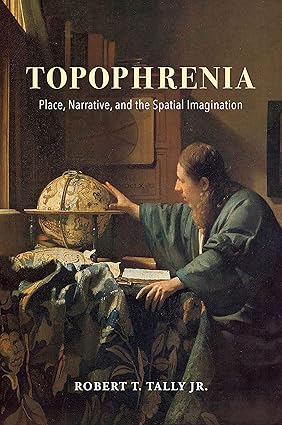
Essays connect literary criticism with mapping, place, and the spatial humanities.
Narrative Maps
Come here for
- Geocriticism and literary cartography explained through literary criticism and theory.
- Narrative maps as ways to understand and imagine the world.
Expect
- The tension between objective space and subjective narrative worlds.
- Topophrenia: place-consciousness alongside disorder, anxiety, and dis-ease.
Where it sits
How strongly BookFrontier reads the book as belonging to each subject.
Nearest books
Matched by our semantic model. Ordered by what its readers also loved.
 Warped SpaceAnthony Vidler63% subject match
 Geography Of NowhereJames Howard Kunstler53% subject match
 Worlds ApartBenjamin Paloff53% subject match
 The Seduction of PlaceJoseph Rykwert52% subject match
 Transpacific ImaginationsYunte Huang52% subject match
 In the Dust of This PlanetEugene Thacker52% subject matchShares Literary Theory
 Giving Voice to StonesBarbara McKean Parmenter52% subject match
 Premodern Ecologies in the Modern Literary ImaginationVin Nardizzi, Tiffany Jo Werth52% subject match
For younger readers: Here, There Be Dragons, If You Lived Here
Start with three books, and this one can be the first.
Members get a new edition every morning: a route out from their books to essays, research and talks, with the reason for each.
Sign upAbout this book
What is our place in the world, and how do we inhabit, understand, and represent this place to others? Topophrenia gathers essays by Robert Tally that explore the relationship between space, place, and mapping, on the one hand, and literary criticism, history, and theory on the other. The book provides an introduction to spatial literary studies, exploring in detail the theory and practice of geocriticism, literary cartography, and the spatial humanities more generally.
Continue reading
The spatial anxiety of disorientation and the need to know one's location, even if only subconsciously, is a deeply felt and shared human experience. Building on Yi Fu Tuan's "topophilia" (or love of place), Tally instead considers the notion of "topophrenia" as a simultaneous sense of place-consciousness coupled with a feeling of disorder, anxiety, and "dis-ease." He argues that no effective geography could be complete without also incorporating an awareness of the lonely, loathsome, or frightening spaces that condition our understanding of that space. Tally considers the tension between the objective ordering of a space and the subjective ways in which narrative worlds are constructed. Narrative maps present a way of understanding that seems realistic but is completely figurative. So how can these maps be used to not only understand the real world but also to put up an alternative vision of what that world might otherwise be? From Tolkien to Cervantes, Borges to More, Topophrenia provides a clear and compelling explanation of how geocriticism, the spatial humanities, and literary cartography help us to narrate, represent, and understand our place in a constantly changing world.
Publisher details
Publisher categories
- Literary Criticism
- Literary Theory
- Books & Reading
- Authors
- Robert T. Tally, Jr.
- Publisher
- Indiana University Press
- Published
- November 9, 2018
- Format
- Print & ebook
- Reading lane
- Literary Criticism