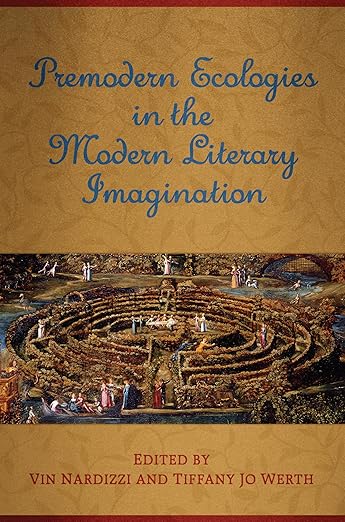
Premodern Ecologies in the Modern Literary Imagination
Essays examine how scholars’ research, writing, and teaching landscapes shape readings of premodern ecologies.
Scholarly Place
Come here for
- Links real environments with their imaginative recreations
- Critical studies of premodern texts, artefacts, and environmental history
Expect
- Consider how scholarly place and time can deepen ecocritical work
- Explore eco-cosmopolitanism’s possibilities and limitations
Where it sits
How strongly BookFrontier reads the book as belonging to each subject.
Nearest books
Matched by our semantic model. Ordered by what its readers also loved. Most of these share its genre: Nature in Literature.
 Postcolonial EcologiesElizabeth DeLoughrey, George H. Handley68% subject match
 Victorian EcocriticismJulie M. Barst, Natalie Rose Cox68% subject match
 Modernism's Inhuman WorldsRasheed Tazudeen65% subject match
 EcoGothicAndrew Smith, William Hughes60% subject match
 Questioning BordersRobin Visser59% subject match
 Climate and CrisesBen Holgate57% subject match
 Landscapes of Writing in Chicano LiteratureI. Martín-Junquera57% subject match
 The Ecological PlotJohn MacNeill Miller56% subject match
Start with three books, and this one can be the first.
Members get a new edition every morning: a route out from their books to essays, research and talks, with the reason for each.
Sign upAbout this book
Premodern Ecologies in the Modern Literary Imagination explores how the cognitive and physical landscapes in which scholars conduct research, write, and teach have shaped their understandings of medieval and Renaissance English literary "oecologies."
The collection strives to practice what Ursula K. Heise calls "eco-cosmopolitanism," a method that imagines forms of local environmentalism as a defense against the interventions of open-market global networks.
Continue reading
It also expands the idea’s possibilities and identifies its limitations through critical studies of premodern texts, artefacts, and environmental history. The essays connect real environments and their imaginative (re)creations and affirm the urgency of reorienting humanity’s responsiveness to, and responsibility for, the historical links between human and non-human existence.
The discussion of ways in which meditation on scholarly place and time can deepen ecocritical work offers an innovative and engaging approach that will appeal to both ecocritics generally and to medieval and early modern scholars.
Publisher details
Publisher categories
- Renaissance Literary Criticism
- 16th-Century Literary Criticism
- 17th-Century Literary Criticism
- Authors
- Vin Nardizzi, Tiffany Jo Werth
- Publisher
- University of Toronto Press
- Published
- April 18, 2019
- Format
- Print & ebook
- Reading lane
- Renaissance Literary Criticism