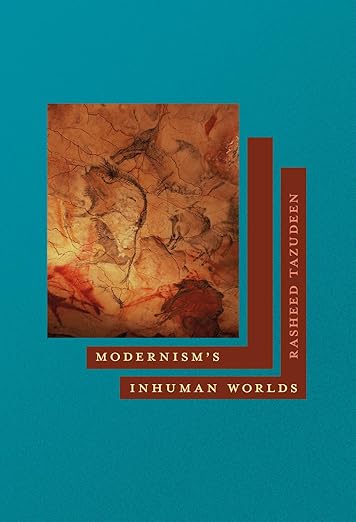
Modernism's Inhuman Worlds
Kindle Edition
Rasheed Tazudeen traces how modernist and metamodernist literature imagines ecological precarity and planetary change.
Inhuman Modernism
Come here for
- Readings spanning Darwin, Carroll, Flaubert, Joyce, Kafka, Woolf, and contemporary poetry
- A focus on soils, forests, oceans, and the earth itself
Expect
- Ecocriticism alongside decolonial, feminist, postcolonial, geographic, and sound studies
- Attention to enigma, riddle, metaphor, and language’s limits
Where it sits
How strongly BookFrontier reads the book as belonging to each subject.
Nearest books
Matched by our semantic model. Ordered by what its readers also loved.
 Premodern Ecologies in the Modern Literary ImaginationVin Nardizzi, Tiffany Jo Werth65% subject matchShares Nature in Literature
 Gothic and ModernismJohn Paul Riquelme58% subject matchShares 20th-Century Literary Criticism
 Modernism: A Very Short IntroductionChristopher Butler57% subject matchShares 20th-Century Literary Criticism
 Homeless Dogs and Melancholy ApesLaura S. Brown57% subject matchShares Nature in Literature
 EcoGothicAndrew Smith, William Hughes57% subject matchShares Nature in Literature
 Prose of the WorldSaikat Majumdar56% subject matchShares 20th-Century Literary Criticism
 Ethnic ModernismWerner Sollors56% subject matchShares 20th-Century Literary Criticism
 When We Are HumanJohn Zerzan55% subject match
For younger readers: Wuftoom, How to Survive the End of the World
Start with three books, and this one can be the first.
Members get a new edition every morning: a route out from their books to essays, research and talks, with the reason for each.
Sign upAbout this book
Modernism's Inhuman Worlds explores the centrality of ecological precarity, species indeterminacy, planetary change, and the specter of extinction to modernist and contemporary metamodernist literatures. Modernist ecologies, Rasheed Tazudeen argues, emerge in response to the enigma of how to imagine inhuman being?including soils, forests, oceans, and the earth itself?through languages and epistemologies that have only ever been humanist.
Continue reading
How might (meta)modernist aesthetics help us to imagine (with) inhuman worlds, including the worlds still to be made on the other side of mass extinction?
Through innovative readings of canonical and emergent modernist and metamodernist works, Tazudeen theorizes inhuman modernism as a call toward further receptivity to the worlds, beings, and relations that tend to go unthought within Western humanist epistemologies. Modernist engagements with the figures of enigma, riddle, and metaphor, according to the book's central argument, offer a means toward what Franz Kafka calls an "otherwise" speaking, based on language's obliqueness to inhuman and planetary being. Drawing on ecocriticism, decolonial and feminist science studies, postcolonial theory, inhuman geography, and sound studies, Tazudeen analyzes an inhuman modernist lineage?spanning from Darwin, Carroll, and Flaubert, through Joyce, Kafka, and Woolf, to contemporary poetic works?as both part of a collaborative rethinking of modernism's planetary and inhuman aesthetics, as well as occasions for imagining new modes of livingness for the extinctions to come.
Publisher details
Publisher categories
- 16th-Century Literary Criticism
- Aesthetics
- History of Science
- Authors
- Rasheed Tazudeen
- Publisher
- Cornell University Press
- Published
- August 15, 2024
- Format
- Ebook
- Reading lane
- 16th-Century Literary Criticism