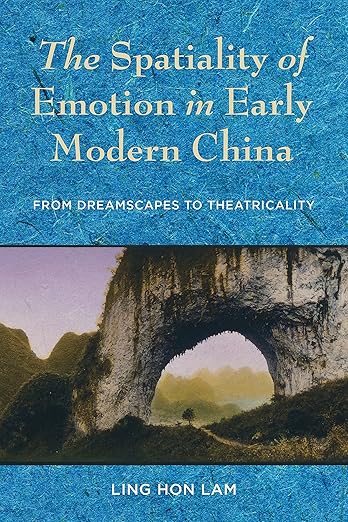
The Spatiality of Emotion in Early Modern China
From Dreamscapes to Theatricality
Columbia University Press · Print & ebook · December 28, 2021
Emotion takes place.
We earn from qualifying purchases.
- Who it’s for
- Ling Hon Lam traces how emotion-realm changed across Chinese literature and culture from dreamscapes to theatricality.
- Genres
- Chinese Literary Criticism, Theater History & Criticism, Comparative Literature
- Published
- Columbia University Press, December 28, 2021
Nearest books
Matched by what the books are about, then ordered by what their readers also loved. Most of these share its genre: Chinese Literary Criticism.
 Translingual PracticeLydia Liu, Lydia H. Liu56% matchAlso shares Comparative Literature
 Changing Stories in the Chinese WorldMark Elvin55% match
 The Stranger and the Chinese Moral ImaginationHaiyan Lee54% match
 Imagining HarmonyPeter Flueckiger52% match
For younger readers: The Emotionary, Along the River, Are You Nobody Too?
Start with three books, and this one can be the first.
Members get a new edition every morning: a route out from their books to essays, research and talks, with the reason for each.
Join the waitlistAbout this book
Emotion takes place. Rather than an interior state of mind in response to the outside world, emotion per se is spatial, at turns embedding us from without, transporting us somewhere else, or putting us ahead of ourselves. In this book, Ling Hon Lam gives a deeply original account of the history of emotions in Chinese literature and culture centered on the idea of emotion as space, which the Chinese call “emotion-realm” (qingjing).
Continue reading
Lam traces how the emotion-realm underwent significant transformations from the dreamscape to theatricality in sixteenth- to eighteenth-century China. Whereas medieval dreamscapes delivered the subject into one illusory mood after another, early modern theatricality turned the dreamer into a spectator who is no longer falling through endless oneiric layers but pausing in front of the dream. Through the lens of this genealogy of emotion-realms, Lam remaps the Chinese histories of morals, theater, and knowledge production, which converge at the emergence of sympathy, redefined as the dissonance among the dimensions of the emotion-realm pertaining to theatricality.The book challenges the conventional reading of Chinese literature as premised on interior subjectivity, examines historical changes in the spatial logic of performance through media and theater archaeologies, and ultimately uncovers the different trajectories that brought China and the West to the convergence point of theatricality marked by self-deception and mutual misreading. A major rethinking of key terms in Chinese culture from a comparative perspective, The Spatiality of Emotion in Early Modern China develops a new critical vocabulary to conceptualize history and existence.
Emotion-Realm in China
Ling Hon Lam traces how emotion-realm changed across Chinese literature and culture from dreamscapes to theatricality.
Come here for
- The shift from medieval dreamscapes to early modern theatricality
- A comparative account of emotion, sympathy, morals, and performance
Expect
- A history spanning sixteenth- to eighteenth-century China
- An account of theatricality, sympathy, and changing ideas of emotion
Where it sits
| Chinese Literary Criticism | 95% |
|---|---|
| Comparative Literature | 37% |
| Theater History & Criticism | 35% |
Percentages are BookFrontier’s reading of the book.
Publisher categories
- Literary Theory
- Chinese Literary Criticism
- 16th-Century Literary Criticism
- 17th-Century Literary Criticism
Show all 5 publisher categories
- 18th Century Literature
- Authors
- Ling Hon Lam
- Publisher
- Columbia University Press
- Published
- December 28, 2021
- Format
- Print & ebook
- Reading lane
- Literary Theory