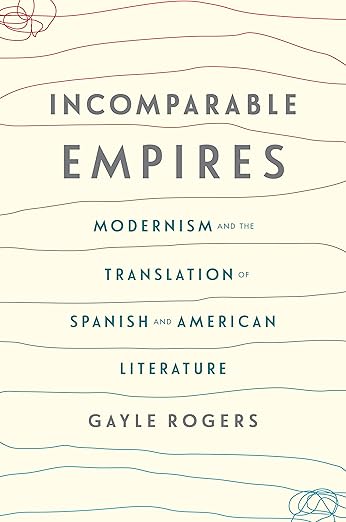
Incomparable Empires
Modernism and the Translation of Spanish and American Literature
Series: Modernist Latitudes
Gayle Rogers traces how empire and translation shaped modernism across American and Spanish literary histories.
Empire and Modernism
Come here for
- Networks linking American and Spanish writers, translators, and literary movements
- Readings of Pound, Jiménez, Dos Passos, and Hemingway
Expect
- Comparative literary history from universities to Harlem–Havana–Madrid
- Textual analyses of Hemingway’s cubist Spanglish and Jiménez’s multilingual maps
Where it sits
How strongly BookFrontier reads the book as belonging to each subject.
Nearest books
Matched by our semantic model. Ordered by what its readers also loved.
 The Twentieth-Century Spanish American NovelRaymond Leslie Williams73% subject matchShares 20th-Century Literary Criticism
 Translating EmpireLaura Lomas73% subject match
 Modernismo, Modernity and the Development of Spanish American LiteratureCathy L. Jrade71% subject match
 Gender and Nation in the Spanish Modernist NovelRoberta Johnson68% subject matchShares Iberian Lit Crit
 Ethnic ModernismWerner Sollors66% subject matchShares 20th-Century Literary Criticism
 Twentieth-Century Spanish American FictionNaomi Lindstrom66% subject matchShares 20th-Century Literary Criticism
 Erotic MysticismNancy LaGreca65% subject match
 Early Spanish American NarrativeNaomi Lindstrom65% subject match
For younger readers: A Young People's History of the United States, Volume 1
Start with three books, and this one can be the first.
Members get a new edition every morning: a route out from their books to essays, research and talks, with the reason for each.
Sign upAbout this book
The Spanish-American War of 1898 seems to mark a turning point in both geopolitical and literary histories. The victorious American empire ascended and began its cultural domination of the globe in the twentieth century, while the once-mighty Spanish empire declined and became a minor state in the world republic of letters.
Continue reading
But what if this narrative relies on several faulty assumptions, and what if key modernist figures in both America and Spain radically rewrote these histories at a foundational moment of modern literary studies?
Following networks of American and Spanish writers, translators, and movements, Gayle Rogers uncovers the arguments that forged the politics and aesthetics of modernism. He revisits the role of empire—from its institutions to its cognitive effects—in shaping a nation's literature and culture. Ranging from universities to comparative practices, from Ezra Pound's failed ambitions as a Hispanist to Juan Ramón Jiménez's multilingual maps of modernismo, Rogers illuminates modernists' profound engagements with the formative dynamics of exceptionalist American and Spanish literary studies. He reads the provocative, often counterintuitive arguments of John Dos Passos, who held that "American literature" could only flourish if the expanding U.S. empire collapsed like Spain's did. And he also details both a controversial theorization of a Harlem–Havana–Madrid nexus for black modernist writing and Ernest Hemingway's unorthodox development of a version of cubist Spanglish in For Whom the Bell Tolls. Bringing together revisionary literary historiography and rich textual analyses, Rogers offers a striking account of why foreign literatures mattered so much to two dramatically changing countries at a pivotal moment in history.
Publisher details
Publisher categories
- Translating & Interpreting
- Hispanic American Lit Crit
- Iberian Lit Crit
- Authors
- Gayle Rogers
- Publisher
- Columbia University Press
- Published
- November 1, 2016
- Format
- Print & ebook
- Reading lane
- Translating & Interpreting