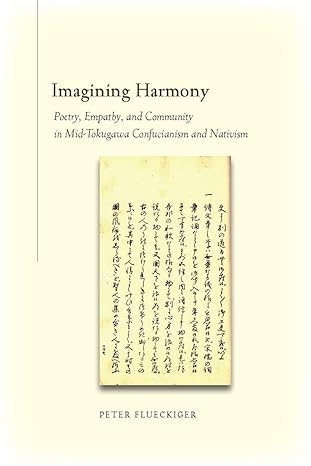
Imagining Harmony
Poetry, Empathy, and Community in Mid-tokugawa Confucianism and Nativism
Peter Flueckiger traces how poetry, emotion, and political thought intersected in eighteenth-century Japan.
Sorai and Poetry
Come here for
- Ogyu Sorai’s literary thought and its political dimensions
- Classical Chinese and Japanese poetry as models for social harmony
Expect
- A study of Sorai, his key disciples, and critics
- An account of poetry’s role in ideas about government and social harmony
Where it sits
How strongly BookFrontier reads the book as belonging to each subject.
Nearest books
Matched by our semantic model. Ordered by what its readers also loved. Most of these share its genre: Japanese History.
 The Textual TownsmanThomas Gaubatz57% subject matchAlso shares Japanese Literary Criticism
 Engaging Japanese PhilosophyThomas P. Kasulis56% subject match
 Translingual PracticeLydia H. Liu55% subject match
For younger readers: Go
Start with three books, and this one can be the first.
Members get a new edition every morning: a route out from their books to essays, research and talks, with the reason for each.
Sign upAbout this book
Many intellectuals in eighteenth-century Japan valued classical poetry in either Chinese or Japanese for its expression of unadulterated human sentiments. They also saw such poetry as a distillation of the language and aesthetic values of ancient China and Japan, which offered models of the good government and social harmony lacking in their time.
Continue reading
By studying the poetry of the past and composing new poetry emulating its style, they believed it possible to reform their own society. Imagining Harmony focuses on the development of these ideas in the life and work of Ogyu Sorai, the most influential Confucian philosopher of the eighteenth century, and that of his key disciples and critics.
This study contends that the literary thought of these figures needs to be understood not just for what it has to say about the composition of poetry but as a form of political and philosophical discourse. Unlike other scholars of this literature, Peter Flueckiger argues that the increased valorization of human emotions in eighteenth-century literary thought went hand in hand with new demands for how emotions were to be regulated and socialized, and that literary and political thought of the time were thus not at odds but inextricably linked.
Publisher details
Publisher categories
- Japanese Literary Criticism
- Authors
- Peter Flueckiger
- Publisher
- Stanford University Press
- Published
- October 19, 2010
- Format
- Print & ebook
- Reading lane
- Japanese Literary Criticism