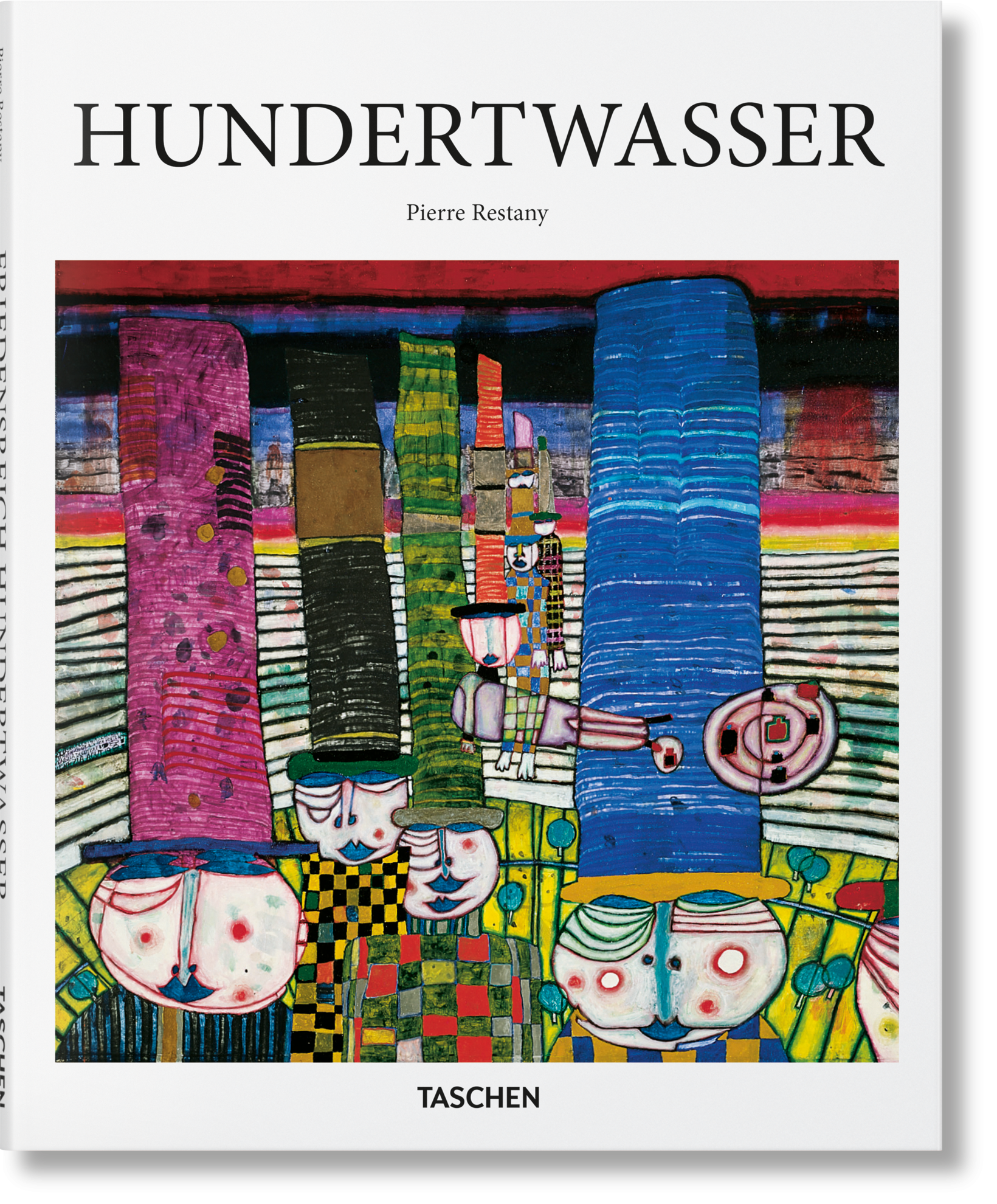
Hundertwasser
Explore Hundertwasser’s distinctive style alongside his architectural projects and ideas for society.
- Themes
- Hundertwasser’s artistic style, Ecological architecture, Critique of modernist design
Hundertwasser’s Architecture
Come here for
- Hundertwasser’s buildings, paintings, manifestos, and social initiatives
- His ecological commitments and rejection of straight-line architecture
Expect
- Vivid color, organic forms, and a fascination with spirals
- A richly illustrated account of his buildings and social vision
Where it sits
How strongly BookFrontier reads the book as belonging to each subject.
Nearest books
Matched by our semantic model. Ordered by what its readers also loved.
 From Bauhaus to Our HouseTom Wolfe53% subject match
 Makers of Modern ArchitectureMartin Filler52% subject match
 Gerhard RichterDieter Schwarz, Nicholas Serota51% subject matchShares Artist Monographs
 Aesthetic DilemmasMarlo Alexandra Burks50% subject match
 Form Follows LoveAnna Heringer, Dominique Gauzin-Müller49% subject matchShares Architect Monographs and Sustainable & Green Design
 Richard Rogers on Modern ArchitectureRichard Rogers49% subject match
 Gerhard RichterBenjamin H. D. Buchloh49% subject matchShares Artist Monographs
 How Architecture WorksWitold Rybczynski48% subject match
For younger readers: If You Lived Here, The Noisy Paint Box: The Colors and Sounds of Kandinsky's Abstract Art, Wall to Wall
Start with three books, and this one can be the first.
Members get a new edition every morning: a route out from their books to essays, research and talks, with the reason for each.
Sign upAbout this book
Vivid color, organic forms, and a loathing of straight lines were just a few stalwart characteristics in the unique practice of Friedensreich Hundertwasser (1928–2000). A non-conformist hero, the artist, architect, and activist left a blazing trail of imagination and ideas in buildings, paintings, manifestos, initiatives, and more.
Continue reading
Hundertwasser’s best-known work is considered by many to be the Hundertwasserhaus in Vienna, a structural synthesis of the vitality and uniqueness that determined the artist’s entire oeuvre. For Hundertwasser, rational, sterile, monotonous buildings caused human misery. He called for a boycott of the modernist paradigm championed by the likes of Adolf Loos, and campaigned instead for an architecture of creative freedom and ecological commitment. A fierce opponent of straight lines, which he called “godless and immoral,” Hundertwasser was fascinated by the spiral, drawing also on the Secessionist forms of Klimt and Schiele. This richly illustrated book traces Hundertwasser’s style and vision not only for each building, but for society at large. From naked addresses at the end of the 1960s to worldwide architecture projects and alternative blueprints for society, author Pierre Restany explores Hundertwasser’s most high-profile and innovative ideas in a thrilling introduction to a pioneering 20th-century mind.
Publisher details
Publisher categories
- Contemporary Architecture (1945-)
- Architect Monographs
- Contemporary Art History (1945-)
- Artist Monographs
- Authors
- Pierre Restany
- Publisher
- TASCHEN
- Published
- July 19, 2018
- Format
- Hardcover
- Reading lane
- Contemporary Architecture (1945-)