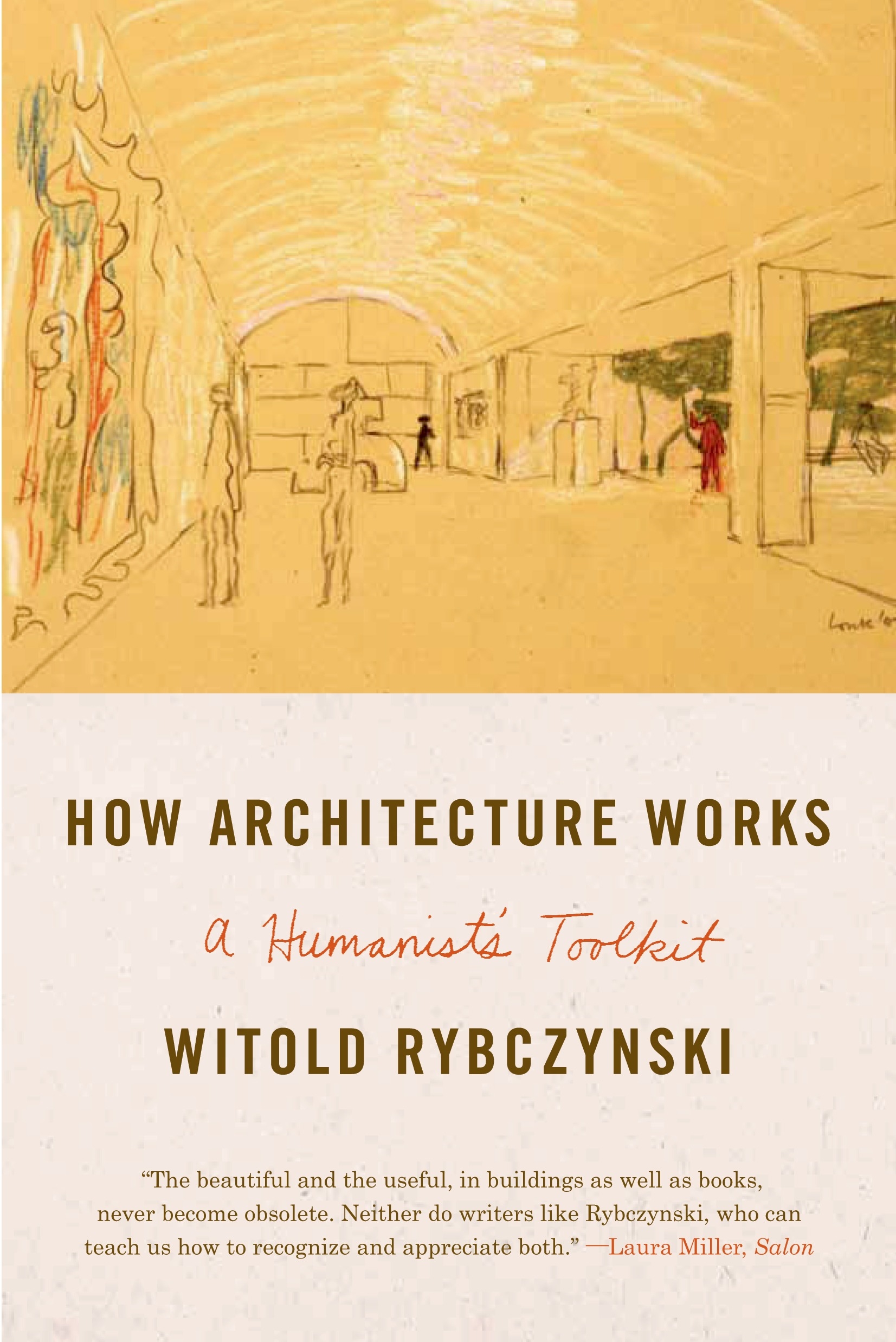
How Architecture Works
A Humanist's Toolkit
A clear-eyed guide to seeing architecture as both public art and part of everyday life.
- Themes
- Architecture and the built environment, Building design, Reading plans and buildings
Reading Buildings
Come here for
- Learning how to read plans and notice what details reveal
- Seeing how buildings respond to their settings
Expect
- A humanist’s toolkit for thinking about the built environment
- Examples ranging from memorials to museums and private retreats
Where it sits
How strongly BookFrontier reads the book as belonging to each subject.
Nearest books
Matched by our semantic model. Ordered by what its readers also loved.
 Home StoriesKim Leggett50% subject match
 You Say to BrickWendy Lesser57% subject match
 A Paradise of Small HousesMax Podemski59% subject matchShares Urban & Land Use Planning
 A Field Guide to American HousesVirginia Savage McAlester59% subject match
 Makers of Modern ArchitectureMartin Filler73% subject matchShares Why Buildings Look That Way
 Why on Earth Would Anyone Build ThatJohn Zukowsky70% subject matchShares Why Buildings Look That Way
 How Buildings LearnStewart Brand70% subject matchShares Architecture and Urban & Land Use Planning
 The Edifice ComplexDeyan Sudjic69% subject matchShares Why Buildings Look That Way
For younger readers: Mosque, Cathedral, If You Lived Here
Start with three books, and this one can be the first.
Members get a new edition every morning: a route out from their books to essays, research and talks, with the reason for each.
Sign upAbout this book
An essential toolkit for understanding architecture as both art form and the setting for our everyday lives
We spend most of our days and nights in buildings, living and working and sometimes playing. Architecture is both the setting for our everyday lives and a public art form—but it remains mysterious to most of us.
Continue reading
In How Architecture Works, Witold Rybczynski, one of our best, most stylish critics and the winner of the Vincent Scully Prize for his writing on architecture, answers our most fundamental questions about how good—and not so good—buildings are designed and constructed. Introducing the reader to the rich and varied world of modern architecture, he reveals how architects as diverse as Frank Gehry, Renzo Piano, and Robert A. M. Stern envision and create their designs. He teaches us how to "read" plans, how buildings respond to their settings, and how the smallest detail—of a stair balustrade, for instance—can convey an architect's vision. How Architecture Works explains the central elements that make up good building design, ranging from a war memorial in London to an opera house in Saint Petersburg, from the National Museum of African American History and Culture in Washington, D.C., to a famous architect's private retreat in Princeton, New Jersey. It is an enlightening humanist's toolkit for thinking about the built environment and seeing it afresh.
"Architecture, if it is any good, speaks to all of us," Rybczynski writes. This revelatory book is his grand tour of architecture today.
Publisher details
Publisher categories
- Why Buildings Look That Way
- Contemporary Architecture (1945-)
- Authors
- Witold Rybczynski
- Publisher
- Farrar Straus & Giroux
- Published
- October 7, 2014
- Format
- Print & ebook
- Reading lane
- Why Buildings Look That Way