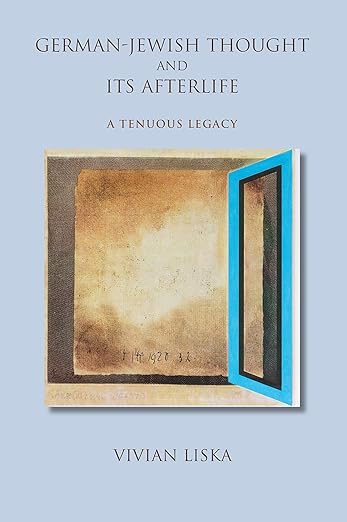
Vivian Liska traces Jewish traditions through German-Jewish writing and their transformations in later theory.
Jewish Traditions
Come here for
- Messianism, law, exile, election, and remembrance across three intellectual periods
- Kafka, Benjamin, Scholem, Arendt, and Celan in dialogue and reception
Expect
- Attention to tradition’s changing form, fate, and function
- Discussion of Blanchot, Derrida, Agamben, Žižek, and Badiou
Where it sits
How strongly BookFrontier reads the book as belonging to each subject.
Nearest books
Matched by our semantic model. Ordered by what its readers also loved.
 Kafka's Jewish LanguagesDavid Suchoff70% subject matchShares Jewish Literary Criticism and German Literary Criticism
 Recovering JewishnessFrederick S. Roden62% subject match
 Memory MattersCaroline Schaumann61% subject matchShares Jewish Literary Criticism and German Literary Criticism
 The Blessing and the CurseAdam Kirsch60% subject matchShares Jewish Literary Criticism
 Women of the WordJudith R. Baskin60% subject matchShares Jewish Literary Criticism
 Walter BenjaminDavid S. Ferris60% subject matchShares German Literary Criticism and Literary Theory
 Modern Orthodox JudaismMenachem-Martin Gordon58% subject match
 Kafka's ClothesMark M. Anderson58% subject matchShares German Literary Criticism
For younger readers: What Jewish Looks Like, I Have Lived a Thousand Years, Man's Search for Meaning: Young Adult Edition
Start with three books, and this one can be the first.
Members get a new edition every morning: a route out from their books to essays, research and talks, with the reason for each.
Sign upAbout this book
In German-Jewish Thought and Its Afterlife, Vivian Liska innovatively focuses on the changing form, fate and function of messianism, law, exile, election, remembrance, and the transmission of tradition itself in three different temporal and intellectual frameworks: German-Jewish modernism, postmodernism, and the current period.
Continue reading
Highlighting these elements of the Jewish tradition in the works of Franz Kafka, Walter Benjamin, Gershom Scholem, Hannah Arendt, and Paul Celan, Liska reflects on dialogues and conversations between them and on the reception of their work. She shows how this Jewish dimension of their writings is transformed, but remains significant in the theories of Maurice Blanchot and Jacques Derrida and how it is appropriated, dismissed or denied by some of the most acclaimed thinkers at the turn of the twenty-first century such as Giorgio Agamben, Slavoj ?i?ek, and Alain Badiou.
Publisher details
Publisher categories
- German Literary Criticism
- Religion & Philosophy
- Authors
- Vivian Liska
- Publisher
- Indiana University Press
- Published
- December 19, 2016
- Format
- Print & ebook
- Reading lane
- German Literary Criticism