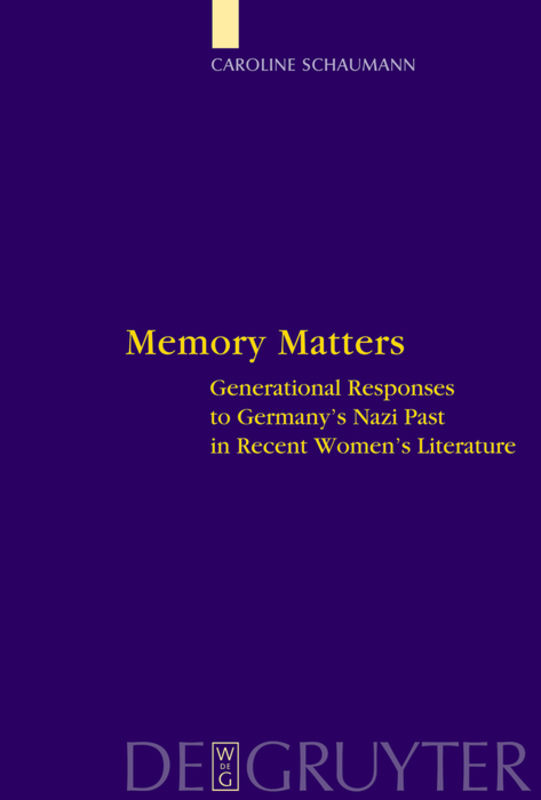
Memory Matters
Generational Responses to Germany's Nazi Past in Recent Women's Literature
Series: ISSN
Caroline Schaumann traces how women’s texts negotiate Germany’s Nazi past across generations and family histories.
Women’s Memory Lines
Come here for
- Six writers’ texts placed in conversation across distinct family histories
- Women’s genealogies and mother-daughter memory conflicts
Expect
- Intergenerational conflict, discord, and empathy
- Memory that intersects across German-Jewish and German-gentile experience
Where it sits
How strongly BookFrontier reads the book as belonging to each subject.
Nearest books
Matched by our semantic model. Ordered by what its readers also loved.
 Those Who Save UsJenna Blum62% subject match
 Worlds ApartBenjamin Paloff61% subject matchShares Jewish Literary Criticism
 The Nazi Officer's WifeBeer, Edith H., Dworkin, Susan60% subject match
 GermanyAndrew I. Port59% subject match
 All But My LifeGerda Weissmann Klein56% subject match
 People Love Dead JewsDara Horn56% subject match
For younger readers: Good-bye Marianne, Questions I Am Asked About The Holocaust, They Went Left
Start with three books, and this one can be the first.
Members get a new edition every morning: a route out from their books to essays, research and talks, with the reason for each.
Sign upAbout this book
Memory Matters juxtaposes in tripartite structure texts by a child of German bystanders (Wolf), an Austrian-Jewish child-survivor (Klüger), a daughter of Jewish émigrés (Honigmann), a daughter of an officer involved in the German resistance (Bruhns), a granddaughter of a baptized Polish Jew (Maron), and a granddaughter of German refuges from East Prussia (Dückers).
Continue reading
Placed outside of the distorting victim-perpetrator, Jewish-German, man-woman, and war-postwar binary, it becomes visible that the texts neither complete nor contradict each other, but respond to one another by means of inspiration, reverberation, refraction, incongruity, and ambiguity. Focusing on genealogies of women, the book delineates a different cultural memory than the counting of (male-inflected) generations and a male-dominated Holocaust and postwar literature canon. It examines intergenerational conflicts and the negotiation of memories against the backdrop of a complicated mother-daughter relationship that follows unpredictable patterns and provokes both discord and empathy. Schaumann’s approach questions the assumption that German-gentile and German-Jewish postwar experiences are necessarily diametrically opposed (i.e. respond to a “negative symbiosis”) and uncovers intersections and continuities in addition to conflicts.
Publisher details
Publisher categories
- Literary Criticism
- German Literary Criticism
- Authors
- Caroline Schaumann
- Publisher
- De Gruyter
- Published
- May 20, 2008
- Format
- Print & ebook
- Reading lane
- Literary Criticism