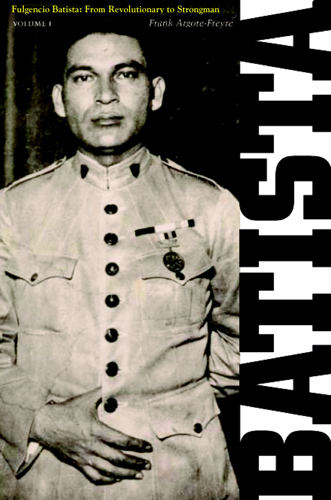
Fulgencio Batista
The Making of a Dictator
Trace Batista’s rise through Cuba’s Republican period, from revolutionary leader to strongman.
Batista’s Republican Years
Come here for
- Batista’s revolutionary leadership from 1933 to 1934
- His strongman image between 1934 and 1939
Expect
- A portrait of Batista’s strengths, weaknesses, accomplishments, and failures
- Cuba’s Republican period, usually neglected by scholars
Where it sits
How strongly BookFrontier reads the book as belonging to each subject.
Nearest books
Matched by our semantic model. Ordered by what its readers also loved. Most of these share its genre: Cuban History.
 Mussolini's ItalyR. J. B. Bosworth44% subject match
 SaddamCon Coughlin46% subject matchAlso shares Political Lives
 The Origins of the Cuban Revolution ReconsideredSamuel Farber72% subject match
 Cuba's Revolutionary WorldJonathan C. Brown69% subject match
 Fidel Castro: My LifeIgnacio Ramonet, Fidel Castro68% subject matchAlso shares Political Lives and Presidents & World Leaders
 Cuba Libre!Tony Perrottet68% subject match
 Visions of Power in CubaLillian Guerra65% subject match
 CubaLightning Guides65% subject match
For younger readers: Leaving Glorytown, How to Say Goodbye in Cuban, Strongman
Start with three books, and this one can be the first.
Members get a new edition every morning: a route out from their books to essays, research and talks, with the reason for each.
Sign upAbout this book
Pawn of the U.S. government. Right-hand man to the mob. Iron-fisted dictator. For decades, public understanding of the pre-Revolutionary Cuban dictator Fulgencio Batista has been limited to these stereotypes. While on some level they all contain an element of truth, these superficial characterizations barely scratch the surface of the complex and compelling career of this important political figure.
Continue reading
Second only to Fidel Castro, Batista is the most controversial leader in modern Cuban history. And yet, until now, there has been no objective biography written about him. Existing biographical literature is predominantly polemical and either borders on hero worship or launches a series of attacks aimed at denigrating his entire legacy.
In this book, the first of two volumes, Frank Argote-Freyre provides a full and balanced portrait of this historically shadowed figure. He describes Batista's rise to power as part of a revolutionary movement and the intrigues and dangers that surrounded him. Drawing on an extensive review of Cuban newspapers, government records, memos, oral history interviews, and a selection of Batista's personal documents, Argote-Freyre moves beyond simplistic caricatures to uncover the real man-one with strengths and weaknesses and with a career marked by accomplishments as well as failures.
This volume focuses on Batista's role as a revolutionary leader from 1933 to 1934 and his image as a "strongman" in the years between 1934 and 1939. Argote-Freyre also uses Batista as an interpretive prism to review an entire era that is usually ignored by scholars-the Republican period of Cuban history. Bringing together global and local events, he considers the significance and relationship of the worldwide economic depression, the beginnings of World War II, and in Cuba, the Revolution of 1933, the expansion of the middle class, and the gradual development of democratic institutions.
Fulgencio Batista and most of Cuba's past prior to the Revolution of 1959 has been lost in the historical mists. Cuba had a rich and fascinating history before the Marxist Revolution and the reign of Fidel Castro. This captivating and long-overdue book uncovers it.
Publisher details
Publisher categories
- Biography & Memoir
- Hispanic American Studies
- Authors
- Frank Argote-Freyre
- Publisher
- Rutgers University Press
- Published
- April 21, 2006
- Format
- Print & ebook
- Reading lane
- Biography & Memoir