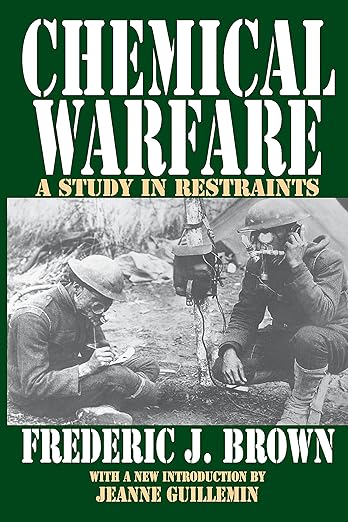
Chemical Warfare
1st Edition, Kindle Edition
Trace how political, military, and technological restraints shaped chemical weapons policy across world wars.
Chemical Policy
Come here for
- World War I's influence on later chemical weapons policy
- Interwar political, military, economic, and psychological restraints
Expect
- American policy shaped by industry, public sentiment, and national and military leaders
- World War II examined across 1939–early 1942 and 1945
Where it sits
How strongly BookFrontier reads the book as belonging to each subject.
Nearest books
Matched by our semantic model. Ordered by what its readers also loved. Most of these share its genre: Chemical & Biological Warfare.
 A History of Chemical WarfareK. Coleman78% subject matchAlso shares World War I History
 The Poisonous CloudL. F. Haber78% subject matchAlso shares World War I History
 War of NervesJonathan Tucker76% subject match
 The A to Z of Nuclear, Biological and Chemical WarfareBenjamin C. Garrett, John Mason Hart73% subject matchAlso shares Nuclear Warfare
 Chemical WeaponryEdward M. Spiers72% subject match
 Holding Their BreathMarion Girard Dorsey71% subject match
 A Higher Form of KillingRobert Harris, Jeremy Paxman70% subject matchAlso shares World War I History
 Chemical WarfareEdward M. Spiers70% subject match
For younger readers: Bomb, What Was World War I?, The War to End All Wars
Start with three books, and this one can be the first.
Members get a new edition every morning: a route out from their books to essays, research and talks, with the reason for each.
Sign upAbout this book
In the aftermath of 9/11, the potential terror of weapons of mass destruction--from nuclear, biological, and chemical to dirty bombs--preoccupies national security experts. In Chemical Warfare, Frederic J. Brown, presents a cogent, innovative framework for understanding the historical forces that have restrained the use of WMD and how they continue to have relevance today.
Continue reading
Analyzing both world wars, he argues that the restraints on use were complex and often unpredictable and ranged from the political to the technological.
The author offers a detailed examination of American chemical warfare policy as it was shaped by industry and public sentiment, as well as national and military leaders. The organization of the book into three parts reflects the importance of battlefield experiences during the First World War and of international political restraints as they evolved during the interwar years and culminated in "no first use" policies by major powers in World War II. Part I examines the use of chemical weapons in World War I as it influenced subsequent national policy decisions. Part II focuses on the evolution of political, military, economic, and psychological restraints from 1919 to 1939. Part III discusses World War II during two critical periods: 1939 to early 1942, when the environment of the war was being established largely without American influence; and during 1945, when the United States faced no credible threat of retaliation to deter its strategic and battlefield use of chemical weapons. Written at the height of controversy about the U.S. use of chemicals in Vietnam, Chemical Warfare offers a valuable historical perspective, as relevant now in its analysis of chemical and also nuclear policy as it was when first published.
Publisher details
Publisher categories
- Military Strategy
- 20th-Century America
- Authors
- Brown, Fredric
- Publisher
- Transaction Publishers
- Published
- November 17, 2005
- Format
- Ebook
- Reading lane
- Military Strategy