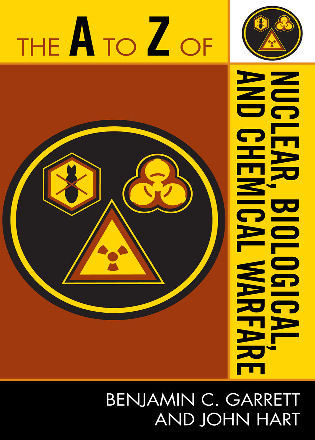
The A to Z of Nuclear, Biological and Chemical Warfare
1st Edition, Kindle Edition
A reference to NBC weapons’ development and use, alongside efforts to limit or control them.
NBC Warfare Reference
Come here for
- Dictionary entries on NBC weapons, historical incidents, and key figures
- Coverage of countries, treaties, and treaty-related organizations
Expect
- More than 500 cross-referenced entries, plus a chronology and introductory essay
- A bibliography and entries spanning substances, events, people, countries, and treaties
Where it sits
How strongly BookFrontier reads the book as belonging to each subject.
Nearest books
Matched by our semantic model. Ordered by what its readers also loved. Most of these share its genre: Chemical & Biological Warfare.
 Chemical WarfareBrown, Fredric73% subject matchAlso shares Nuclear Warfare
 The Gathering Biological Warfare StormJim A. Davis, Barry R. Schneider70% subject match
 Plague MakersWendy Barnaby70% subject match
 War of NervesJonathan Tucker68% subject matchAlso shares Arms Control & Security
 A Higher Form of KillingRobert Harris, Jeremy Paxman67% subject match
 A History of Chemical WarfareK. Coleman65% subject matchAlso shares Arms Control & Security
 Biological WeaponsJeanne Guillemin64% subject matchAlso shares Arms Control & Security
For younger readers: Bomb, What Was World War I?, Never Silent
Start with three books, and this one can be the first.
Members get a new edition every morning: a route out from their books to essays, research and talks, with the reason for each.
Sign upAbout this book
Human experience with nuclear, biological, and chemical (NBC) warfare has been limited, especially in comparison to conventional forms of warfare. Our experience with nuclear warfare is confined to a period of less than one week during the end of World War II, when the United States successfully used two nuclear weapons against targets in Japan.
Continue reading
The course of biological warfare and modern use of biological weapons are difficult to track owing to the difficulty of differentiating deliberate use from natural outbreaks. However, the keen potential of biological weapons in acts of terror was shown in the mass disruption caused in the fall 2001 experience in the U.S. with the release of anthrax through the American postal system. Chemical weapons have been used in a handful of conflicts since their introduction to modern warfare during World War I, most recently during the Iran-Iraq War during the 1980s. Despite this limited experience, NBC warfare continues to exert a certain fascination among states.The A to Z of Nuclear, Biological, and Chemical Warfarecovers the development and use of NBC weapons as well as efforts to limit or control the use of these weapons through a chronology, a bibliography, an introductory essay, and dictionary entries. Over 500 cross-referenced dictionary entries provide a unique selection of terms related to NBC warfare, ranging from basic descriptions of substances used in NBC warfare to details on incidents and episodes where NBC weapons were used. Entries are structured around historical events, persons important to NBC warfare, countries where such weapons have been developed or used, and international treaties and treaty-related organizations.
Publisher details
Publisher categories
- History
- Authors
- Benjamin C. Garrett, John Mason Hart
- Publisher
- Bloomsbury Academic
- Published
- September 16, 2009
- Format
- Ebook
- Reading lane
- History