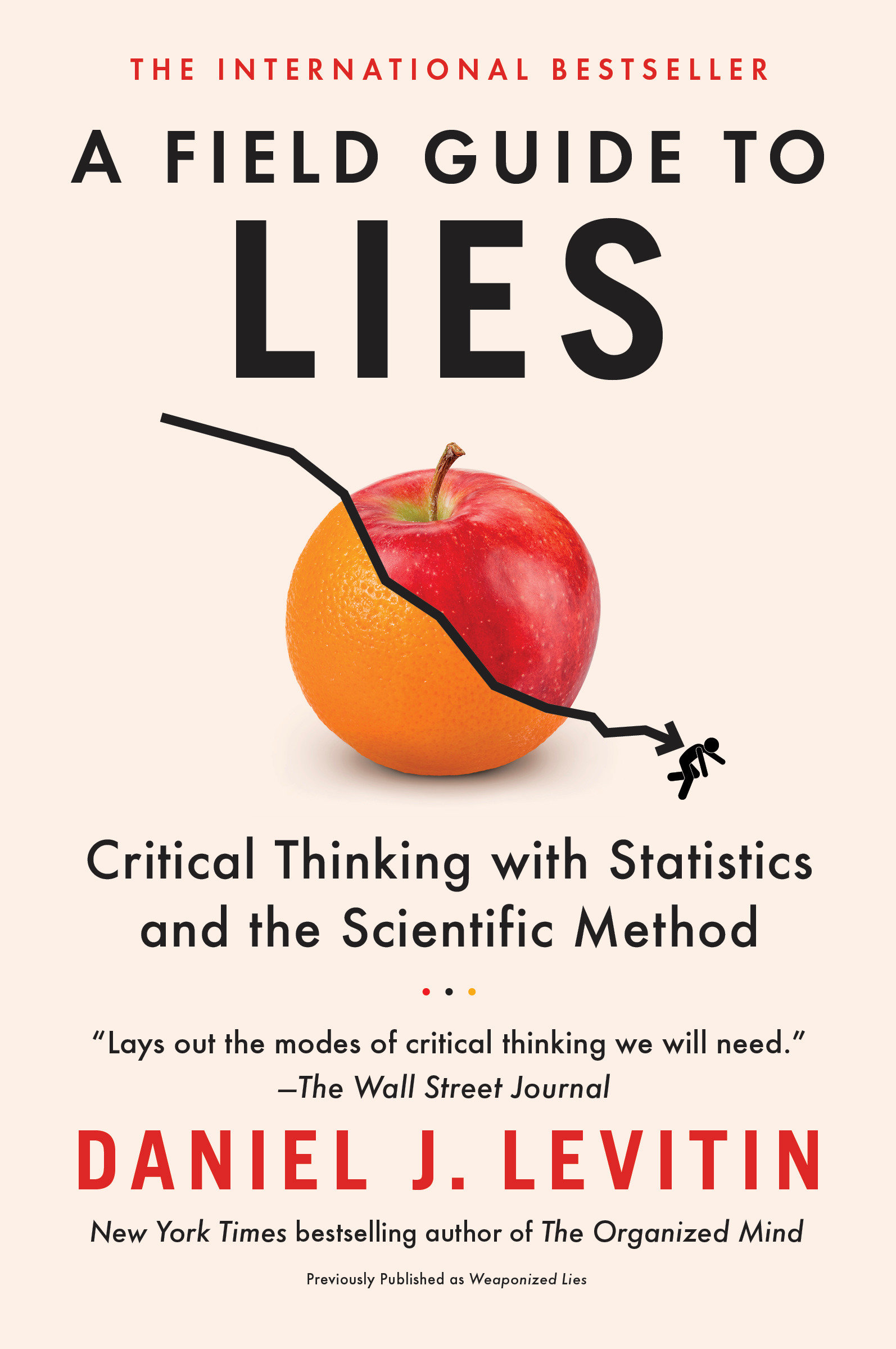
A Field Guide to Lies
Critical Thinking with Statistics and the Scientific Method
A practical guide to spotting how statistics, graphs, and arguments can mislead.
- Themes
- Critical thinking, Evaluating statistics and arguments, Information literacy
Read Between the Numbers
Come here for
- A sharper eye for dubious claims and data
- Critical thinking grounded in science
Expect
- Examples spanning statistics and faulty arguments
- A middle path between gullibility and cynicism
Where it sits
How strongly BookFrontier reads the book as belonging to each subject.
Nearest books
Matched by our semantic model. Ordered by what its readers also loved.
 Weapons of Math DestructionCathy O'Neil56% subject match
 Calling BullshitCarl T. Bergstrom, Jevin D. West69% subject match
 How Not to Be WrongJordan Ellenberg61% subject match
For younger readers: Big Lies, What the Fact?, Maybe Yes, Maybe No
Start with three books, and this one can be the first.
Members get a new edition every morning: a route out from their books to essays, research and talks, with the reason for each.
Sign upAbout this book
Winner of the National Business Book Award
From the New York Times bestselling author of The Organized Mind and This Is Your Brain on Music, a primer to the critical thinking that is more necessary now than ever
We are bombarded with more information each day than our brains can process—especially in election season. It's raining bad data, half-truths, and even outright lies.
Continue reading
New York Times bestselling author Daniel J. Levitin shows how to recognize misleading announcements, statistics, graphs, and written reports, revealing the ways lying weasels can use them.
It's becoming harder to separate the wheat from the digital chaff. How do we distinguish misinformation, pseudo-facts, and distortions from reliable information? Levitin groups his field guide into two categories—statistical information and faulty arguments—ultimately showing how science is the bedrock of critical thinking. Infoliteracy means understanding that there are hierarchies of source quality and bias that variously distort our information feeds via every media channel, including social media. We may expect newspapers, bloggers, the government, and Wikipedia to be factually and logically correct, but they so often aren't. We need to think critically about the words and numbers we encounter if we want to be successful at work, at play, and in making the most of our lives. This means checking the plausibility and reasoning—not passively accepting information, repeating it, and making decisions based on it. Readers learn to avoid the extremes of passive gullibility and cynical rejection. Levitin's charming, entertaining, accessible guide can help anyone wake up to a whole lot of things that aren't so. And catch some weasels in their tracks!
Publisher details
Publisher categories
- Business Statistics
- Applied Psychology
- How Media Works
- Authors
- Daniel J. Levitin
- Publisher
- Penguin Publishing Group
- Published
- November 19, 2019
- Format
- Print & ebook
- Reading lane
- Business Statistics