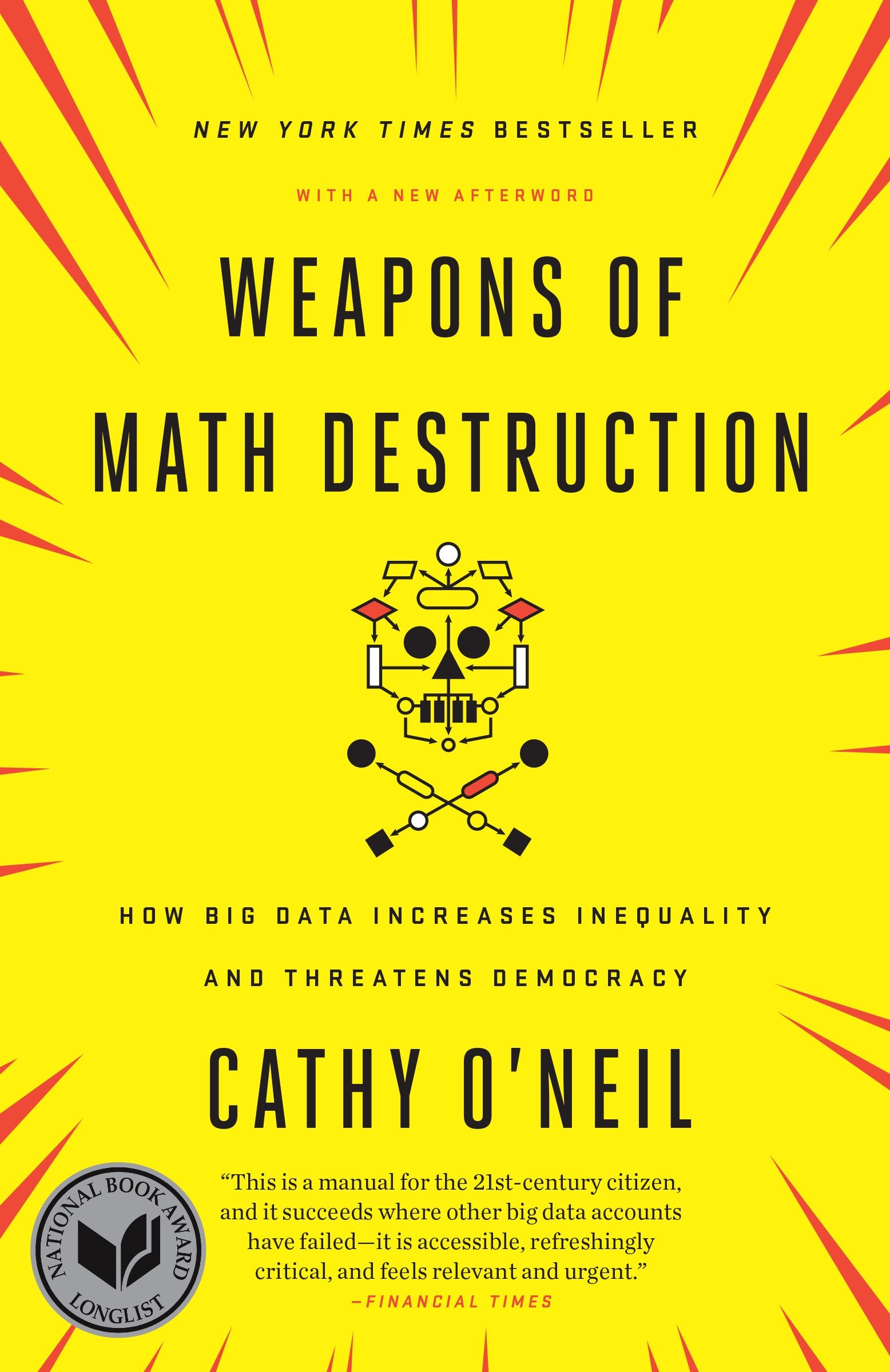
Weapons of Math Destruction
How Big Data Increases Inequality and Threatens Democracy
- Who it’s for
- readers interested in social impact of technology
- Themes
- big data ethics, social inequality, democracy
- Pacing
- Reflective
Why this clicks
Come here for
- Tech critique with political bite
Expect
- Argument over anecdote
- Accessible explanation, not jargon
Where it sits
How strongly BookFrontier reads the book as belonging to each subject.
Nearest books
Matched by our semantic model. Ordered by what its readers also loved.
 Dark MoneyJane Mayer60% subject match
 Everybody LiesSeth Stephens-Davidowitz70% subject match
 Calling BullshitCarl T. Bergstrom, Jevin D. West58% subject match
 Capital in the Twenty-First CenturyThomas Piketty53% subject match
 AI SuperpowersKai-Fu Lee53% subject matchShares AI & Machine Learning
 This Is How They Tell Me the World EndsNicole Perlroth54% subject match
 Humble PiMatt Parker56% subject match
 Winners Take AllAnand Giridharadas58% subject match
For younger readers: Big Lies
Start with three books, and this one can be the first.
Members get a new edition every morning: a route out from their books to essays, research and talks, with the reason for each.
Sign upAbout this book
NEW YORK TIMES BESTSELLER • A former Wall Street quant sounds the alarm on Big Data and the mathematical models that threaten to rip apart our social fabric—with a new afterword
“A manual for the twenty-first-century citizen . . . relevant and urgent.”—Financial Times
NATIONAL BOOK AWARD LONGLIST • NAMED ONE OF THE BEST BOOKS OF THE YEAR BY The New York Times Book Review • The Boston Globe • Wired • Fortune • Kirkus Reviews • The Guardian • Nature • On Point
Continue reading
We live in the age of the algorithm. Increasingly, the decisions that affect our lives—where we go to school, whether we can get a job or a loan, how much we pay for health insurance—are being made not by humans, but by machines. In theory, this should lead to greater fairness: Everyone is judged according to the same rules.
But as mathematician and data scientist Cathy O’Neil reveals, the mathematical models being used today are unregulated and uncontestable, even when they’re wrong. Most troubling, they reinforce discrimination—propping up the lucky, punishing the downtrodden, and undermining our democracy in the process. Welcome to the dark side of Big Data.
Publisher details
Publisher categories
- Business Statistics
- Public Policy
- Privacy & Surveillance
- Authors
- Cathy O'Neil
- Publisher
- Crown
- Published
- September 5, 2017
- Format
- Print & ebook
- Reading lane
- Business Statistics