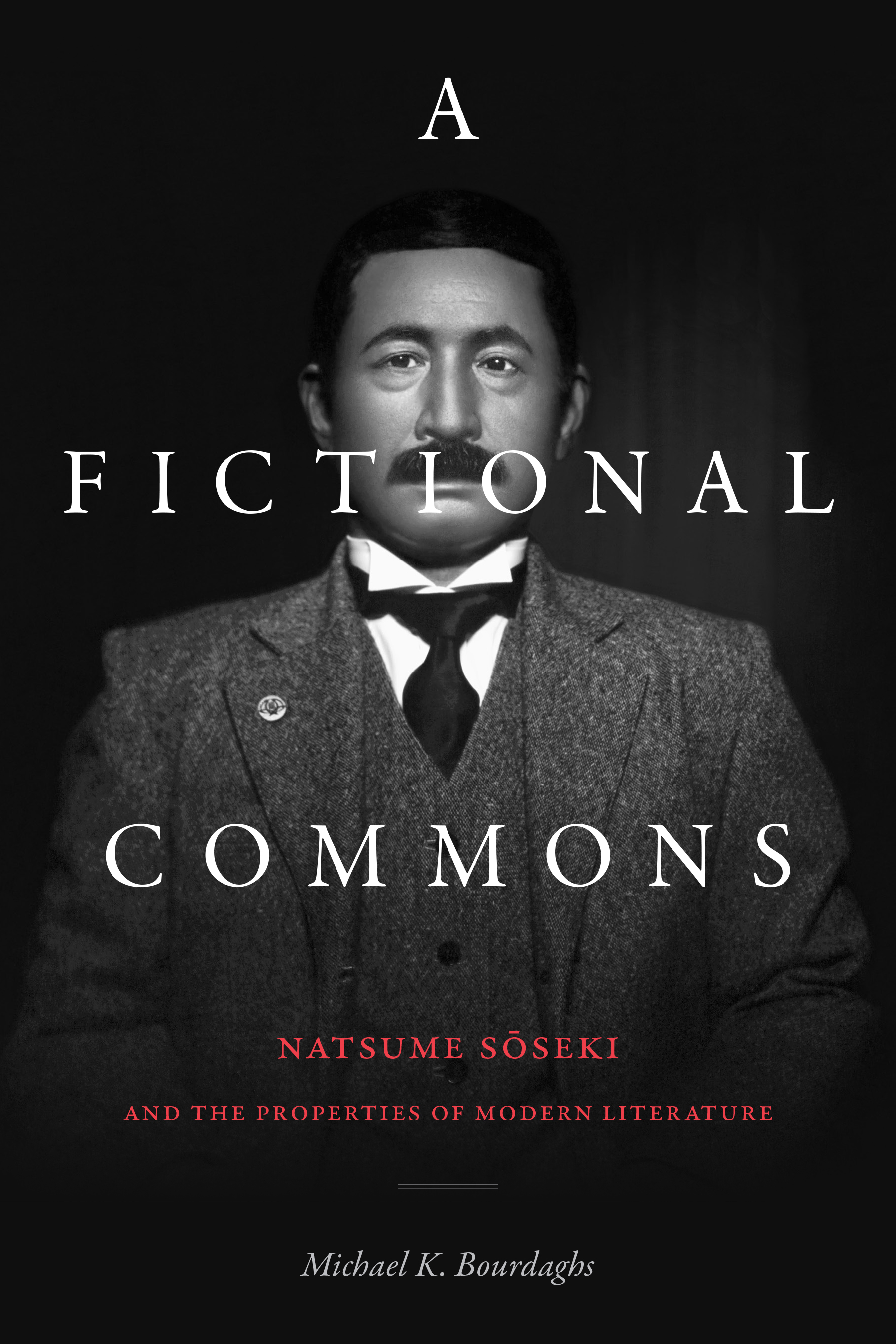
A Fictional Commons
Natsume Soseki and the Properties of Modern Literature
Bourdaghs reads Sōseki’s literature as a way to think beyond private property.
Sōseki and Ownership
Come here for
- Sōseki’s narratives of inheritance
- Literature’s imagined alternatives to private ownership
Expect
- Sōseki in dialogue with William James and Mizuno Rentarō
- Literature theorized as a response to global capitalism
Where it sits
How strongly BookFrontier reads the book as belonging to each subject.
Nearest books
Matched by our semantic model. Ordered by what its readers also loved. Most of these share its genre: Japanese Literary Criticism.
 Origins of Modern Japanese LiteratureKojin Karatani62% subject matchAlso shares Literary Theory
 The GateNatsume Soseki59% subject match
 Imagining HarmonyPeter Flueckiger58% subject match
 The Textual TownsmanThomas Gaubatz56% subject match
 Writing the Love of BoysJeffrey Angles54% subject match
 Translingual PracticeLydia H. Liu53% subject match
For younger readers: Go, Samurai Shortstop
Start with three books, and this one can be the first.
Members get a new edition every morning: a route out from their books to essays, research and talks, with the reason for each.
Sign upAbout this book
Modernity arrived in Japan, as elsewhere, through new forms of ownership. In A Fictional Commons, Michael K. Bourdaghs explores how the literary and theoretical works of Natsume Sōseki (1867–1916), widely celebrated as Japan's greatest modern novelist, exploited the contradictions and ambiguities that haunted this new system.
Continue reading
Many of his works feature narratives about inheritance, thievery, and the struggle to obtain or preserve material wealth while also imagining alternative ways of owning and sharing. For Sōseki, literature was a means for thinking through—and beyond—private property. Bourdaghs puts Sōseki into dialogue with thinkers from his own era (including William James and Mizuno Rentarō, author of Japan’s first copyright law) and discusses how his work anticipates such theorists as Karatani Kōjin and Franco Moretti. As Bourdaghs shows, Sōseki both appropriated and rejected concepts of ownership and subjectivity in ways that theorized literature as a critical response to the emergence of global capitalism.
Publisher details
Publisher categories
- Literary Theory
- Japanese Literary Criticism
- Authors
- Michael K. Bourdaghs
- Publisher
- Duke University Press
- Published
- September 24, 2021
- Format
- Print & ebook
- Reading lane
- Literary Theory