
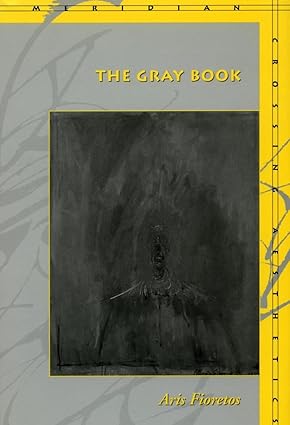
Book
The Gray Book
Aris Fioretos
Stanford University Press · Hardcover · May 1, 1999
Reading lane: European Literary Criticism
Generally considered the least lively and most bleak of casts, gray is the taint of vagueness and uncertainty.
Disclosure: Some outbound links are affiliate links. If you buy through them, we may earn a commission. It doesn't affect which books we include. Learn more in our disclosure policy.
At a Glance
Who It's For
Book Details
- Authors
- Aris Fioretos
- Publisher
- Stanford University Press
- Published
- May 1, 1999
- Format
- Hardcover
- Theme
- European Literary Criticism · LITERARY CRITICISM / Modern / 20th Century
- Reading lane
- European Literary Criticism
Affinity
Publisher Categories
European Literary Criticism
About This Book
Generally considered the least lively and most bleak of casts, gray is the taint of vagueness and uncertainty. Marking the threshold region where luminous life seems suspended but death has not yet darkened the horizon, it belongs to an evasive and evanescent world, carrying the tint of smoke, fog, ashes, and dust. As the ambiguous space of thought and remembrance where things blend and blur, gray measures the difference between distance and proximity, shading into tinges of...
Read full description
Similar Books
Raymond Chandler
Fredric Jameson · Verso Books
Shared affinity
European Literary Criticism
Everything and Less
Mark McGurl · Verso Books
Shared affinity
European Literary Criticism
On Native Grounds
Alfred Kazin · HarperCollins
Shared affinity
European Literary Criticism

The Weird and the Eerie
Mark Fisher · Watkins Media
Shared affinity
Affinity match is still building for this title.

Understanding David Foster Wallace
Marshall Boswell · University of South Carolina Press
Shared affinity
European Literary Criticism

How Beautiful It Is and How Easily It Can Be Broken
Daniel Mendelsohn · HarperCollins
Shared affinity
European Literary Criticism

Walter Benjamin
David S. Ferris, David Ferris · Stanford University Press
Shared affinity
Affinity match is still building for this title.

The World, the Text, and the Critic
Edward W. Said · Knopf Doubleday Publishing Group
Shared affinity
European Literary Criticism