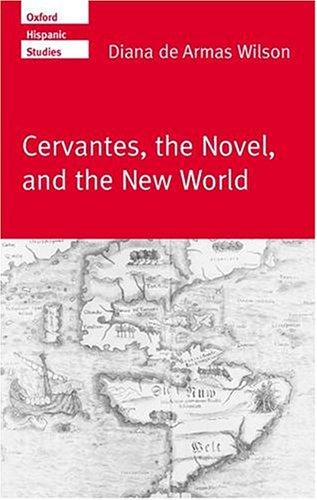
Cervantes, the Novel, and the New World
1st Edition
Oxford University Press · Print & ebook · December 15, 2000
Two sets of related issues prompt this study: the birth of the New World in European consciousness and the rise of the Cervantine novel in Spain.
We earn from qualifying purchases.
- Who it’s for
- This study traces how New World colonial discourses shape Cervantes’s Don Quixote and Persiles.
- Genres
- Iberian Lit Crit, Renaissance Literary Criticism, Hispanic American Lit Crit
- Published
- Oxford University Press, December 15, 2000
Nearest books
Matched by what the books are about, then ordered by what their readers also loved.
 ConquistadoresFernando Cervantes68% match
 The Man Who Invented FictionWilliam Egginton66% matchShares Iberian Lit Crit and Renaissance Literary Criticism
 Cervantes in AlgiersMaria Antonia Garces61% matchShares Iberian Lit Crit and Renaissance Literary Criticism
 Don QuixoteMiguel de Cervantes Saavedra61% match
For younger readers: The King's Fifth, I, Juan De Pareja, 1493 for Young People
Start with three books, and this one can be the first.
Members get a new edition every morning: a route out from their books to essays, research and talks, with the reason for each.
Join the waitlistAbout this book
Two sets of related issues prompt this study: the birth of the New World in European consciousness and the rise of the Cervantine novel in Spain. The conquest, exploration, and colonization of the Indies resonate through Cervantes's two novels, Don Quixote (1605, 1615) and the Persiles (1617), both fortified by imperialism. Cervantes begins publishing in the 1580s, just as the might of imperial Spain turned from Europe towards the Atlantic.
Continue reading
Twice refused emigration papers to America - which he depicts as the 'refuge and haven of all the desperate men of Spain' - Cervantes turns to fiction. His novels internalize many colonial discourses and at least four genres implicated in Spain's New World enterprise: the Books of Chivalry, the utopias, the colonial war epic, and American ethnohistory. The first full-length study to move beyond an inventory of Cervantes's references to the Indies - to Mexico and Peru, cannibals and tobacco, parrots and alligators - this book interprets his novels as a transatlantic, cross-cultural, and multi-linguistic achievement.
Cervantes Across the Atlantic
This study traces how New World colonial discourses shape Cervantes’s Don Quixote and Persiles.
Come here for
- Cervantes's novels read through conquest, exploration, and colonization
- Four genres linked to Spain’s New World enterprise
Expect
- Close attention to transatlantic, cross-cultural, and multilingual dimensions
- Discussion of chivalric books, utopias, colonial war epics, and American ethnohistory
Where it sits
| Iberian Lit Crit | 60% |
|---|---|
| Renaissance Literary Criticism | 55% |
| Hispanic American Lit Crit | 32% |
Percentages are BookFrontier’s reading of the book.
Publisher categories
- Iberian Lit Crit
- Authors
- Diana de Armas Wilson
- Publisher
- Oxford University Press
- Published
- December 15, 2000
- Format
- Print & ebook
- Reading lane
- Iberian Lit Crit