
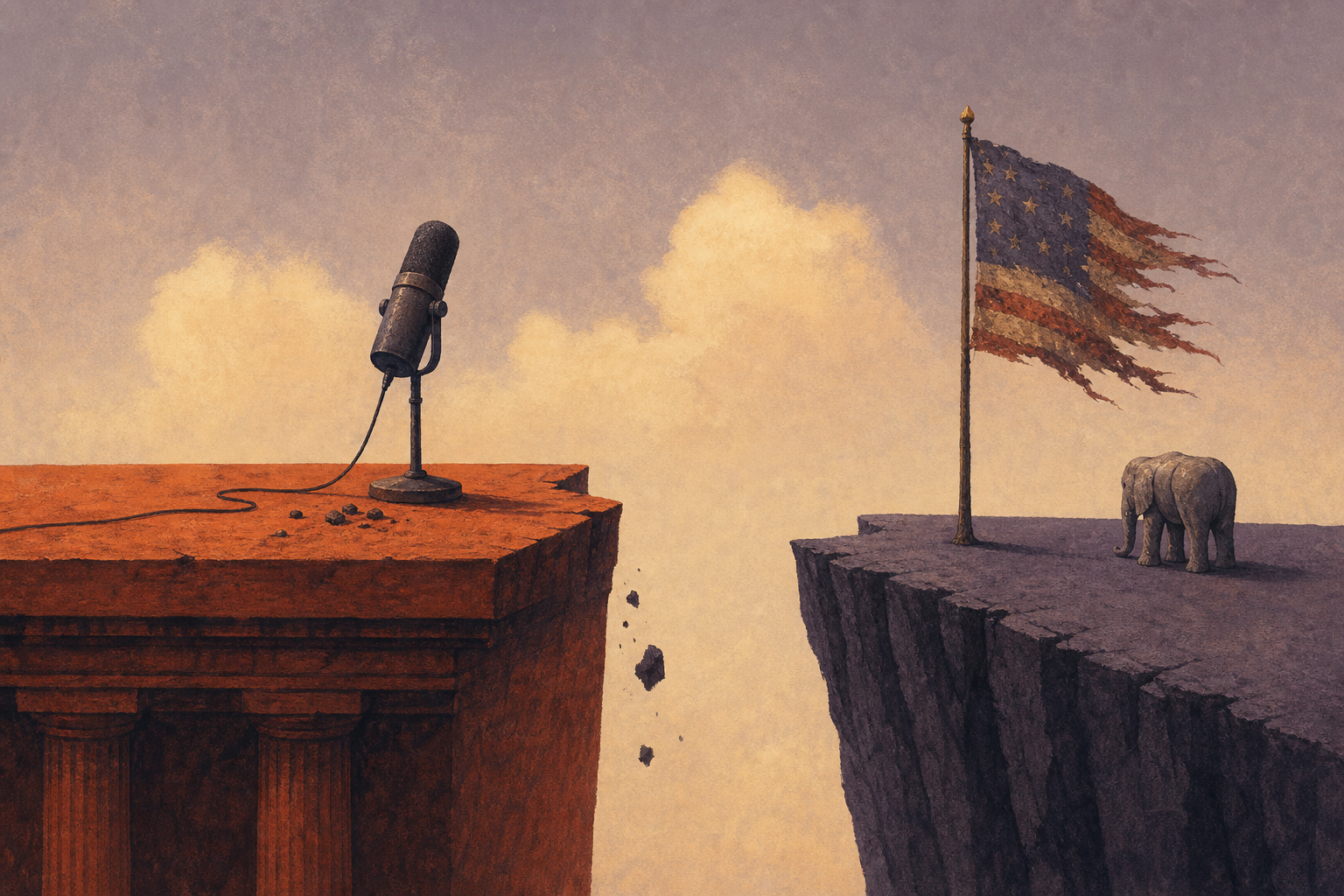
What does it mean when the man who spent years selling the Republican base on its grievances announces he wants nothing more to do with the party? Tucker Carlson, on a podcast ahead of the November 2026 midterms, said there is no chance he would support the GOP, brushing off its politics with the ease of someone who no longer needs the institution. The headline writes itself. The story underneath it does not. Carlson breaking with the party is a logical step in a long migration, and the easy move is to treat it as news instead of the latest entry in a pattern that started years ago. He has been performing rupture for decades. The question worth asking is what he is rupturing from, and whether the party ever held his loyalty in the first place.
Most coverage of this moment stops at the quote and the timing. Carlson said it, the midterms are close, here is what a few strategists think it signals. That framing assumes the party was his home and the break is the event. It skips the harder work of explaining how a bow-tied magazine writer who once needled conservatives for their failures became someone who treats the Republican establishment as beneath his notice. The quote only makes sense against the full arc. Without that, you get a man changing his mind. With it, you get a man following an incentive structure that rewarded each escalation. The recap tells you he left. It cannot tell you that he was always more interested in the audience than the apparatus, and that audiences, unlike parties, travel with you.
Jason Zengerle's "Hated by All the Right People" is a biography of Carlson that doubles as media criticism, and the doubling is the point. The Washington Post called it mordant and vigorously reported, which is a polite way of saying Zengerle hands his subject no favors. He tracks the turn from, in The New York Times Book Review's phrase, the bow-tied beau ideal of the Washington establishment into the MAGA conspiracy theorist in chief. That sentence covers almost three decades and a great deal of self-reinvention. The earlier Carlson is the surprise. People who knew him in his political-journalism days describe a serious and gifted writer who enjoyed arguing with liberal friends and calling out conservative failures with the same relish.
That version is hard to square with the cable host who later built an evening hour on resentment and innuendo. Zengerle never pretends the two are strangers. He shows the same restlessness, the same appetite for being the smartest contrarian in the room, pointed in a new direction once the rewards changed. The book stays concrete about the mechanics of the trade: magazine bylines, the bow tie as brand, the cable contracts, the move to Fox News and the discovery that grievance pulled better numbers than analysis. Each step is small. The cumulative drift is enormous.
The media-criticism instinct earns its keep here, because Zengerle treats Carlson as a man who found a market rather than one who lost his way. That framing comes at a cost worth naming. By leaning on incentive and audience, the book can make Carlson seem almost weightless, a weathervane swinging wherever the ratings blow. Anyone who watched the actual broadcasts knows the conviction did not always read as performance, and the line between cynicism and belief smears under stage lights. This is the book's real weakness. Zengerle is sharp on the structure that rewarded the turn and shakier on what Carlson himself believes, which may be unanswerable.
The trouble is that the book sometimes treats that open question as already closed, narrating motive it has not earned. The reporting still holds. The Times review called it breezy, entertaining, and ultimately disquieting, and the disquiet is the part that stays with you. You finish it understanding that the recent break with the Republican Party is the destination of a path the book has been mapping the whole time. A man who built a following independent of any party was never going to be held by one.
Which brings the question back around. If Carlson breaking with the Republican Party is not really news about the party, what is it about? Zengerle's answer is that it is about a kind of public figure who learned to carry his own audience and treat every institution as temporary. You can quarrel with how cleanly the book resolves his motives. The arc it traces is harder to dispute. If you want the version of this story that outlasts the next podcast clip, this is where to find it.